Taoism Stories: Ancient Wisdom for Modern Life
Oct 27, 2026
Taoism stories have carried wisdom across the centuries, offering practical guidance in memorable parables and teachings. These tales are more than ancient folklore. Many people find they offer a fresh way to think about stress, find balance and move through life with more ease. From the famous butterfly dream to tales of effortless mastery, they show how to work with the natural flow of things rather than forcing our way through obstacles. Whether you are beginning a Tai Chi practice or exploring Taoist philosophy, these stories offer ideas you can apply to daily life.
The Power of Parable: Why Taoism Stories Matter
Taoism stories work differently from instruction manuals or philosophical essays. They bypass the analytical mind and speak to our intuitive understanding.
A good story plants a seed that grows over time. You might hear that Cook Ding's blade never dulls because he cuts through the spaces between joints, and months later, in the middle of a difficult conversation, you suddenly see what it means to find the natural opening rather than push through resistance.
Learning Through Narrative
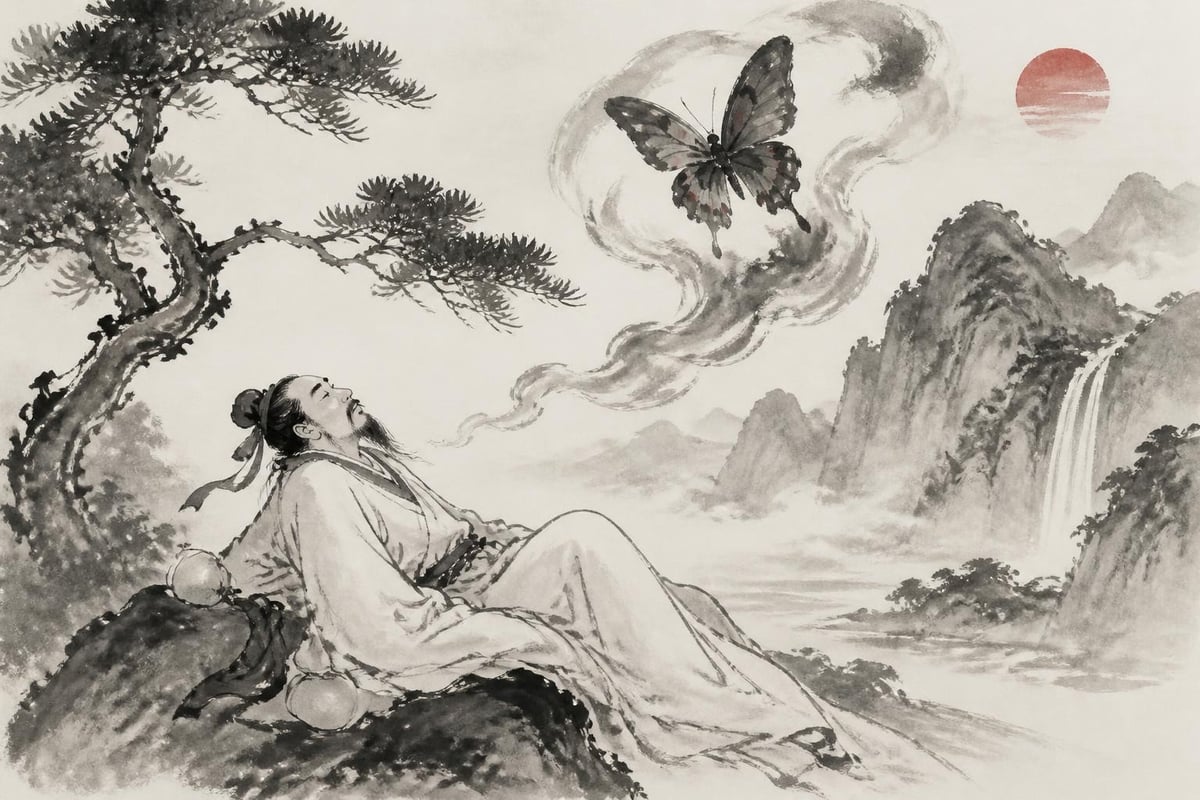
The ancient Taoist teachers understood something many of us know from experience: stories stay with us far longer than abstract ideas. When Zhuangzi wanted to point to the relativity of perspective, he did not write a logical argument. He told the story of dreaming he was a butterfly, then waking unsure whether he was Zhuangzi who had dreamed of being a butterfly, or a butterfly now dreaming of being Zhuangzi.
This approach is a natural fit for Tai Chi. The slow, yielding movements echo the lessons the parables share: yielding, naturalness and responsive action. If you are curious, our Tai Chi course is a gentle place to experience this for yourself.
Classic Taoism Stories and Their Teachings
The classics of Taoist literature are full of memorable stories. Each one looks at a different side of finding balance and flowing with natural rhythms.
The Useless Tree
Carpenter Shi travels with his apprentice and passes an enormous oak tree near a village shrine. The apprentice marvels at its size, but Carpenter Shi dismisses it as worthless timber - its branches twisted, its wood unsuitable for any practical purpose.
That night, the tree appears to Carpenter Shi in a dream. "You compare me to useful trees like cherry, pear and orange," it says. "They bear fruit and are cut down. Their branches are broken. Their usefulness brings suffering. I have cultivated uselessness, and because of it, I have grown ancient and massive. I serve as shelter and shade. My uselessness is precisely what makes me valuable."
Key lessons from this story:
- What society calls useless may hold real value
- Trying to meet every conventional expectation can be costly
- Different forms of contribution matter equally
- Sometimes the greatest service is simply being present
The Empty Boat
You are floating peacefully on a river when suddenly another boat crashes into yours. If someone is steering that boat, anger flares instantly. You shout at their carelessness.
But if the boat is empty, drifting unmanned, no anger arises. You simply push it away and carry on.
The teaching is simple: many conflicts grow less from what others do than from our belief that they meant harm. When we meet an "empty boat" - someone acting from their own confusion, pain or unconscious habits - we can respond with calm adjustment rather than reactive anger.
This story supports the practice of Taoist meditation, where we learn to notice our reactions without being swept away by them.
Cook Ding's Mastery
Prince Wen Hui watches his cook, Ding, carve an ox. The blade moves like a dance, flesh and bone separating with whispers and sighs. The prince marvels at this skill.
Cook Ding explains: "When I first began, I saw only the whole ox. After three years, I no longer saw the whole ox. Now, I meet it with spirit rather than eyes. My senses stop, and spirit moves as it wishes. I follow the natural structure, cutting through the spaces between joints, moving through the openings. A good cook changes his blade once a year - he cuts. An ordinary cook changes his blade monthly - he chops. I have used this blade nineteen years. It has carved thousands of oxen, yet the edge remains as sharp as the day it left the grindstone."
| Aspect | Ordinary Cook | Good Cook | Cook Ding |
|---|---|---|---|
| Approach | Hacks and chops | Cuts deliberately | Moves through natural spaces |
| Blade lifespan | One month | One year | Nineteen years (thousands of oxen) |
| Method | Force | Skill | Spirit and natural structure |
| Result | Broken blades, torn meat | Competent work | Effortless mastery |
This Taoism story illustrates wu wei - effortless action in tune with natural principles. In Tai Chi practice, we meet a similar idea: force tends to create resistance and tiredness, while moving with natural structure feels easier and steadier.
Stories of the Eight Immortals
The Eight Immortals appear in countless traditional tales, each representing a different path and a different side of human nature. Unlike the more abstract philosophical stories, these feature colourful characters whose adventures teach by example. We share them here as cultural wisdom and inspiration. Our courses focus on Tai Chi, Qi Gong, Taoist meditation and Taoist philosophy.
Lü Dongbin and Compassionate Action
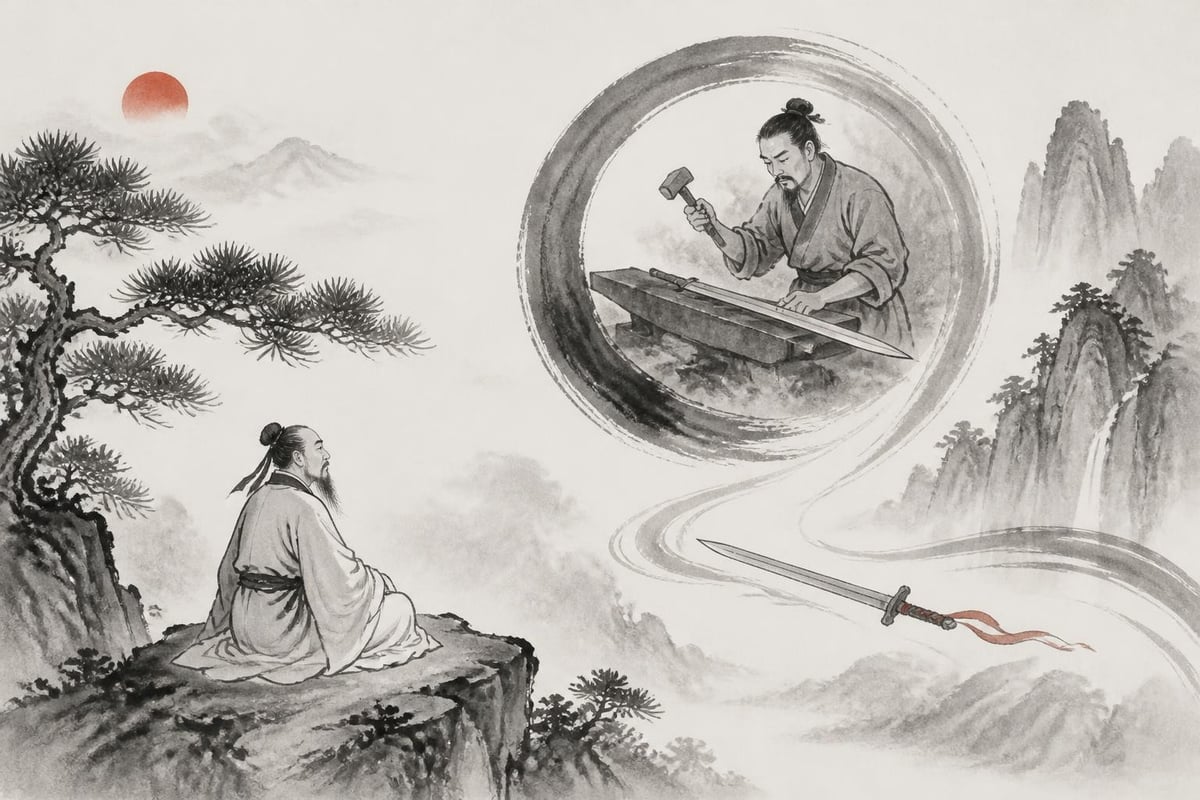
Lü Dongbin, scholar and swordsman, achieves immortality but returns repeatedly to the human realm to help others find their path. His stories suggest that true cultivation does not mean abandoning the world, but engaging with it through wisdom and compassion.
In one tale, he disguises himself as a seller of oil to test people's honesty. Those who treat him kindly despite his humble appearance receive blessings. Those who dismiss or cheat him learn harder lessons. The message is clear: how we treat others when we expect no reward shows who we really are.
He Xiangu's Natural Power
He Xiangu, the only woman among the Eight Immortals, gains her abilities by eating mother-of-pearl powder and moonbeams. Her stories celebrate feminine wisdom, intuitive knowledge and the power of gentleness.
She shows that growth does not require aggressive striving. Sometimes the strongest path is a gentle one, a quality you may meet in Qi Gong practice.
The Eight Immortals teach through diversity:
- Different people need different paths
- No single method suits everyone
- Real strength takes many forms
- Community supports each person's growth
- Humour and playfulness belong in spiritual practice
Applying Taoism Stories to Daily Practice
These ancient stories are not museum pieces. They are practical reminders for everyday challenges.
From Story to Movement
When you practise Tai Chi, you can feel these teachings in the body. The yielding quality mirrors the empty boat. The natural flow you aim for reflects Cook Ding's blade finding the spaces between joints. The rootedness you develop echoes the useless tree's steady presence. For more on the ideas behind the movements, see our guide to Tai Chi principles.
As you practise, you may start to notice how the principles in these stories show up in your own movement. You can read more about our teacher Master Gu on our About page.
If you are new to Tai Chi, please check with your healthcare professional before starting any new exercise.
Recognising Story Moments in Life
Every frustration offers an empty boat moment. Every task that needs skill is a chance to meet Cook Ding's spirit. Every time you feel inadequate for not meeting conventional expectations, the useless tree whispers its teaching.
The practice is noticing these moments. When traffic delays you, can you find the empty boat? When work flows effortlessly, can you recognise Cook Ding's spirit in your own hands? When others question your unconventional path, can you remember the tree's dream?
The Butterfly Dream and Transformation
Perhaps no Taoism story captures the imagination quite like Zhuangzi's butterfly dream. Its simplicity holds big questions about identity, change and the nature of reality. To read more about the thinker behind the tale, see our article on Zhuang Zhou.
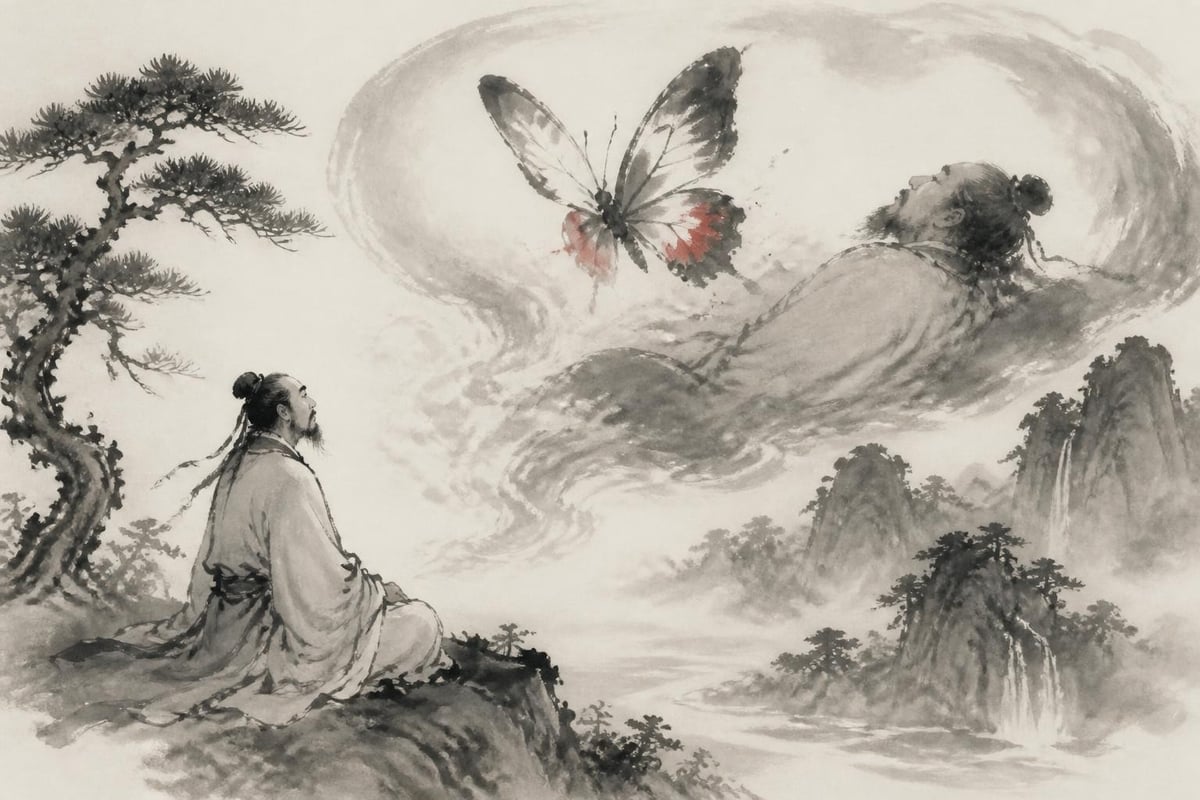
After waking from his dream of being a butterfly, Zhuangzi wonders which state is real. Was he a man dreaming of being a butterfly, or is he now a butterfly dreaming of being a man? The story does not settle the question - that is precisely the point.
Layers of Meaning
On the surface, this tale questions the nature of consciousness and reality. Deeper down, it speaks to the fluidity of identity. We often cling to fixed ideas about who we are, but the butterfly dream suggests these boundaries are far more flexible than we imagine.
For practitioners, this idea can feel close to home during meditation or relaxed Tai Chi practice. In moments when the boundary between self and movement feels softer, and you are not sure whether you are doing Tai Chi or Tai Chi is doing you, Zhuangzi's question can feel like lived experience rather than abstract philosophy.
Our free Taoist course is a gentle introduction to Tai Chi, Qi Gong and meditation with our teacher Master Gu, a 15th-generation San Feng Pai Wudang Taoist Master with 25+ years of teaching experience. It is a calm way to begin experiencing the ideas that Taoism stories point towards.
Lesser-Known Tales with Deep Wisdom
While the butterfly dream and Cook Ding dominate discussions of Taoism stories, dozens of lesser-known parables carry equally valuable teachings. Our teacher Master Gu tells one of them, the Taoist vinegar taster story, in the short video below.
The Man Who Lost His Axe
A man loses his axe and suspects his neighbour's son of stealing it. Watching the boy, everything confirms his suspicion - the way the boy walks, talks and looks at him all seem to say "thief".
Then the man finds his axe in the valley where he had left it. When he next sees the neighbour's son, nothing about the boy's behaviour suggests theft.
This brief story teaches:
- Preconceived beliefs shape perception
- We find evidence for what we already believe
- Changed circumstances reveal our projections
- Suspicion colours everything we observe
The Fasting of the Heart
Confucius sends his student Yan Hui on a diplomatic mission. Yan Hui worries about failing, so he seeks advice. Confucius tells him to practise the fasting of the heart.
"I am already poor and have not drunk wine or eaten meat in months," Yan Hui protests.
"That is the fasting of the body," Confucius replies. "The fasting of the heart is different. Unify your attention. Do not listen with your ears, listen with your heart. Do not listen with your heart, listen with your qi. Let your ears stop at listening, your heart stop at matching. Qi is empty, waiting for all things. The Dao gathers in emptiness. This emptying is the fasting of the heart."
This teaching points towards a quiet, open kind of attention, and gentle awareness like this can enrich Tai Chi and Qi Gong practice.
Stories as Living Tradition
The Taoism stories we have explored are not frozen artefacts from the past. Each generation reinterprets them, finding new relevance for current challenges. The principles stay constant - balance, natural flow, effortless action, perspective - while their applications change.
Modern Interpretations
Today, the empty boat speaks to social media conflicts and email misunderstandings. Cook Ding's blade speaks to sustainable ways of working and avoiding burnout. The useless tree gives permission to follow an unconventional career path.
These stories can offer perspective, but they can sit alongside, not replace, professional support - if stress or burnout is affecting you, please also speak to your GP or a qualified professional.
These stories adapt because they address fundamental human experiences rather than specific historical situations. The details change, but the core ideas about alignment, resistance and natural rhythms stay relevant.
Transmitting Through Practice
Reading these stories builds understanding. Practising the arts they inform can make that understanding something you feel. When a Tai Chi teacher asks you to "yield like water" or "find the space between", they are pointing to the same ideas Cook Ding discovered with his blade.
In our Taoist Wellness Online community, you can meet like-minded students who share how these stories come alive in practice, and support each other as you find your own interpretations through movement, meditation and daily life.
The Role of Paradox in Taoist Teaching
Many Taoism stories embrace paradox rather than resolving it. The useless tree finds value in uselessness. The butterfly dream asks which state is real without answering. This approach serves a specific purpose.
Linear logic has its place, but some truths cannot be captured that way. Paradox interrupts our usual analytical process, creating an opening for direct understanding. When the rational mind stops trying to resolve the contradiction, intuitive wisdom can emerge.
Working with Paradox
In Tai Chi practice, you meet constant paradoxes: be soft yet strong, relax yet keep structure, move slowly yet respond quickly. These are not contradictions to resolve but complementary truths to hold together.
The stories prepare us for this way of learning. They train us to hold more than one perspective, to recognise that truth can look contradictory from our limited viewpoint, and to trust direct experience over logical consistency.
Taoism stories offer more than entertainment or historical interest. They are practical reminders about balance, natural flow and effortless action, told through memorable narratives. These ancient parables continue to help people find a deeper understanding and a more harmonious way of living. Whether you are exploring courses in Tai Chi, Qi Gong or Taoist meditation with our teacher Master Gu at Taoist Wellness Online, or simply looking for more balance in daily life, these stories offer wisdom that feels as fresh today as when it was first told.
Related reading