Wei Qi: Ancient Strategy Game for Mental Clarity
Oct 15, 2026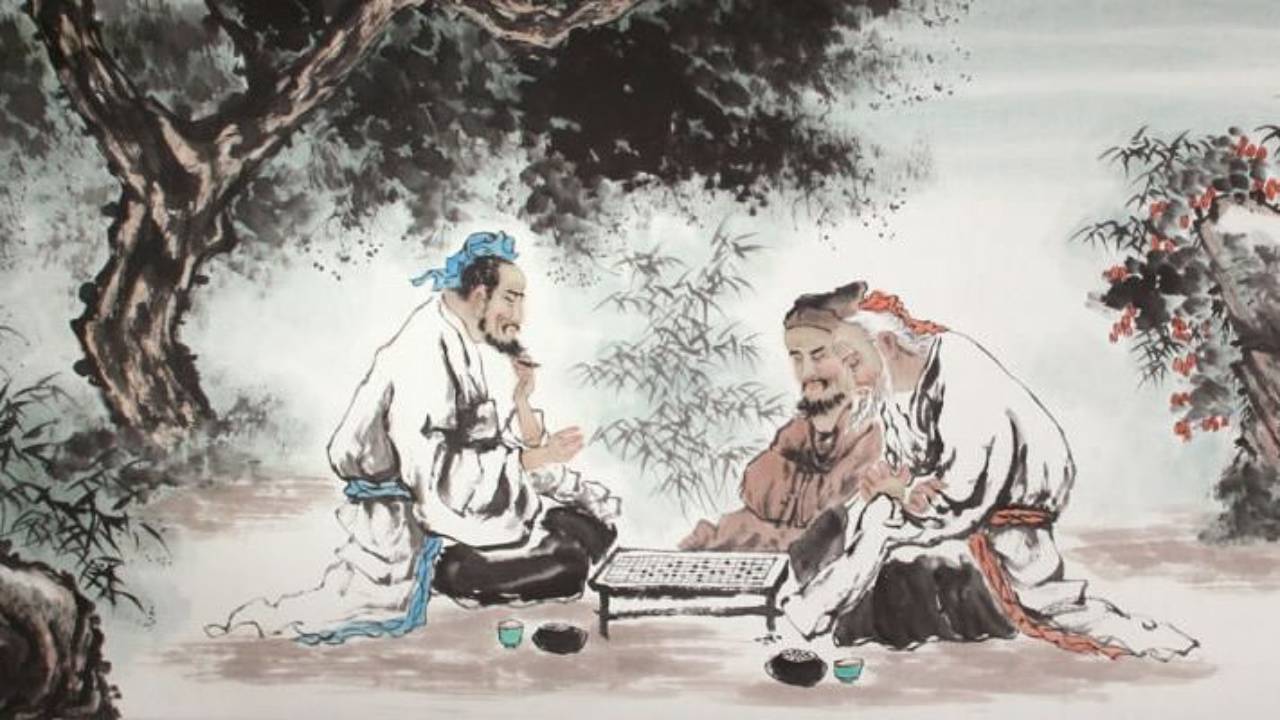
Wei qi stands as one of humanity's oldest and most profound board games, traditionally said to originate in China over 4,000 years ago. Also known as Go in Japan and Baduk in Korea, this elegant game of black and white stones has captivated minds across centuries, serving not merely as entertainment but as a practice for cultivating strategic thinking, patience, and mental clarity. The flowing patterns of stones across the board mirror principles found throughout Taoist philosophy, where balance, adaptation, and wholeness guide both gameplay and personal development. For those seeking to deepen their mental discipline alongside gentle practices like Tai Chi and Qi Gong, wei qi offers a complementary path towards greater awareness and presence.
The Origins and Philosophy of Wei Qi
Wei qi emerged in ancient China, with the earliest written references dating back roughly 2,500 years, during the Zhou Dynasty. Scholars believe the game existed in oral tradition and practice long before written records appeared. Unlike chess, which simulates battlefield combat with distinct pieces and hierarchical movement, wei qi represents something more fundamental: the relationship between empty space and occupied territory, between potential and manifestation.
The game's philosophical roots are often linked with Taoist thought. Each stone placed on the board creates ripples of influence, changing the entire landscape much like a pebble dropped into still water. This mirrors the Taoist understanding that small actions can have far-reaching consequences, and that true strength often lies in restraint rather than force.
The Taoist Principles in Wei Qi
Several core Taoist concepts find natural expression through wei qi gameplay:
- Wu wei (effortless action): strong players learn when not to play, allowing natural patterns to emerge
- Balance of opposites: black and white stones create dynamic tension without hierarchy
- Flowing with change: successful strategies adapt to the evolving board rather than forcing predetermined plans
- Wholeness: victory comes from seeing the entire board, not fixating on isolated battles
The game teaches players to think in systems rather than components, to value influence over possession, and to recognise that apparent weakness can become strength when the context shifts. These lessons parallel the wisdom explored in Taoist philosophy and meditation. For more on the sage behind many of these ideas, see our introduction to Lao Tzu.
How Wei Qi Works: Basic Structure and Rules
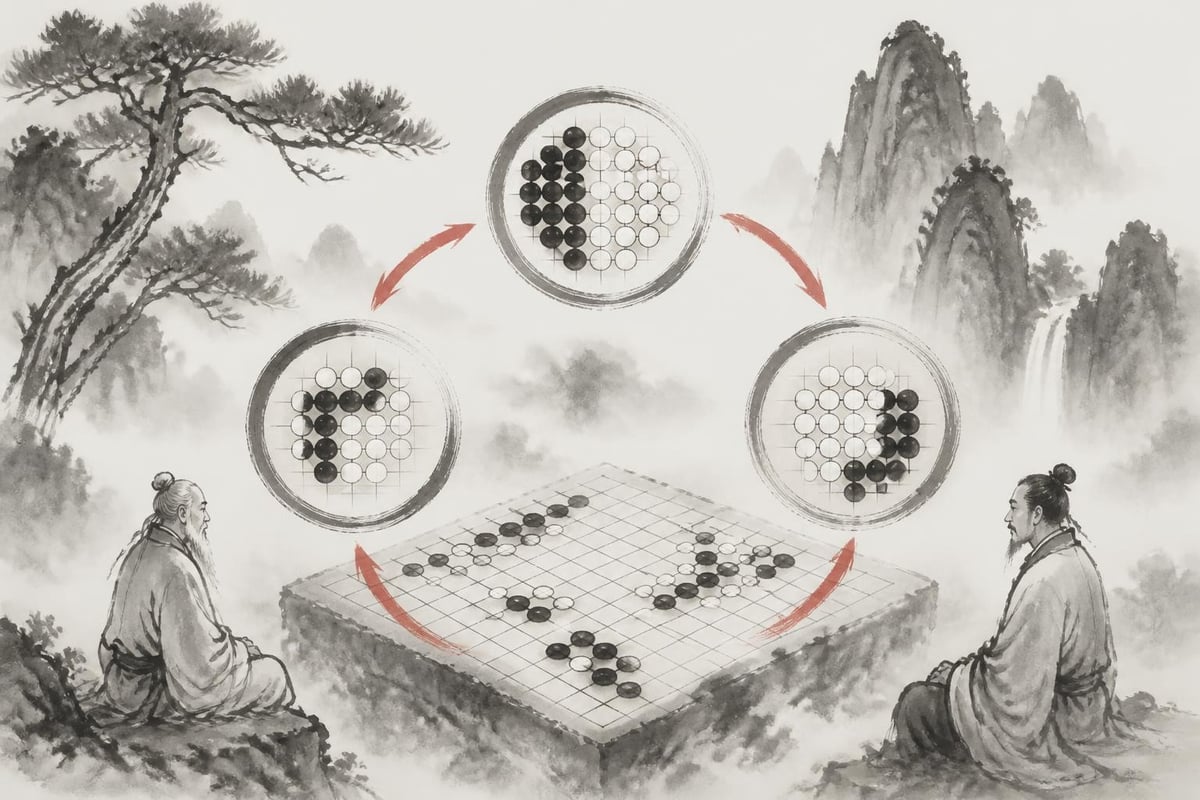
Wei qi uses a square board marked with a 19×19 grid of lines, creating 361 intersection points where players place their stones. Players alternate placing black and white stones on vacant intersections, aiming to control more territory than their opponent by the end of the game. The elegant simplicity of these basic rules belies extraordinary strategic depth.
Core Game Mechanics
The fundamental mechanics create endless variation:
- Placement: stones go on intersections, not in squares, and once placed they don't move
- Capture: groups of stones with no empty adjacent intersections (liberties) are removed from the board
- Territory: empty intersections surrounded by your stones count as your territory
- Eyes: groups with two separate enclosed spaces cannot be captured and are considered alive
| Element | Description | Strategic Importance |
|---|---|---|
| Liberties | Empty points adjacent to a stone or group | Determines group survival |
| Influence | Potential control radiating from stone positions | Shapes territorial development |
| Life and death | Whether groups can survive opponent attacks | Critical for strategic planning |
| Ko rule | Prevents immediate recapture creating infinite loops | Adds tactical complexity |
Different rulesets exist worldwide, with the Chinese and Japanese variants being the most common. Chinese rules count both territory and the stones on the board, while Japanese rules count only territory plus captured stones. These subtle differences rarely affect casual play but matter in professional competition.
Mental Benefits: Why Wei Qi Sharpens the Mind
Many players find that wei qi offers real benefits for focus and mental engagement. Some studies suggest that regular play may support pattern recognition, spatial reasoning and planning skills. The game demands simultaneous attention to local battles and the global strategy, training the mind to move between detail and overview, between action and context.
Cognitive Enhancement Through Play
Players often develop several mental capacities:
- Strategic thinking: planning several moves ahead while staying flexible
- Pattern recognition: identifying standard formations and their variations in different contexts
- Emotional awareness: noticing frustration when plans fail and learning to stay composed under pressure
- Decision-making: weighing complex options with incomplete information
The mental discipline of wei qi complements gentler physical practices beautifully. Just as Tai Chi cultivates body awareness, wei qi sharpens mental clarity and strategic vision. Both teach practitioners to stay present, to recognise patterns, and to respond appropriately rather than react habitually.
For those building a foundation in mindfulness and focus, combining mental training through strategic games with movement practices creates a rounded approach to wellbeing. The Taoist meditation practices taught by Master Gu help develop the same quality of centred awareness that can support your wei qi play.
Wei qi is a rewarding pastime, not a treatment. If you're struggling with stress, anxiety or low mood, please also speak to your GP or a qualified professional.
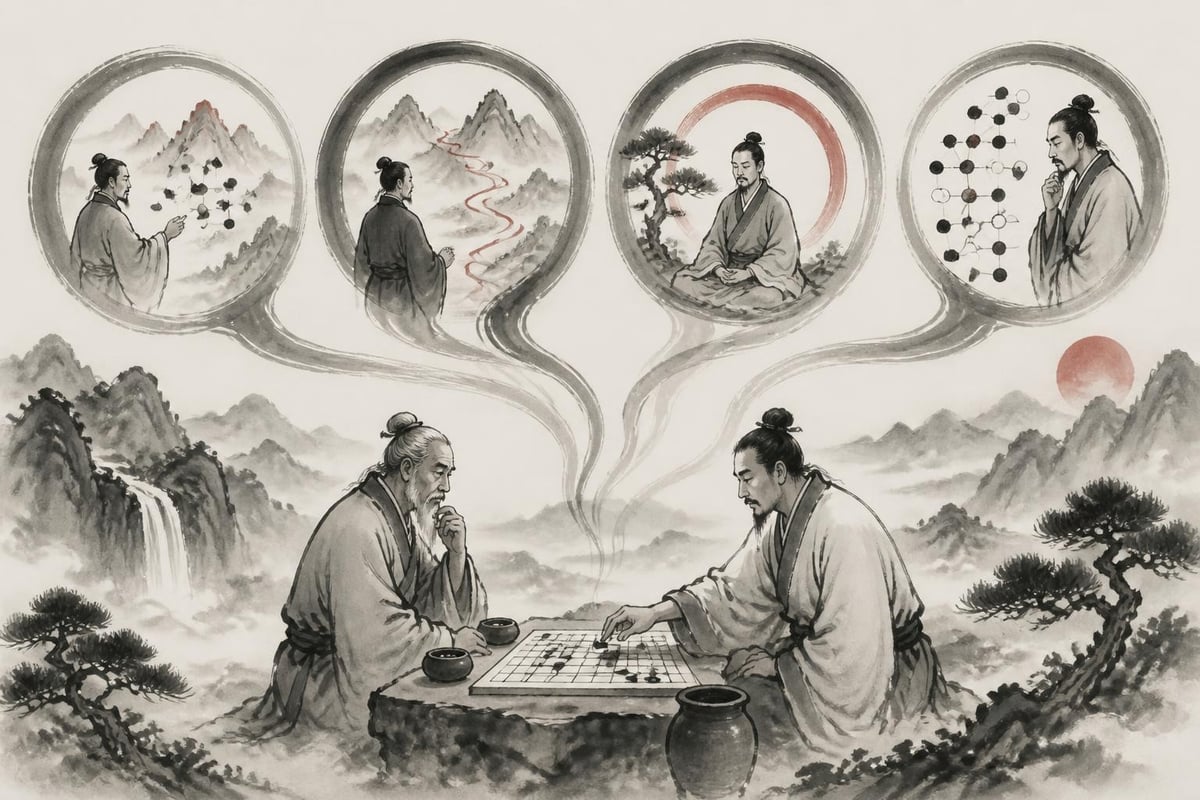
Wei Qi in Modern Practice and Competition
The game thrives globally in 2026, supported by national federations, international tournaments, and millions of online players. Professional players in China, Japan, and Korea compete for prestigious titles, while amateur enthusiasts gather in clubs, cafés, and online platforms to enjoy casual games and study together.
The Professional and Amateur Scene
Modern wei qi exists across multiple levels:
Professional tier: full-time players who train intensively from childhood, compete in ranked tournaments, and often study with established masters. Top professionals can read dozens of moves ahead with extraordinary precision.
Amateur dan ranks: serious players who have reached advanced skill levels through dedicated study, often taking part in regional and national competitions.
Casual players: people who enjoy the game recreationally, appreciating its depth without pursuing competitive excellence.
The game's complexity has also made it interesting to AI researchers. The 2016 match in which AlphaGo defeated world champion Lee Sedol was widely seen as a watershed moment, showing that neural networks could master a kind of strategic intuition once thought to be uniquely human. It changed both AI development and how players understand strategy.
Learning Wei Qi: Pathways for Beginners
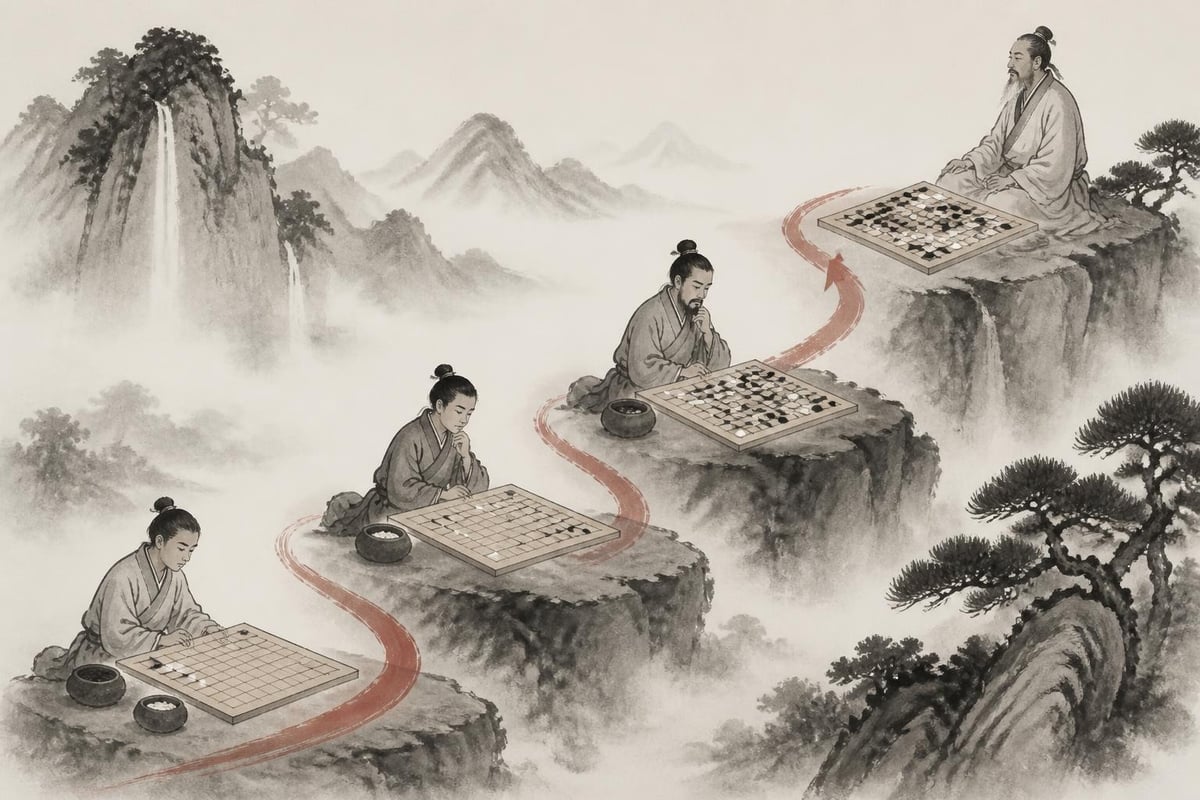
Starting wei qi can feel overwhelming at first, given the vast empty board and seemingly infinite possibilities. Yet the journey from beginner to confident player offers real satisfaction. Most new players begin on smaller boards (9×9 or 13×13) before moving to the full 19×19 grid, allowing them to grasp the fundamentals without drowning in complexity.
Effective Learning Strategies
| Approach | Benefits | Best For |
|---|---|---|
| Tutorial websites | Structured lessons with interactive problems | Self-directed learners |
| Local clubs | Face-to-face instruction and social connection | People who thrive in community |
| Online platforms | Opponents at any skill level, at any time | Flexible schedules |
| Books and videos | A deeper look at specific concepts and joseki | Systematic study |
Beginners can focus on:
- Learning to count liberties and recognise when groups are captured
- Understanding the value of corner, edge, and centre positions
- Practising basic life-and-death problems to develop reading skills
- Playing many games rather than obsessing over perfect moves
The learning curve mirrors the progression in practices like Tai Chi, where basic forms gradually reveal deeper principles through patient repetition. Initially, both wei qi and movement arts feel mechanical and confusing. With steady practice, patterns emerge, intuition develops, and what once seemed impossibly complex becomes more natural and flowing.
Wei Qi and Cultivating Presence
Perhaps wei qi's greatest gift lies in how it trains presence and awareness. During a game, the mind can't wander to yesterday's regrets or tomorrow's worries without the consequences showing up on the board. Each stone demands full attention. Each opponent's move calls for genuine listening and response. This quality of engaged presence has much in common with meditative awareness.
Strong players describe entering flow states during intense games, where time seems to dissolve and the boundary between self and board blurs. This experience of complete absorption echoes what many people find in Qi Gong practice, where you learn to settle fully into the present moment. If you're curious how that feels in movement, our article on the flow of Tai Chi is a lovely place to start.
Building Sustainable Practice
Creating a regular wei qi practice involves:
- Setting realistic expectations: progress comes through hundreds of games, not overnight revelation
- Balancing study and play: mix problem-solving practice with actual games
- Reviewing your games: you often learn more from analysing mistakes than from random new games
- Finding community: connect with other players who share your interest
The discipline of steady improvement in wei qi builds the same patience needed for consistent Tai Chi or meditation. Both ask you to show up regularly, stay patient with plateaus, and trust the gradual accumulation of skill and understanding.
If you're building a practice that brings together mental and physical cultivation, our free Taoist course is a gentle place to start, offering an introduction to Wudang Tai Chi, Qi Gong and Taoist meditation with Master Gu, which can sit comfortably alongside strategic mental training. As with any new exercise, please check with your healthcare professional first if you have existing health concerns.
The Cultural Significance of Wei Qi
Throughout history, wei qi has held a special place in East Asian culture. Scholars considered it one of the four essential arts, alongside calligraphy, painting, and playing the guqin (a seven-stringed instrument). The game appeared frequently in classical literature, poetry, and paintings, symbolising intellectual refinement and strategic wisdom.
In Chinese stories and art, wei qi is often associated with Taoist recluses and sages, a pairing that reflects how well the game's demands for presence, adaptation and patience fit the Taoist path.
Modern Cultural Evolution
Today's wei qi culture continues to evolve:
- Educational programmes: many schools in East Asia teach wei qi to develop children's focus and patience
- Online communities: digital platforms connect players worldwide, crossing geographic and language barriers
- Cross-cultural exchange: Western players increasingly engage with Asian traditions, creating new hybrid teaching approaches
- Competitive scene: professional tournaments attract large audiences through live streaming and commentary
The game's ability to bridge cultures while keeping its essential character reflects a key Taoist principle: true wisdom adapts to new contexts without losing its core. Just as Wudang Tai Chi can be practised anywhere while keeping its authentic principles, wei qi travels across continents while preserving the strategic and philosophical depth that has made it meaningful for so many centuries.
Digital Wei Qi: Playing and Learning Online
The digital age has transformed how people discover, play, and study wei qi. Online servers host millions of games daily, connecting beginners with advanced players, offering AI opponents at any strength, and providing tools for game review and pattern study. This accessibility has opened up what was once limited to those with local clubs or willing teachers.
Several platforms serve the global wei qi community, each with its own strengths. These digital spaces offer not just gameplay but learning resources, including tutorials, problem sets, game databases, and forums where players discuss strategy.
For people balancing several interests, online play offers real flexibility. A fifteen-minute game at lunchtime or a calm evening study session can both contribute to gradual improvement, just as a short daily Qi Gong practice builds steadily over time.
Wei Qi as Complementary Practice
For students of Taoist arts, wei qi can be a lovely complement to physical practice. Where Tai Chi develops body awareness and flowing movement, wei qi sharpens strategic thinking and mental presence. Where meditation cultivates inner stillness, wei qi trains dynamic response within structured boundaries. Together, these practices create a rounded path of development.
Both Tai Chi and wei qi involve seeing patterns, noticing how things develop, and responding appropriately rather than forcing outcomes. Many people find the two inform each other in unexpected ways.
Integration Across Practices
Consider how these disciplines may reinforce each other:
| Practice | Primary Development | Complementary Benefits |
|---|---|---|
| Wei Qi | Strategic thinking, pattern recognition | Mental discipline for meditation, patience for form practice |
| Tai Chi | Body awareness, flowing movement | Physical expression of balance and adaptation, grounded presence |
| Qi Gong | Gentle movement, relaxed breathing | Calm focus for wei qi, relaxed vitality for steady practice |
| Meditation | Inner stillness, awareness | Composure during competitive games, presence during practice |
The community of practitioners at Taoist Wellness Online understands this rounded approach, where mind and body are cultivated together rather than in separate compartments. It mirrors classical Taoist thinking, where no artificial boundary separates mind from body, strategy from movement, or game from spiritual practice.
Finding Your Path with Wei Qi
Beginning wei qi in 2026 has never been easier, yet the depth of the game remains as challenging and rewarding as ever. Whether you approach it as serious study or casual enjoyment, whether you play occasionally or daily, wei qi offers gifts to those who engage with patience and genuine curiosity.
The journey begins simply: find a board, learn the basic rules, and play your first game. Expect confusion and mistakes, and embrace them. Each error teaches something about the subtle relationships between stones, about reading ahead, about the consequences of hasty action. Like any worthwhile practice, wei qi rewards consistency over intensity, and patient observation over forced progress.
Start where you are. Play simple games. Study basic patterns. Connect with others who share your interest. Let the practice unfold naturally, trusting that regular engagement will gradually reveal the game's deeper layers. This same gentle persistence serves well in any practice, whether you're learning Tai Chi forms, building a meditation habit, or developing your skill at the wei qi board.
Wei qi offers a rewarding path to mental clarity, strategic thinking, and present-moment awareness that sits beautifully alongside gentle physical practice. Whether you're drawn to the game's ancient wisdom, its strategic depth, or simply the pleasure of placing stones on a board, wei qi can become a meaningful part of your journey towards balance and personal growth. At Taoist Wellness Online, Master Gu, a 15th-generation San Feng Pai Wudang Taoist Master with 25+ years of teaching experience, guides students in authentic Wudang Tai Chi, Qi Gong, and Taoist meditation, cultivating the same awareness and patience that make wei qi such a rewarding discipline.