Xingyiquan: Ancient Power and Internal Strength
Oct 28, 2026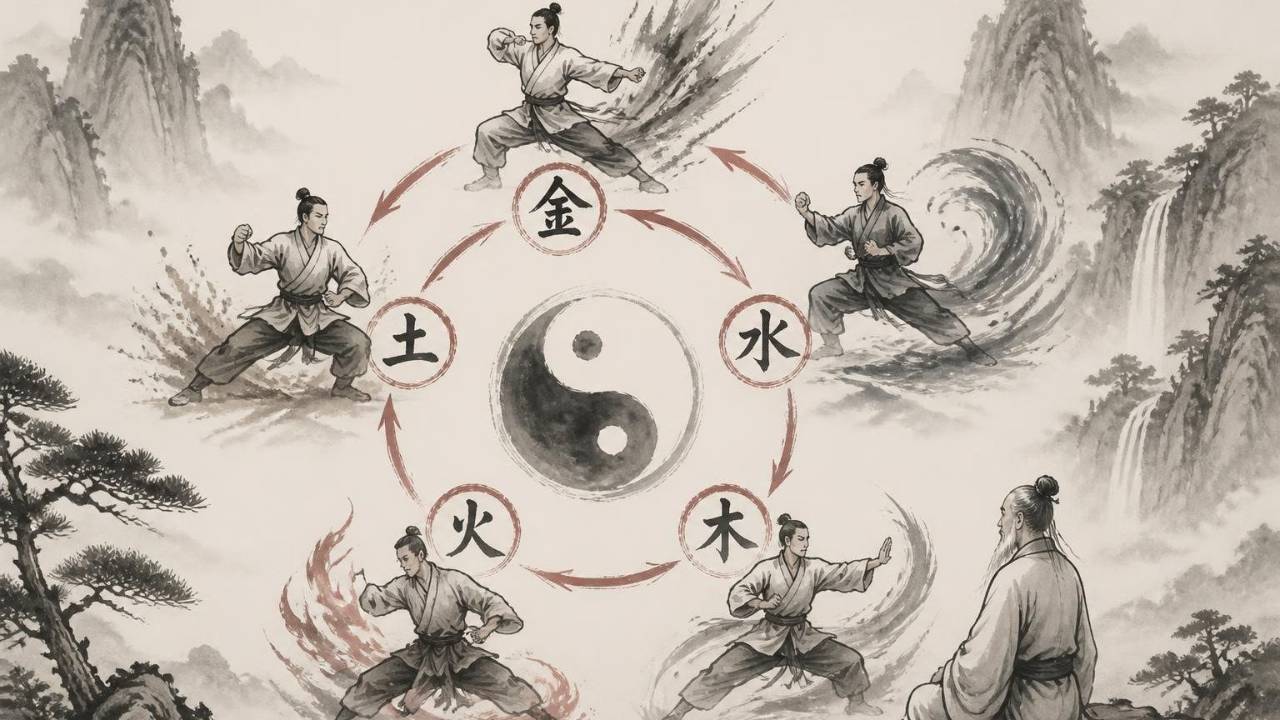
Xingyiquan is one of the most direct and powerful expressions of Chinese internal martial arts. While many people recognise tai chi for its flowing movements, xingyiquan takes a different path - emphasising linear techniques, short bursts of power and the patient repetition of simple movements. This ancient system has shaped countless practitioners over centuries, offering a window into how Taoist principles can show up through vigorous, focused movement. Whether you are drawn to internal arts for health, self-defence or personal growth, understanding xingyiquan reveals connections between mind, body and breath that run through many Chinese martial traditions.
Please note: xingyiquan is a vigorous martial art. Please check with your healthcare professional before starting any new exercise, and stop if you feel dizzy or in pain. Taoist Wellness Online does not teach xingyiquan - our courses are Tai Chi, Qi Gong, Taoist meditation and Taoist philosophy.
The Origins and Historical Development of Xingyiquan
The history of xingyiquan carries layers of legend and documented fact. Traditional accounts trace the art to General Yue Fei of the Song Dynasty, though many historians suggest the system took shape later, during the Ming and Qing periods. What we can say is that xingyiquan emerged from a rich cultural setting where martial skill, military strategy and personal cultivation were closely intertwined.
Several key figures appear in the story of its development:
- Ji Longfeng (Ji Jike), often credited with systematising the art in Shanxi province during the 17th century
- Cao Jiwu, who passed the practice on to later generations
- Li Luoneng, whose 19th-century teaching is linked to the three major lineages that persist today
- Guo Yunshen, famous for his half-step crushing fist
Regional Styles and Lineage Divisions
By the late 19th century, xingyiquan had diversified into distinct regional expressions. The three main branches - Shanxi, Hebei and Henan - each emphasise different aspects of the core principles while keeping the fundamental structure.
| Lineage | Primary Characteristics | Notable Features |
|---|---|---|
| Shanxi | Compact stances, vertical power | Emphasises rising and falling movement |
| Hebei | Lower postures, broader movements | Known for more martial applications |
| Henan | Softer, rounder expression | Closer in feel to other internal arts |
The transmission of xingyiquan has always valued direct teacher-student relationships. Unlike more widespread practices, this art traditionally passed through small groups, with masters carefully choosing students who showed both physical aptitude and good character. This selective approach preserved the depth of the system while allowing regional variations to flourish.
Core Principles and Training Methods
Xingyiquan runs on deceptively simple principles that take years to embody. The name itself - "form and intention boxing" - points to the central teaching: outer shape and inner intention work as one. Every movement asks for coordination of mind, breath and body.
Foundational training traditionally begins with standing practice (zhan zhuang), similar to practices in other internal arts. Practitioners often spend months developing a relaxed, balanced posture before adding movement. This patience is deliberate - it builds the steady foundation that the techniques rest on.
The Five Element Approach
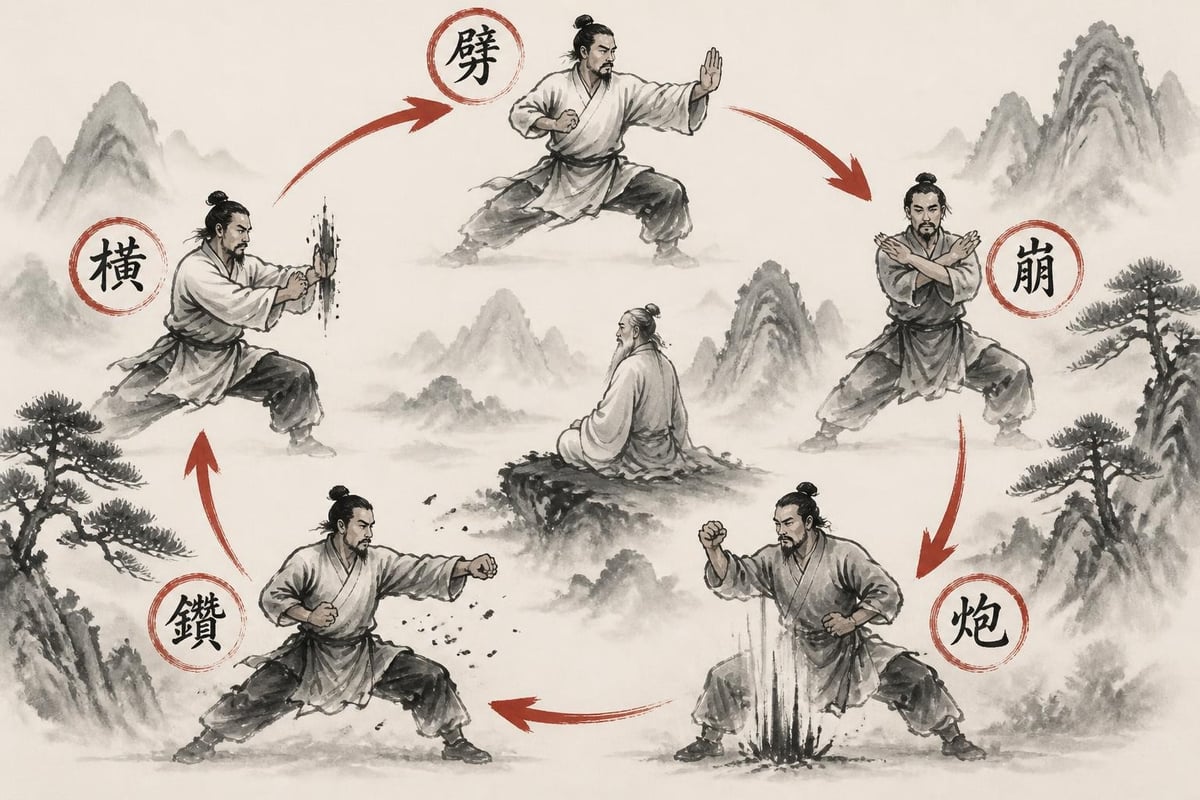
At the heart of xingyiquan lies five element theory, expressed through five fundamental fist techniques:
- Splitting Fist (Pi Quan) corresponds to metal, cutting downward like an axe
- Crushing Fist (Beng Quan) relates to wood, releasing power like an arrow from a bow
- Drilling Fist (Zuan Quan) connects to water, spiralling forward and upward
- Pounding Fist (Pao Quan) embodies fire, moving outward with cannon-like force
- Crossing Fist (Heng Quan) represents earth, sweeping across with a steady, stabilising quality
These are not just fighting techniques. Each element fist trains particular qualities of movement and body mechanics. Practitioners repeat them thousands of times, refining the link between intention and physical expression. The repetition is not mindless - it works as a moving meditation that builds focus and body awareness.
Animal Forms and Advanced Practice
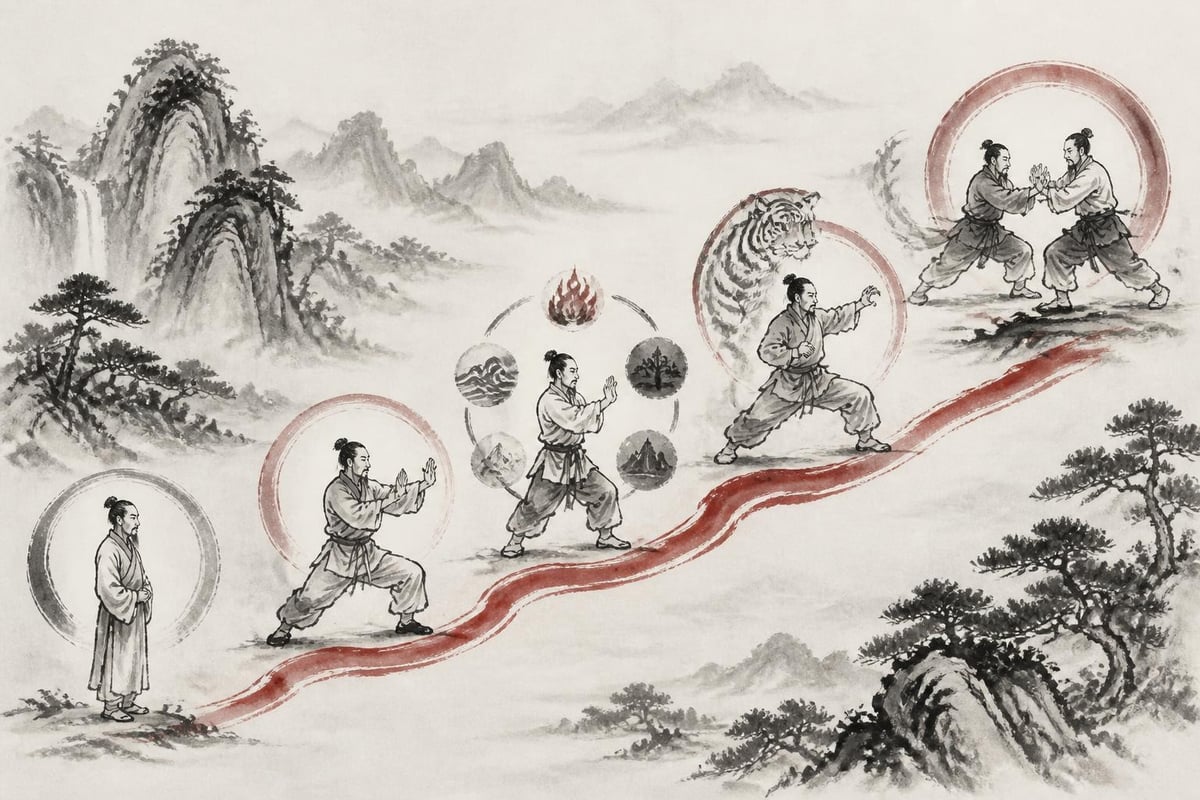
Beyond the five elements, xingyiquan includes twelve animal forms that widen the practitioner's movement vocabulary and tactical options:
- Dragon (Long)
- Tiger (Hu)
- Monkey (Hou)
- Horse (Ma)
- Alligator (Tuo)
- Chicken (Ji)
- Hawk (Yao)
- Swallow (Yan)
- Snake (She)
- Tai Bird (Tai)
- Eagle (Ying)
- Bear (Xiong)
Each animal form teaches distinct qualities. Tiger is associated with courage and strength. Snake trains supple movement and precise timing. Bear is linked with rooted stability and weight. Unlike the five element fists, which are practised endlessly as fundamentals, animal forms usually come later in training, once the basics are well established.
Developing Internal Strength Through Xingyiquan Practice
The word "internal" in internal martial arts points to a particular kind of training. Chinese tradition uses the term jing - trained force that differs from muscular strength alone. In this view, power comes from whole-body coordination, good structure and relaxed, connected movement.
Key aspects of internal development in traditional teaching include:
- Moving from the centre of the body (the lower dantian, in Chinese tradition)
- Coordinating the six harmonies: hands with feet, elbows with knees, shoulders with hips
- Staying connected between the ground and the hands
- Letting intention (yi) lead the movement, with the body following
The training method reflects these priorities. Rather than practising many techniques superficially, xingyiquan favours deep practice of a few essential movements. Some practitioners spend a year or more mainly working on a single fist technique, discovering layer after layer of refinement.
Breathing in Xingyiquan
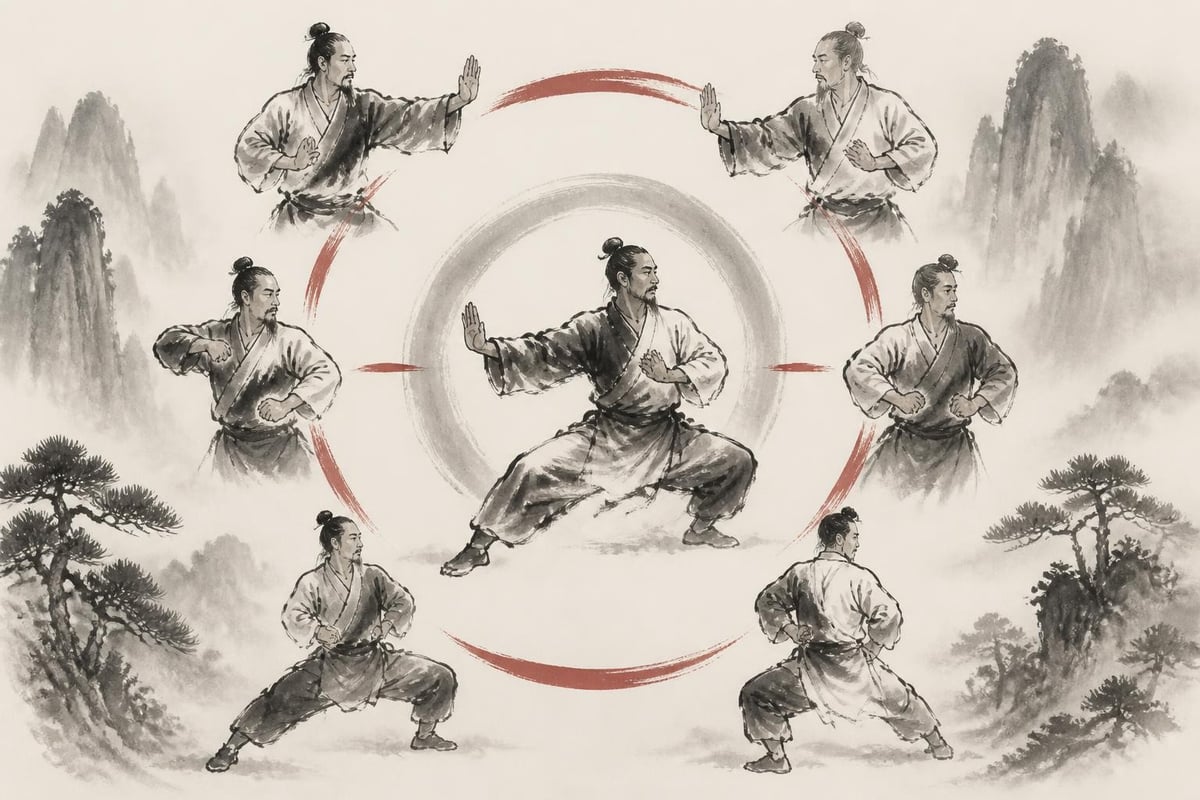
Breathing in xingyiquan differs from the slower, natural breathing associated with Wudang tai chi. In the martial tradition, breath is often matched with short, forceful movements. This style of breathing suits trained martial artists working with an experienced teacher. In our own approach, breath stays natural and unforced, and we do not suggest copying martial breathing methods from a description.
If you try any standing or breathing practice, keep it gentle. Rest if you feel light-headed, and please speak to your healthcare professional first if you are pregnant, have recently had surgery, or have a heart or breathing condition or high blood pressure.
Xingyiquan's Relationship to Taoist Philosophy
Although xingyiquan developed in military and martial settings, its principles echo core Taoist teachings. The emphasis on natural power rather than forced strength reflects wu wei - effortless action. The cyclical relationship between the five elements mirrors Taoist ideas about how things change and support each other.
The practice itself can become a form of moving meditation. When you repeat the same movement hundreds of times, the thinking mind may gradually quieten. What remains is direct experience - body, breath and intention together in the present moment. This absorbed focus touches on qualities many people also meet in seated Taoist meditation, just through a different doorway.
Balancing Hardness and Softness
Outside observers often see xingyiquan as purely hard or aggressive. This misses the central teaching. In its traditional ideal, xingyiquan combines hardness and softness, with neither dominating. The body stays relaxed (song) even while delivering strong movements. This paradox - soft inside, firm outside - takes careful development and cannot be forced through muscular tension.
The progression from beginner to advanced practitioner often involves learning to soften what was previously tense. New students typically use too much force. As understanding deepens, unnecessary tension tends to drop away, leaving a more efficient way of moving that comes from good structure. This mirrors the Taoist principle of returning to naturalness - not adding complexity, but removing what gets in the way.
Modern Practice and Preservation
In 2026, xingyiquan faces both opportunities and challenges. The art has spread around the world, with practitioners on every continent. At the same time, traditional transmission needs dedicated teachers and committed students - both increasingly rare in our fast-paced world.
Some teachers have adapted xingyiquan for modern life, emphasising movement quality and relaxation. Others keep strict traditional methods, insisting that the martial applications must stay central to preserve the art's character. Both approaches help keep this practice alive.
If you are exploring how authentic Chinese practices can support your own sense of balance, our free Taoist course is a gentle place to begin. Taught by our teacher Master Gu, a 15th-generation San Feng Pai Wudang Taoist Master with 25+ years of teaching experience, it introduces Tai Chi, Qi Gong, meditation and Taoist wisdom - the foundations that sit behind many internal arts.
Contemporary Training Approaches
Modern practitioners have several entry points into xingyiquan study:
| Approach | Focus Area | Best For |
|---|---|---|
| Traditional lineage | Complete system with martial applications | Serious martial artists |
| Health-oriented | Movement quality, posture, relaxation | Wellness seekers |
| Athletic/sport | Competition forms and performance | Younger practitioners |
| Academic | Historical research and cultural preservation | Scholars and documentarians |
Each approach has value, though depth of understanding usually grows with time invested and quality of instruction. The art rewards patient, consistent practice over years and decades. Quick mastery is not possible - xingyiquan's simplicity on the surface hides a great deal of complexity beneath.
Integrating Xingyiquan Principles Into Broader Practice
Even practitioners focused on other internal arts can learn from xingyiquan's approach. The emphasis on structure, whole-body coordination and intention carries across different systems. Many tai chi practitioners study xingyiquan to explore more direct movement, while xingyiquan students often study tai chi movements to add softness and circular flow.
Complementary Practices
Xingyiquan sits well alongside other Taoist wellness practices:
- Standing meditation (Zhan Zhuang) may help develop steadiness and posture awareness
- Qi Gong, such as Ba Duan Jin, offers gentle movement that may support flexibility and relaxation - you can explore this in our Qi Gong course
- Natural, relaxed breathing may help you stay calm while you move
- Philosophical study deepens your understanding of the ideas behind physical practice
The combination is not automatic. It takes thoughtful practice, and a teacher with deep roots in an authentic tradition can help you avoid mixing methods that pull in different directions.
Finding Authentic Instruction and Resources
Quality instruction is the most important factor in xingyiquan. The art's subtlety means small details in body mechanics make a big difference. Video instruction can supplement learning but cannot replace hands-on correction from a skilled teacher in the room. Online learning, including ours, cannot physically correct your posture, so we encourage a gentle, patient approach and a qualified in-person teacher for any martial art.
When evaluating potential teachers, consider:
- A clear lineage to recognised masters
- Demonstrated skill in both form and application
- An ability to explain principles, not just demonstrate techniques
- A teaching method that suits your learning style and goals
Many people begin their path into Chinese internal arts through gentler practices before exploring specialist systems like xingyiquan. Starting with foundational work in tai chi or qi gong builds body awareness that supports later learning. Exploring tai chi first can give you useful context for internal martial arts as a whole.
Continuing Development
Serious xingyiquan practice is a lifelong path. Even masters with decades of experience keep refining their understanding. This open-ended quality can be freeing - there is no final destination, just deepening practice.
Regular practice matters more than intensive bursts. Fifteen minutes a day usually serves better than an occasional marathon session. Consistency lets the body and mind settle into the practice gradually and sustainably.
If you study with a qualified teacher, you might keep practice fresh by cycling through different parts of the system. Spend a month on one element fist, then move to another. Work with an animal form for a season, then return to the basics. This variety keeps interest high while covering the whole system.
Applying Xingyiquan Wisdom to Daily Life
The value of xingyiquan reaches beyond martial skill. The art can build qualities useful in every area of life - focus, determination, adaptability and calm under pressure. Training teaches you to meet challenges with directness and clarity rather than hesitation.
The discipline of repeating the same movement hundreds of times can build mental resilience. Learning to relax inside while moving with strength outside may help you stay centred during stressful moments. Paying attention to how your body moves can also sharpen body awareness in everyday activities. Practices like this can sit alongside, but should not replace, professional support - if stress is affecting you, please also speak to your GP or a qualified professional.
These benefits tend to emerge gradually, and results vary. Like water wearing stone, regular training can reshape patterns of tension, thought and response over time. You do not practise xingyiquan just to fight better - you practise to live better, moving through the world with greater ease and presence.
Xingyiquan offers a direct path into internal training that unites body, breath and intention through focused practice. Whether you are drawn to the martial side or to the ancient wisdom behind it, the principles of this art can change how you think about movement and balance. At Taoist Wellness Online, our teacher Master Gu guides you through courses in Tai Chi, Qi Gong and Taoist meditation, helping you build calm, steady foundations that support any internal arts path.
Related reading