The Dao: Ancient Wisdom for Modern Balance
Sep 27, 2026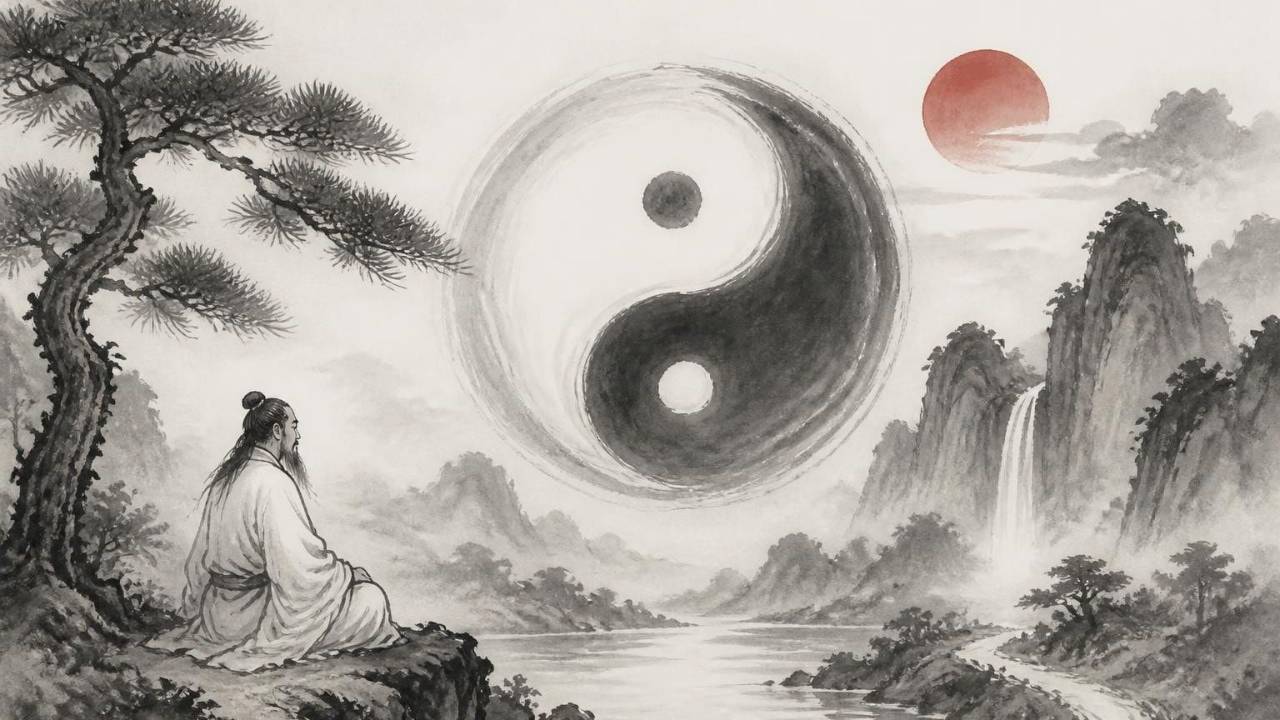
The dao is more than a concept. It's a living, breathing reality that shapes how we move through life, how we relate to our energy, and how we find balance in an increasingly chaotic world. For thousands of years, Taoist practitioners have followed this path, not as a rigid doctrine, but as a gentle invitation to align with the natural rhythms of existence. Understanding the dao isn't about memorising philosophy or adopting strict rules. It's about opening yourself to a way of being that honours simplicity, balance, and the profound wisdom already present in nature and within your own body.
What Is the Dao?
The dao is often translated as "the way" or "the path," but these English words barely scratch the surface of its depth. At its core, the dao represents the fundamental principle underlying all existence: the natural order, the flow of energy, the rhythm of transformation that governs everything from the changing seasons to the beating of your heart.
The dao cannot be fully captured in words. The opening line of the Dao De Jing, the foundational Taoist text, makes this clear: "The dao that can be spoken is not the eternal Dao." This isn't meant to frustrate or mystify. It simply reminds us that intellectual understanding alone won't reveal the dao's essence. We experience it through practice, through movement, through stillness, and through living in harmony with what is.
Master Gu explains this symbol and its meaning directly in the video below.
The Dao as Natural Flow
Think of water flowing downhill. It doesn't force its way. It doesn't resist. It simply follows the path of least resistance, adapting to every obstacle, wearing down stone over time through gentle persistence. This is the dao in action.
- Natural movement without force
- Adaptation to changing circumstances
- Strength through flexibility
- Persistence through patience
- Harmony with surroundings
When you practise Wudang Tai Chi or Qi Gong, you're not just learning forms or exercises. You're learning to embody this natural flow. Each slow, deliberate movement teaches your body to release tension, to stop fighting against gravity and resistance, and to move with the dao rather than against it.
The Dao and Qi: Energy in Motion
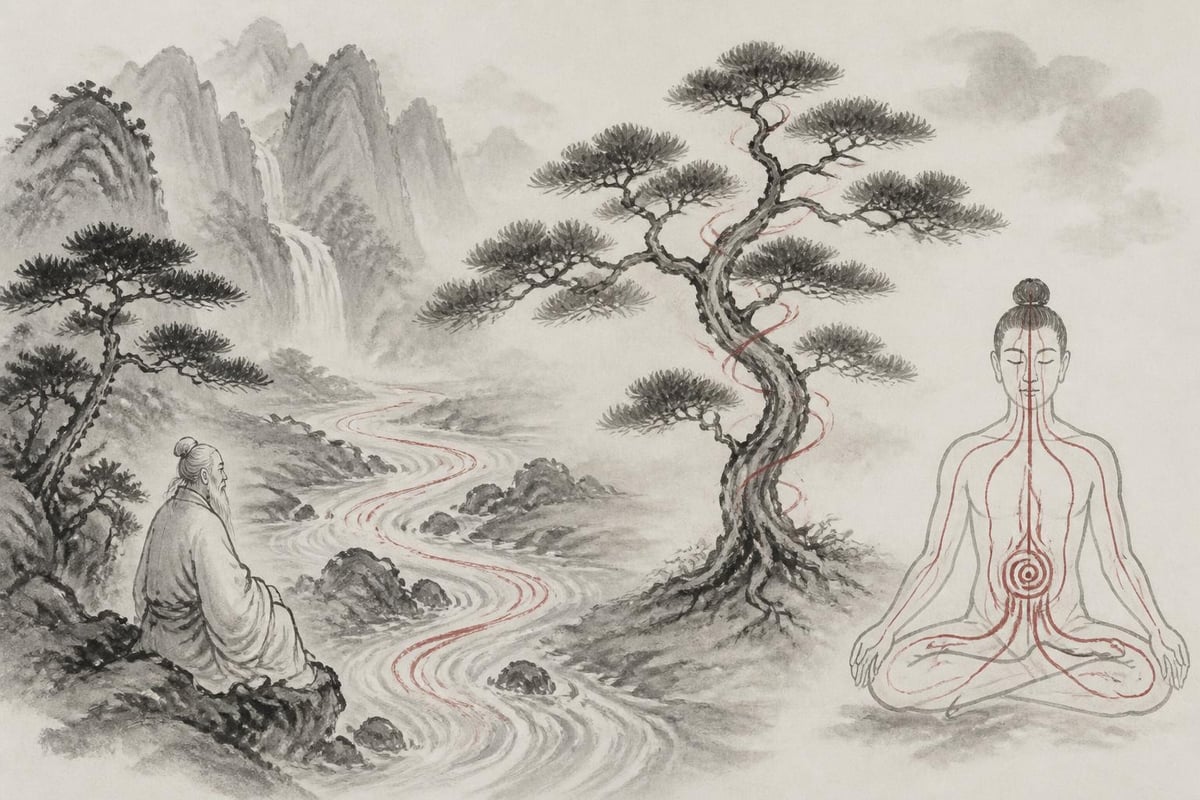
The dao expresses itself through Qi, the vital life energy that animates all living things. Understanding the relationship between the dao and Qi is essential for anyone exploring our Qi Gong course.
| Concept | Description | Practice Application |
|---|---|---|
| The Dao | The underlying principle, the way of nature | Guides your intention and approach |
| Qi | Vital energy, life force | What you cultivate and direct |
| Wu Wei | Effortless action, non-forcing | How you practise and live |
| Yin-Yang | Complementary opposites | Balance in movement and rest |
When Qi flows freely through your body's meridians, you experience vitality, clarity, and balance. When it becomes blocked or stagnant, you feel tired, scattered, or unwell. The dao provides the blueprint for healthy Qi flow. By aligning with the dao, you create conditions for your energy to move naturally and powerfully.
Cultivating Qi Through Daoist Practice
Our free Taoist course offers a practical introduction to these principles. Through simple practices, you begin to feel your Qi, direct it with your awareness, and allow it to circulate through your body in ways that restore balance and vitality.
Daily practice doesn't require hours. Even a few minutes of mindful movement or standing meditation can reconnect you with your natural energy flow. The key is consistency and presence, not perfection or intensity.
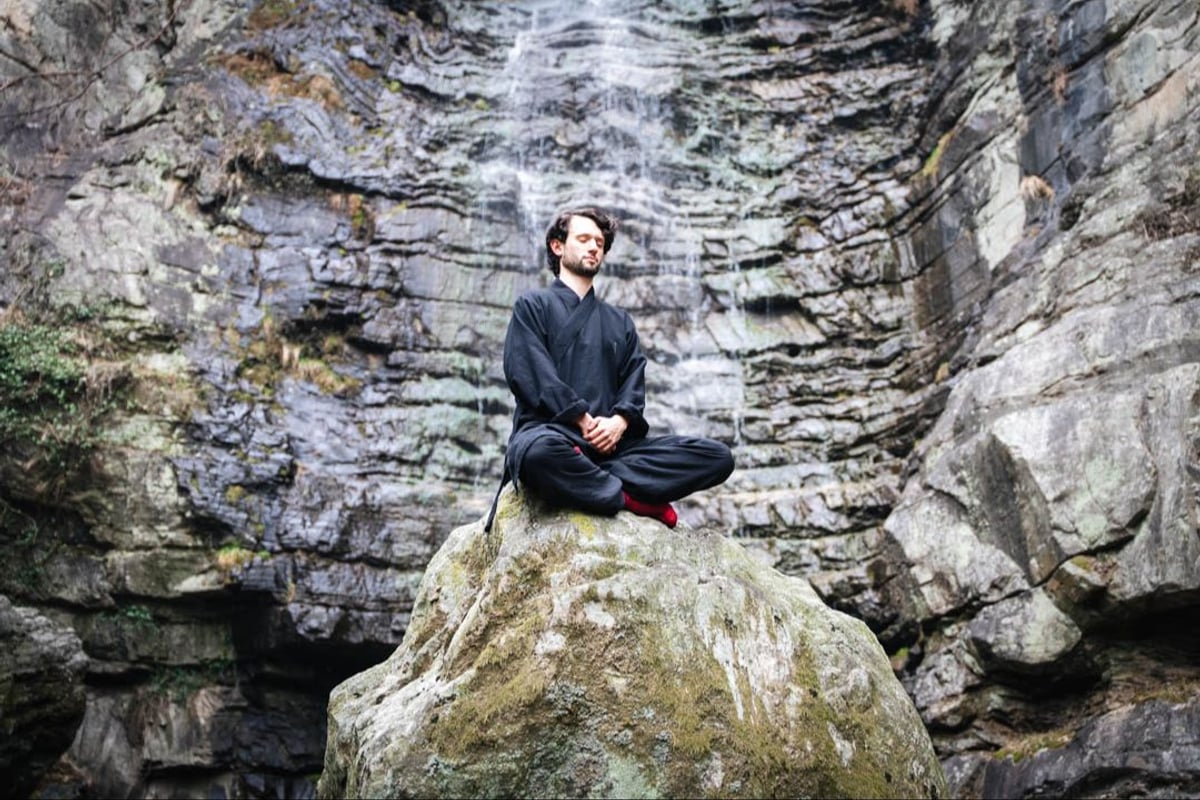
Yin and Yang: The Dao's Dance of Balance
The dao manifests through the interplay of yin and yang, the complementary forces that create all phenomena. This isn't about good versus evil or light versus dark. Yin and yang are interdependent aspects of a unified whole.
Yin qualities:
- Rest, receptivity, stillness
- Inward focus, reflection, night
- Water, earth
- Cooling, nourishing, contracting
Yang qualities:
- Activity, expression, movement
- Outward focus, action, day
- Fire, heaven
- Warming, activating, expanding
Neither yin nor yang is better or worse. Both are necessary. The dao teaches us to recognise when we're out of balance and to gently adjust. Too much yang activity without yin rest leads to burnout. Too much yin withdrawal without yang engagement leads to stagnation.
In Wudang Tai Chi, every movement contains both yin and yang. As you shift your weight, one leg becomes yang (full, active, rooted) while the other becomes yin (empty, receptive, light). This constant alternation trains your body and mind to navigate change with grace.
Wu Wei: Effortless Action Aligned with the Dao
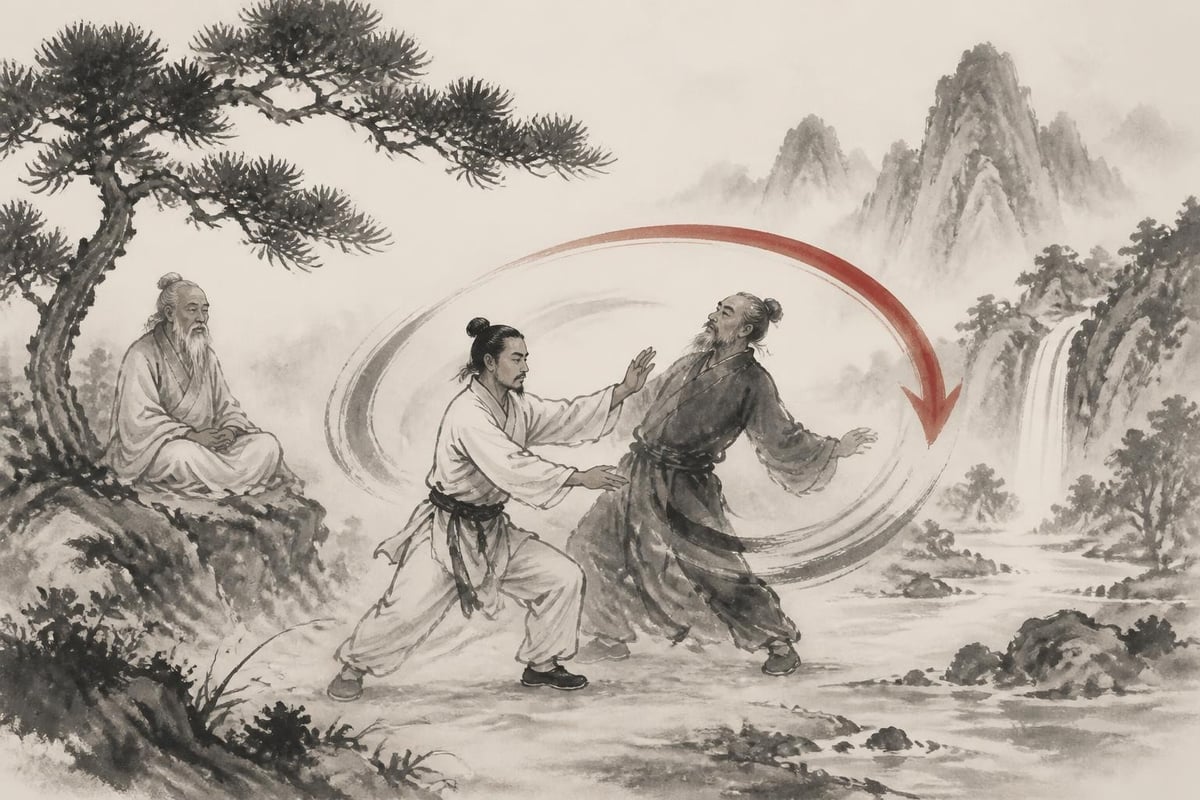
Wu wei is one of the dao's most practical teachings. Often translated as "non-action" or "effortless action," wu wei doesn't mean doing nothing. It means acting in complete alignment with the natural flow, without forcing or struggling.
Picture a skilled sailor. She doesn't fight the wind or the waves. She works with them, adjusting her sails and rudder to harness the very forces that could sink her boat. This is wu wei, the art of accomplishing much by forcing little.
Applying Wu Wei in Modern Life
Our culture often celebrates hustle, grinding, and pushing through at all costs. The dao offers a different path. When you align with wu wei, you:
- Observe before acting - Notice the natural flow of situations before intervening
- Choose timing wisely - Act when conditions are favourable, wait when they're not
- Use minimal force - Accomplish your goals with the least necessary effort
- Stay flexible - Adapt your approach as circumstances change
- Trust the process - Allow outcomes to unfold naturally rather than controlling every detail
This doesn't mean being passive or lazy. It means being strategic, patient, and responsive. Our Taoist meditation course helps you develop the inner stillness and clarity needed to recognise when to act and when to wait.
The Dao in Daily Life
You don't need to retreat to a mountain monastery to follow the dao. Ancient wisdom becomes most powerful when integrated into ordinary moments.
Morning routine: Instead of immediately checking your phone, take three conscious breaths. Feel your feet on the floor. Notice the quality of your energy. This simple pause aligns you with the dao before the day's demands pull you in every direction.
Work challenges: When facing a difficult problem, resist the urge to force a solution. Step back. Take a walk. Let your mind settle. Often, the answer emerges naturally when you stop grasping for it. This is the dao working through you.
Relationships: The dao teaches us to accept people as they are, not as we wish they'd be. This doesn't mean tolerating harmful behaviour. It means recognising that trying to change others through force or manipulation rarely works. Create space for natural transformation instead.
The Dao and Community
Following the dao doesn't mean walking alone. In fact, our community demonstrates how Taoist principles create deeper connections. When individuals each cultivate their own balance and inner harmony, they naturally support and uplift one another without codependency or drama.
The Dao in Movement: Tai Chi and Qi Gong
Wudang Tai Chi and Qi Gong are moving meditations that teach your body to embody the dao. Every form, every posture, every breath is an opportunity to practise alignment with natural principles.
| Practice | Primary Focus | Connection to the Dao |
|---|---|---|
| Tai Chi | Continuous flowing movement | Teaches smooth transitions, balance in motion, rooting and rising |
| Qi Gong | Cultivating and directing Qi | Develops sensitivity to energy, strengthens vitality, clears blockages |
| Standing Meditation | Stillness and alignment | Builds internal strength, calms the mind, reveals natural posture |
| Taoist Meditation | Inner observation | Quiets mental chatter, connects with deeper wisdom, cultivates presence |
When you learn authentic Wudang Tai Chi through our Tai Chi course, you're not just memorising choreography. You're training your nervous system to respond to life with the same qualities you cultivate in practice: calmness under pressure, stability amid change, and power without aggression.
The forms are like maps. They show you the territory of the dao in your own body. But the real journey happens when you step off the map and explore that territory directly through your own experience.
The Dao and Personal Transformation
Following the dao is inherently transformative, though the transformation is often subtle and gradual rather than dramatic. You might not wake up one day feeling completely different. Instead, you notice small shifts over weeks and months.
Your reactions to stress soften. You find pockets of peace in moments that used to overwhelm you. Your body feels more comfortable, more alive. Decisions that once felt agonising become clearer. You waste less energy fighting reality and have more available for what truly matters.
This transformation doesn't require you to become someone else. The dao is about returning to your true nature, not adding layers of spiritual achievement or identity. As the Dao De Jing suggests, the path often involves subtraction rather than addition, releasing what's false to reveal what's authentic.
Obstacles on the Path
Common challenges when learning to follow the dao:
- Impatience with the process - Wanting immediate results or dramatic breakthroughs
- Overthinking the philosophy - Getting stuck in concepts instead of practising
- Comparing yourself to others - Measuring your progress against someone else's journey
- Expecting perfection - Judging your practice as right or wrong, good or bad
- Forgetting to practise - Letting daily pressures crowd out your commitment
Each of these obstacles offers its own teaching. When you notice impatience, you practise acceptance. When you catch yourself overthinking, you return to your breath and body. The dao is patient with your mistakes because mistakes are part of the natural learning process.
The Dao Beyond Technique
While practices like Tai Chi and Qi Gong provide structured ways to explore the dao, the ultimate aim is to live it directly. This means bringing Taoist principles into every aspect of your life, not just your practice sessions.
In communication: Speak when you have something valuable to add. Listen deeply without planning your response. Allow silence when it serves understanding better than words.
In consumption: Notice what truly nourishes you versus what you consume out of habit or compulsion. The dao supports simplicity and discernment.
In rest: Honour your body's need for genuine restoration. Quality sleep, quiet time, and strategic disengagement aren't luxuries. They're essential to maintaining your connection with the dao.
Our Taoist philosophy course explores these broader applications, showing how ancient wisdom addresses contemporary challenges like information overload, decision fatigue, and the constant pressure to be productive.
Learning from an Authentic Master
The dao has been transmitted through lineages of masters and students for millennia. While you can certainly explore these teachings on your own, learning from someone who embodies the principles makes the path clearer and more accessible.
Master Gu represents the 15th generation of Wudang masters, carrying forward teachings that have been refined and preserved through centuries of practice. This isn't about hero worship or giving away your power. It's about recognising that some forms of knowledge are best transmitted directly from teacher to student, through demonstration, correction, and subtle energetic transmission.
What an authentic teacher provides:
- Correction of subtle misalignments you can't see yourself
- Energy transmission that deepens your practice
- Context and nuance that books and videos can't capture
- Encouragement when you doubt yourself
- Challenge when you become complacent
The dao itself is the ultimate teacher, but a skilled guide helps you recognise its lessons more quickly and clearly.
The Dao and Seasonal Living
Nature follows the dao perfectly, and by observing natural cycles, we learn to align our own rhythms with the deeper patterns of existence. Each season carries its own energy and wisdom. Our Harmony and Nature article explores this seasonal alignment in more depth.
Spring brings expansion, new beginnings, and rising yang energy. It's a time to plant seeds, both literal and metaphorical, and to direct your energy toward new projects and possibilities.
Summer peaks in yang activity and outward expression. It's when plans come to fruition, when we engage most actively with the world, when growth accelerates.
Autumn begins the shift toward yin, the time of harvest and preparation. We gather the fruits of our efforts and begin turning inward, releasing what no longer serves.
Winter completes the cycle with deep yin energy, rest, and restoration. It's when the dao invites us to conserve energy, reflect deeply, and allow the soil of our being to replenish itself for the next cycle.
Modern life often tries to maintain perpetual summer, constant growth and activity. The dao reminds us that sustainability requires honouring all phases of the cycle.
The Dao as Return
One of the dao's most beautiful teachings is that we're not trying to achieve something foreign or difficult. We're simply returning to what's always been true. Your body already knows how to breathe, how to heal, how to find balance. Your original nature is already aligned with the dao.
Practice strips away the layers of tension, conditioning, and false belief that obscure this natural wisdom. Each session of Tai Chi or meditation is less about adding something new and more about removing what blocks your inherent clarity and vitality.
This perspective offers tremendous relief. You're not broken and needing to be fixed. You're not lacking and needing to achieve. You're complete already, learning to remember what you've temporarily forgotten.
The journey back to the dao is both the simplest and the most profound work you can do. It asks everything of you while demanding nothing. It transforms you completely while returning you to yourself. If you'd like to explore where this all began, our What is Taoism article is a good place to start.
The dao offers a path of genuine balance, natural movement, and sustainable energy in a world that often demands the opposite. By exploring these ancient principles through authentic Wudang practices, you reconnect with wisdom that's both timeless and immediately practical. Whether you're seeking greater physical vitality, mental clarity, or spiritual depth, the dao welcomes you exactly as you are and guides you toward your fullest potential. Begin your journey with Taoist Wellness Online and discover how these transformative practices can restore harmony and energy to your daily life.