Alan Watts Taoism: Ancient Wisdom for Modern Life
Aug 04, 2026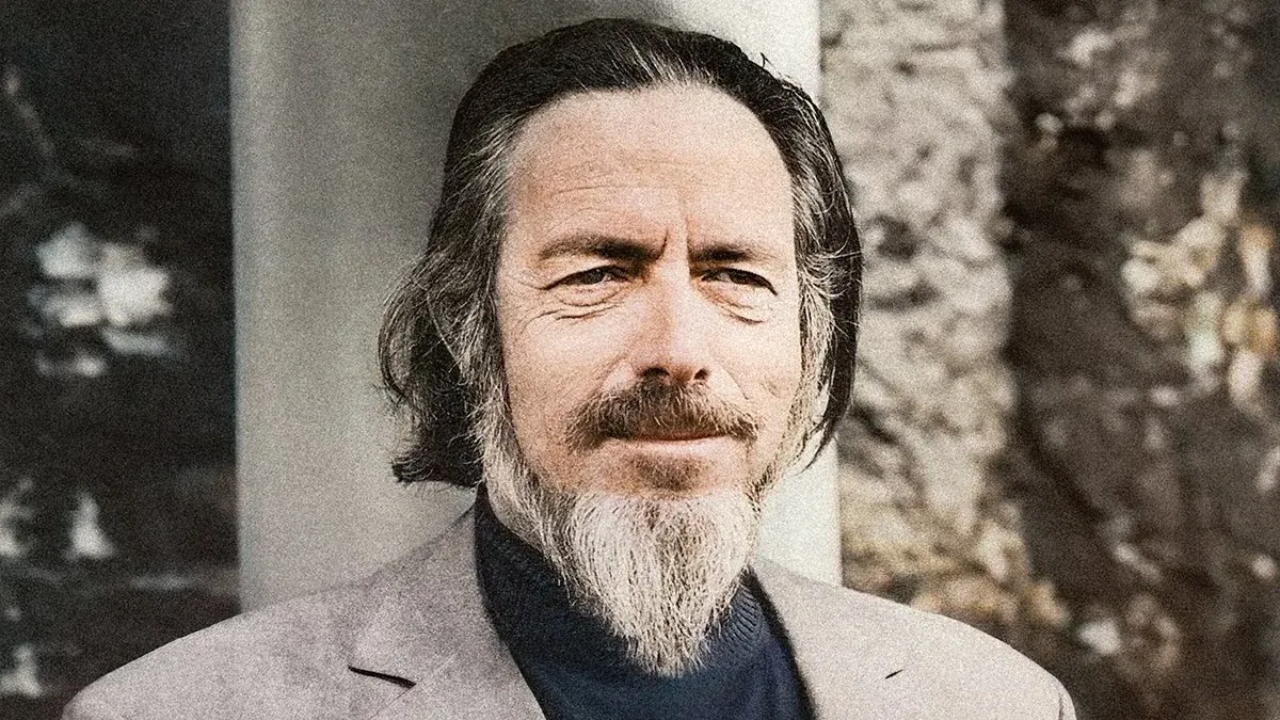
When British philosopher Alan Watts first introduced Western audiences to Eastern thought in the mid-20th century, he opened a doorway that millions would eventually walk through. His unique interpretation of ancient Chinese philosophy helped people understand that Taoism wasn't just an exotic belief system, but a practical approach to living with greater ease and authenticity. Through lectures, radio broadcasts, and books, Alan Watts' teaching on Taoism became a bridge between two vastly different cultures, translating concepts like wu wei and the Tao into language that resonated with modern seekers.
The Man Who Made Taoism Accessible
Alan Watts possessed a rare gift: the ability to take profound philosophical concepts and make them feel immediately relevant to everyday life. Born in England in 1915, he developed a fascination with Asian philosophy as a teenager and spent his adult life studying, teaching, and interpreting these traditions for Western audiences.
His approach to Taoism differed from dry academic study. Watts believed these teachings should be experienced, not just analysed. He spoke about the Tao the way a musician might describe rhythm, emphasising feeling over intellectual understanding.
Why His Interpretation Still Matters
The relevance of Watts' teaching on Taoism extends far beyond historical interest. In 2026, as people navigate constant digital stimulation, work pressure, and information overload, his teachings about natural flow and effortless action feel more applicable than ever.
Watts understood something essential: Taoism addresses universal human experiences. The struggle between control and surrender, the tension between doing and being, the search for meaning in an unpredictable world - these challenges transcend culture and time.
Key themes Watts emphasised:
- The paradox of trying to relax
- Nature as the ultimate teacher
- The futility of forcing outcomes
- Finding power in yielding
- The illusion of the separate self
Core Concepts in Alan Watts' Taoist Teachings
Understanding Watts' interpretation of Taoism requires grasping several foundational ideas that he returned to repeatedly throughout his work. These weren't abstract theories but practical observations about how life actually works when we stop fighting against it.
Wu Wei: The Art of Effortless Action
Perhaps no concept received more attention in Watts' teachings than wu wei, often translated as "non-doing" or "effortless action." He explained this wasn't about laziness or passivity, but about acting in harmony with the natural flow of events.
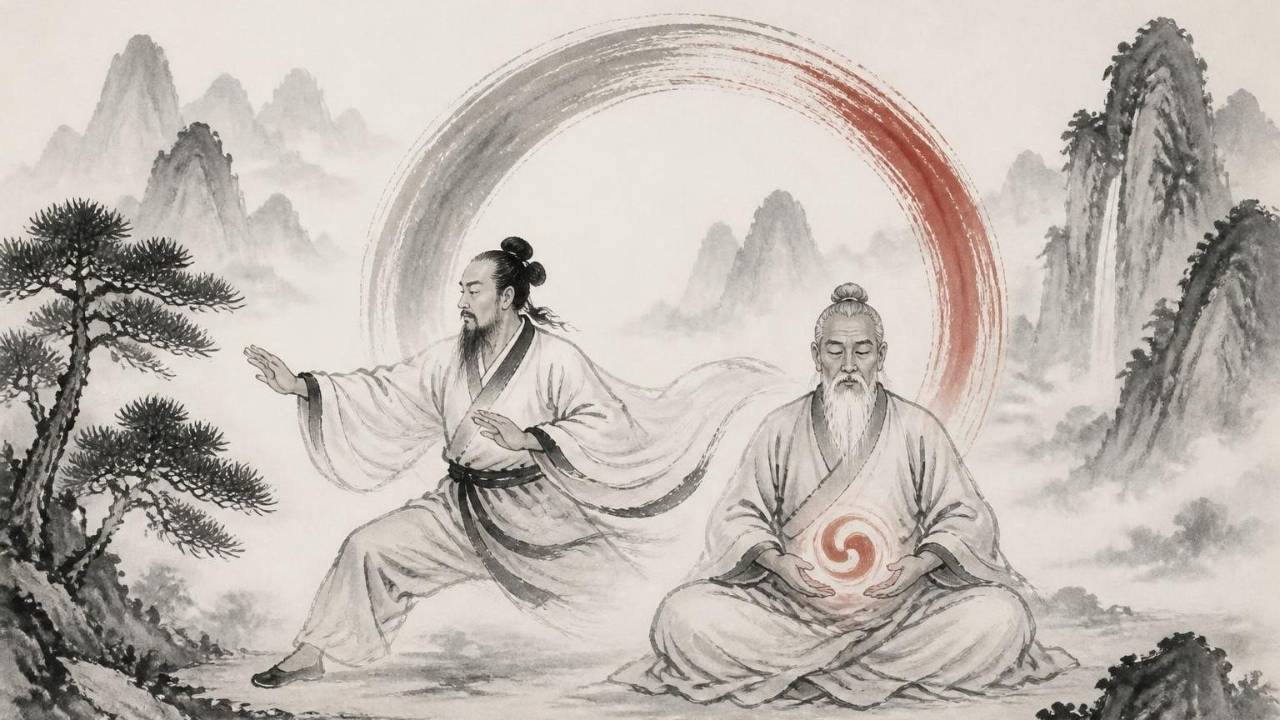
Think of a skilled Tai Chi practitioner moving through forms. There's clear action happening, but it doesn't feel forced or strained. The movements emerge from a deep alignment with principles of balance and natural mechanics. This same quality can infuse ordinary activities like cooking, conversation, or creative work.
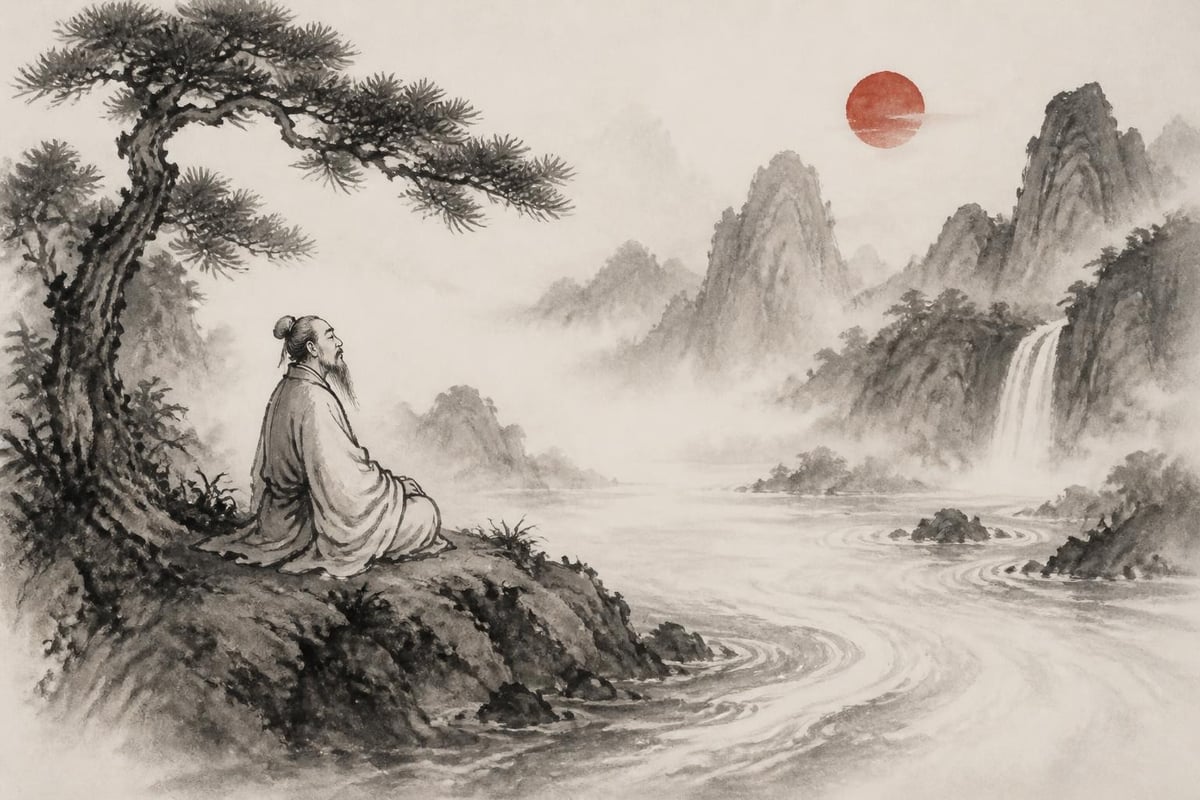
Watts loved to use water as a metaphor for wu wei. Water doesn't push against obstacles; it finds the path of least resistance, yet over time it can carve through stone. This patient, persistent, adaptive quality represents the Taoist approach to challenges.
Master Gu shares a short clip below featuring Alan Watts speaking on this very idea, a fitting reminder of how far his words have travelled and how naturally they sit alongside Wudang teaching.
| Wu Wei Principle | Forced Action | Natural Action |
|---|---|---|
| Effort Quality | Strained, tense | Relaxed, flowing |
| Approach | Against the grain | With the grain |
| Result | Exhausting | Energising |
| Example | Forcing sleep | Allowing sleep to come |
The Tao That Cannot Be Named
Watts frequently discussed the opening lines of the Tao Te Ching: "The Tao that can be spoken is not the eternal Tao." He emphasised that Taoism points toward direct experience rather than intellectual understanding.
This created an interesting challenge in his work. How do you teach something that fundamentally cannot be taught? Watts approached this by using stories, metaphors, and humour to gesture toward truths that slip away when grasped too tightly.
The Tao itself represents the underlying pattern or flow of existence. It's not a deity to worship or a set of rules to follow. Instead, it's the natural order that reveals itself when we quiet our conceptual thinking and simply observe.
Practical Applications for Modern Life
The beauty of Watts' interpretation of Taoism lies in its immediate applicability. You don't need to adopt new beliefs or join a tradition. These insights work as practical tools for reducing struggle and increasing flow in daily life.
Letting Go of Control
One of Watts' most powerful messages addressed our addiction to control. We exhaust ourselves trying to manage every outcome, forgetting that much of life unfolds beyond our influence.
Areas where releasing control creates freedom:
- Other people's opinions and choices
- Past events that cannot be changed
- Future outcomes with too many variables
- Natural processes like healing or creativity
- The thoughts that arise in meditation
This doesn't mean becoming passive or irresponsible. It means distinguishing between what you can genuinely influence and what you're better off accepting. Students often find our Tai Chi course a natural next step for embodying this principle, where forcing a movement creates tension while allowing the form to emerge creates grace.
Finding Rhythm in Opposites
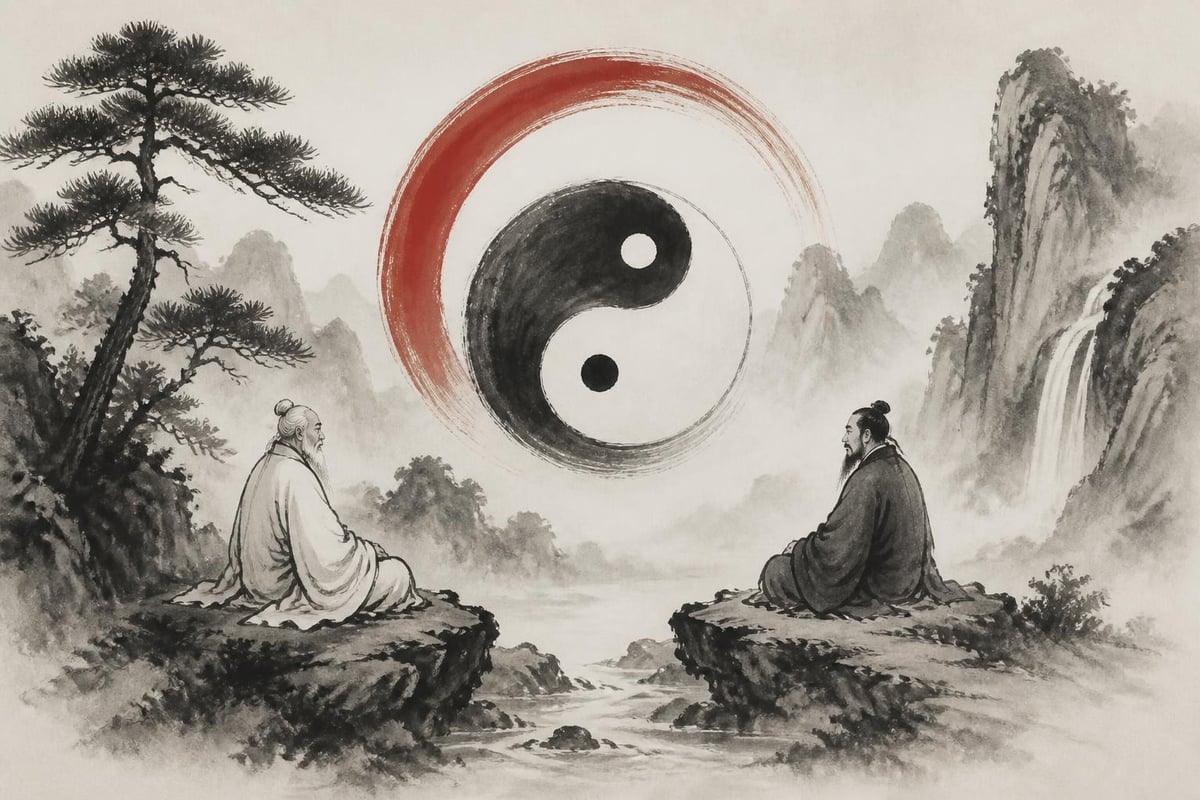
Watts emphasised that Taoism embraces paradox. Light and dark, active and receptive, fullness and emptiness - these aren't enemies but dancing partners that define each other.
In the Wudang tradition, this shows up clearly in movement practices. Each posture contains both yin and yang elements. As you sink into your root, you simultaneously rise through your crown. As you yield on one side, you express on the other.
From Philosophy to Practice
Reading about Watts' teaching on Taoism provides intellectual understanding, but the real transformation happens through embodied practice. This is where ancient movement arts become invaluable.
How Tai Chi Embodies Taoist Principles
Every aspect of Tai Chi practice reflects core Taoist teachings. The slow, continuous movements train your nervous system to find power in relaxation rather than tension. The circular patterns mirror natural forces like wind and water.
When you practise Tai Chi with awareness, you're not just exercising - you're studying the Tao through your own body. You discover firsthand how sinking creates lift, how yielding generates strength, how slowness develops speed.
Taoist principles found in Tai Chi:
- Softness overcomes hardness
- Stillness within movement
- Rooting allows rising
- Minimum effort, maximum effect
- Following rather than leading
Meditation as Direct Experience
Watts spoke extensively about meditation, though he warned against turning it into another achievement project. Taoist meditation isn't about reaching special states or becoming a better person. It's about seeing clearly what's already here.
Why not try our Taoist Meditation course, which focuses on naturalness within authentic lineages. You're not forcing your mind to be quiet; you're observing how stillness naturally emerges when you stop stirring up the water. Our article on Taoist Meditation: Ancient Practice for Modern Life explores this same idea of effortless action within stillness in more depth.
The Watercourse Way
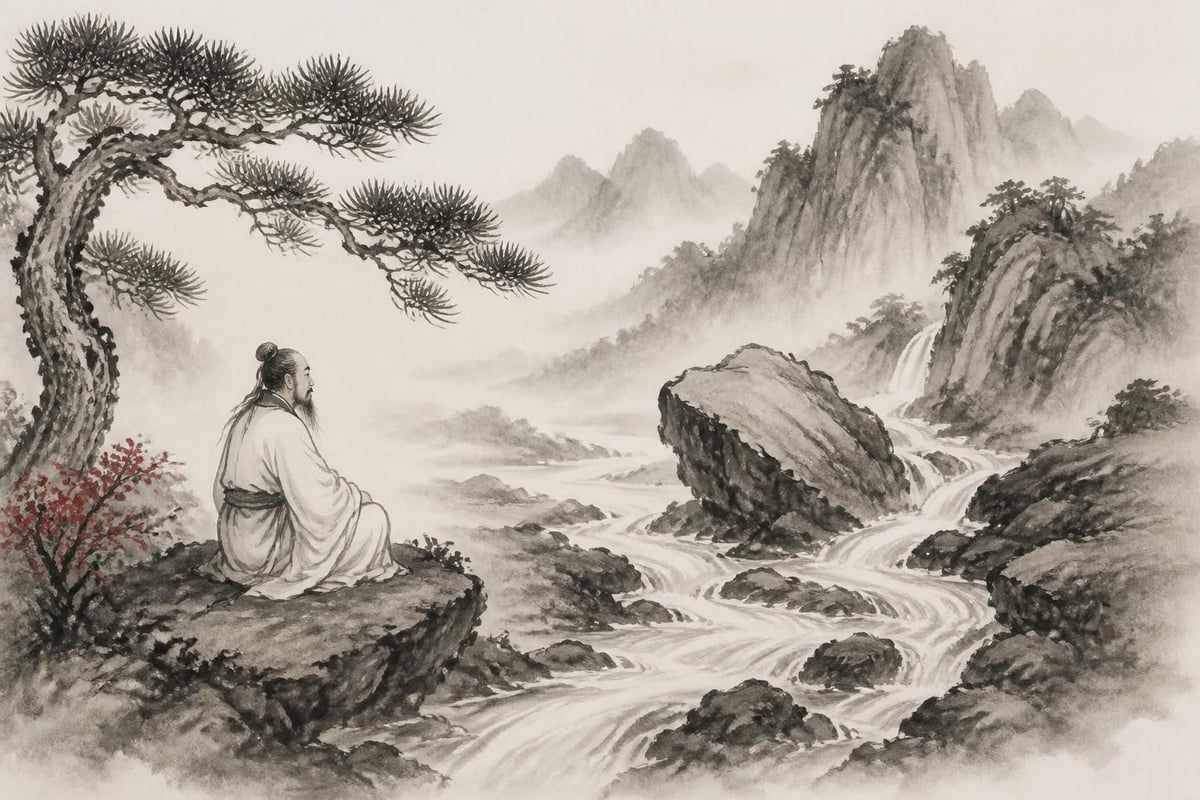
In his later years, Watts worked on what would become one of his most beloved books about Taoism. He explored how the Tao operates like water finding its course, always flowing toward completion without striving or forcing.
This "watercourse way" offers a powerful model for how to move through life. Water doesn't worry about obstacles. It doesn't complain about taking the long route. It simply flows, adapts, persists, and eventually reaches the ocean.
Applying Water's Wisdom
Consider how you approach challenges. Do you meet them like a battering ram, trying to smash through with force? Or can you flow around them, finding creative solutions that use less energy?
| Rigid Approach | Fluid Approach |
|---|---|
| Must happen my way | Many paths to the goal |
| Fighting circumstances | Working with circumstances |
| Depleting energy | Conserving energy |
| Creating resistance | Reducing friction |
The watercourse way doesn't mean avoiding difficulty. Water flows downhill, which sometimes means dropping into dark, narrow channels. But it doesn't resist this descent - it trusts the natural movement toward wholeness.
Integration with Authentic Practice
While Watts' teachings opened many Western minds to Taoist philosophy, he consistently emphasised that concepts alone remain incomplete. True understanding comes through direct transmission within authentic lineages and sustained personal practice.
The Wudang tradition represents one such authentic lineage, preserving teachings that stretch back centuries. When you study with a genuine master who embodies these principles, you receive more than techniques - you receive a transmission of understanding that goes beyond words.
For those drawn to deepen their practice beyond intellectual study, working with established traditions provides structure, community, and guidance. Taoist Wellness Online connects students with Master Gu, a 15th-generation San Feng Pai Wudang Taoist Master with over 25 years of teaching experience, offering authentic instruction in Tai Chi, Qi Gong, and meditation alongside a community of practitioners worldwide.
Living the Paradox
One of the most challenging aspects of Watts' teaching on Taoism involves embracing paradox without trying to resolve it. Western thinking often seeks to eliminate contradiction, to find the one right answer. Taoist thinking recognises that truth often lives in the tension between opposites.
The Practice of Not Practising
Watts loved to point out the paradox inherent in spiritual practice: we try to achieve spontaneity, we work hard to relax, we follow a path to pathlessness. This isn't a problem to solve but a koan to contemplate.
Common paradoxes in Taoist practice:
- Discipline leads to freedom
- Structure creates spontaneity
- Regular practice develops naturalness
- Effort cultivates effortlessness
- Learning helps you unlearn
The key lies in understanding that these aren't contradictions but developmental stages. You practise forms until they become formless. You follow the path until the path dissolves and you simply walk.
Balancing Study and Experience
Another paradox emerges in how we approach learning itself. Reading about Taoism, listening to lectures, and studying texts all have value. But Watts consistently warned against mistaking the menu for the meal.
Many people in our global student community discover this directly: understanding shifts from conceptual to experiential through regular practice. The philosophy stops being something you think about and becomes something you embody.
The Joy of Purposelessness
Modern culture obsesses over purpose, goals, and achievement. Watts offered a refreshing alternative through his interpretation of Taoist playfulness. Life doesn't need a purpose beyond itself, just as music doesn't exist to reach the final note.
The Dance of Existence
When you watch children play or observe animals in nature, you witness this purposeless joy. A cat doesn't chase a leaf to accomplish something - the chasing is its own reward. A river doesn't flow toward the ocean to achieve a goal - flowing is what rivers do.
This doesn't mean abandoning goals or becoming irresponsible. It means shifting your relationship to outcomes. You can pursue projects and work toward aims while holding them lightly, finding satisfaction in the process itself rather than treating the present as merely a means to some future end.
Finding Freedom in Form
The structured practice of Wudang Tai Chi and Qi Gong demonstrates how form and freedom coexist. The movements follow precise patterns passed down through generations, yet within that structure, each practitioner discovers their own expression.
This mirrors life itself. We move within certain structures - physical laws, social contexts, personal circumstances - yet infinite creativity remains possible within these constraints. The Taoist approach accepts limitation as the canvas on which freedom paints.
Contemporary Relevance
The insights of Watts' teaching on Taoism perhaps matter more in 2026 than when he first shared them. Our accelerating world generates unprecedented stress, disconnection, and complexity. Ancient wisdom about flow, balance, and naturalness offers genuine solutions to modern problems.
Technology and the Tao
Watts died in 1973, long before smartphones and social media. Yet his teachings speak directly to digital-age challenges. The constant notifications, the pressure to respond immediately, the addiction to novelty - all represent the opposite of wu wei.
Applying Taoist principles to technology use means finding natural rhythms rather than reactive patterns. It means creating space for stillness in a world that prizes constant stimulation. It means choosing depth over breadth, quality over quantity.
Taoist approaches to modern challenges:
- Information overload - Return to direct experience over conceptual consumption
- Chronic stress - Practise yielding rather than constant resistance
- Disconnection from nature - Observe natural patterns in your own body and environment
- Achievement pressure - Value being alongside doing
- Loss of meaning - Find purpose in the present moment rather than future outcomes
Building Sustainable Practice
The question isn't whether Taoist wisdom applies to modern life - clearly it does. The question is how to integrate these insights into sustainable daily practice. This is where community and guidance become essential.
Many people start with enthusiasm after reading about these ideas but struggle to maintain practice alone. Our article on Taoist Training: Ancient Practices for Modern Balance looks at exactly this challenge, showing how wu wei and yin-yang balance translate into a daily, sustainable routine.
The Transmission Continues
Alan Watts served as a crucial bridge, making Taoist philosophy accessible to millions who might never have encountered it otherwise. His legacy lives on not just in his books and recordings but in the countless people whose lives shifted through exposure to these ideas.
Yet Watts himself would likely emphasise that his work was meant to point you toward direct experience, not to become another concept to collect. The real transmission of Taoism happens through practice, through teachers who embody the principles, through communities that support your journey.
For those called to go deeper, our Daoist Philosophy course offers the next step within a traditional lineage. These teachings become not just interesting ideas but lived realities that transform how you move, breathe, and engage with the world.
The journey into Alan Watts' teaching on Taoism begins with curiosity but deepens through committed practice, where ancient wisdom becomes lived experience rather than abstract philosophy. Taoist Wellness Online provides authentic instruction in the Wudang tradition through Tai Chi, Qi Gong, meditation, and philosophy courses with Master Gu, helping students worldwide discover the practical power of these timeless teachings. Whether you're new to these practices or looking to deepen your understanding, the path of balance and natural flow awaits.
If you'd like to experience these ideas for yourself rather than just read about them, our free 4-week Taoist Wellness course is a gentle place to begin.