Tai Chi Walking for Beginners Step by Step
Oct 01, 2026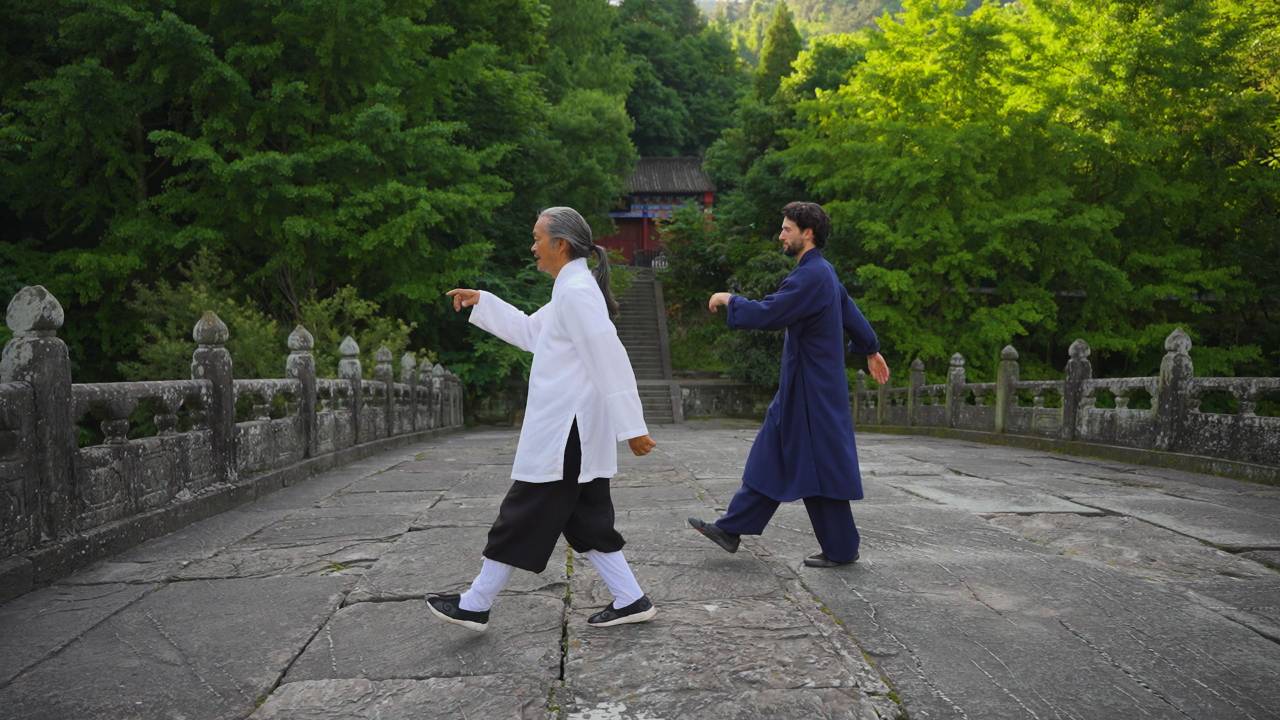
Walking is something we do every day without much thought, yet what if each step could become a meditation? Tai chi walking transforms this ordinary activity into an extraordinary practice that cultivates balance, strengthens your qi, and brings the wisdom of ancient Taoist movement into modern life. Whether you're new to tai chi or looking to deepen your understanding, learning tai chi walking for beginners step by step opens a doorway to mindful movement that goes wherever you go. This gentle practice doesn't require special equipment or a studio, just your awareness, your breath, and a willingness to slow down.
What Makes Tai Chi Walking Different
Tai chi walking isn't just slow walking. It's a deliberate practice rooted in the principles of weight transfer, grounding, and internal energy cultivation. While regular walking often happens on autopilot, tai chi walking brings conscious awareness to every shift of weight, every placement of the foot, every breath.
The core differences include:
- Intentional weight shifting between feet, never rushing the transition
- Rooted connection with the earth through each step
- Coordinated breathing that follows the rhythm of movement
- Soft, relaxed joints rather than locked knees or stiff ankles
- Mindful awareness of internal sensations and energy flow
This practice emphasises a complete weight transfer from one leg to the other, creating what practitioners call "substantial" and "insubstantial" legs. The substantial leg bears all your weight while the insubstantial leg becomes light, ready to move. This fundamental principle appears throughout tai chi forms.
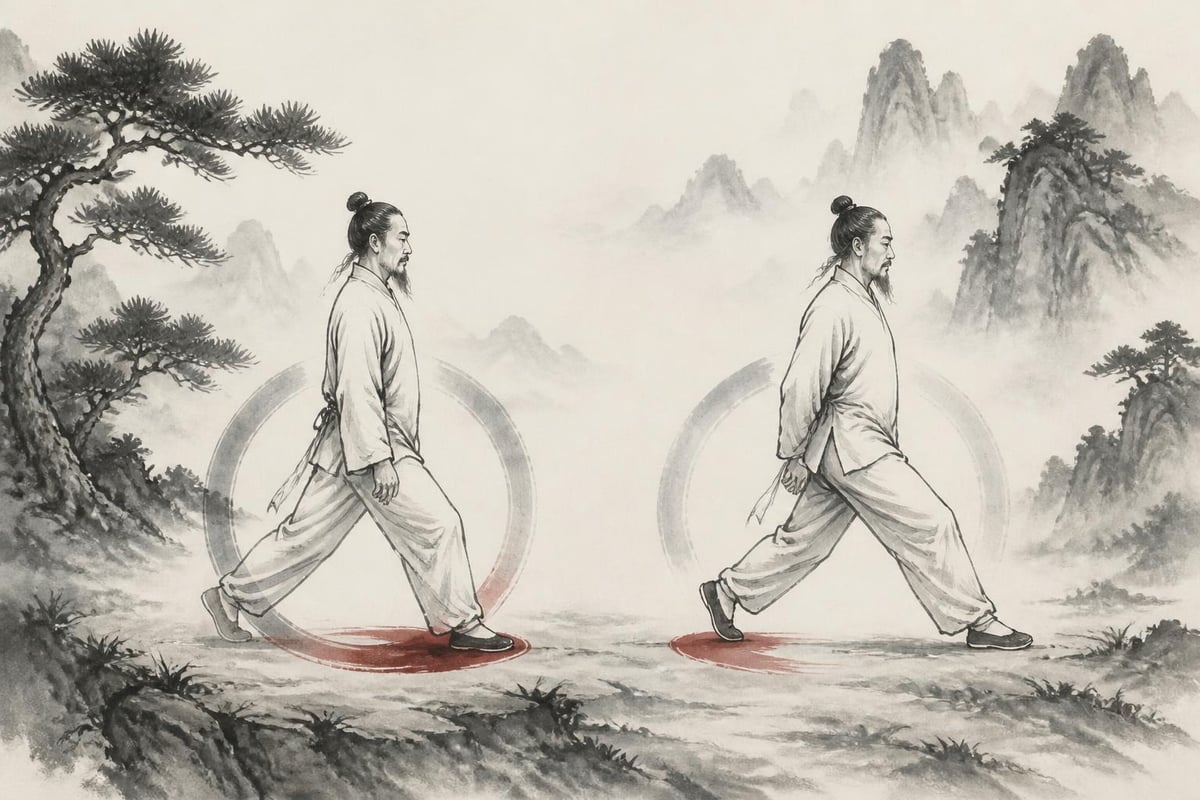
Your body learns to move from your centre, not from your limbs. This shifts how you experience walking entirely.
The Foundation: Posture and Alignment
Before taking your first tai chi step, you need proper alignment. Stand with feet shoulder-width apart, knees slightly bent, never locked. Your spine lengthens gently upward while your tailbone drops slightly down, creating space in your lower back.
Key alignment points:
- Crown of head suspended as if held by a gentle string
- Shoulders relaxed and dropped away from ears
- Chest soft, not puffed out
- Hip joints open and relaxed
- Weight distributed evenly across both feet
This standing posture forms what our Tai Chi course calls "wuji stance" - the state of emptiness before movement begins. From this neutral position, you're ready to explore tai chi walking for beginners step by step with proper foundation.
George and Master Gu walk through everything you need to know in the Wudang Mountains in the video below.
Step-by-Step Tai Chi Walking Practice
Let's break down the actual mechanics of tai chi walking. These steps might feel awkward at first, that's completely normal. Your body is learning a new language of movement.
Step One: Establish Your Starting Position
Begin in wuji stance with feet parallel, shoulder-width apart. Breathe naturally. Feel the ground beneath both feet equally. Let your awareness settle into your lower abdomen, about two inches below your navel. This area, called the dantian in Taoist practice, serves as your centre of gravity and energy.
Take three deep breaths here. Notice any tension and consciously release it.
Step Two: Shift Your Weight Completely
This is where tai chi walking diverges from regular walking. Slowly shift all your weight onto your left leg. Take your time, this isn't a race. Your right leg should become completely empty of weight, though your right foot remains lightly touching the ground.
Common mistakes to avoid:
- Rushing the weight shift
- Keeping weight split between both legs
- Leaning your upper body instead of shifting from your centre
- Holding your breath during the transition
This weight transfer should feel like water slowly pouring from one vessel to another. Smooth, continuous, complete.
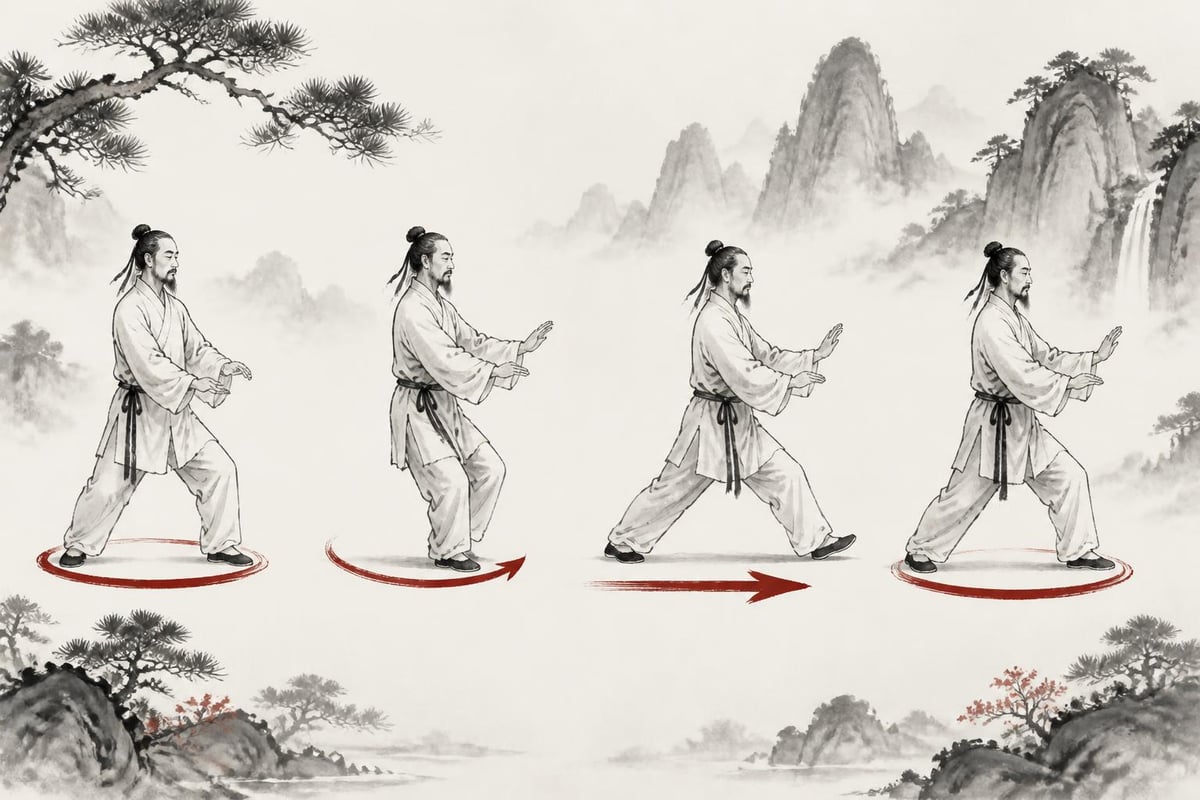
Step Three: Lift and Step Forward
With all weight on your left leg, allow your right foot to become light enough to lift naturally. Raise it just an inch or two off the ground. Step forward with your heel touching down first, toes pointing slightly upward.
Your heel lands softly, not with a thud. The entire foot rolls down gradually as you begin transferring weight forward. This heel-to-toe roll mimics how babies naturally walk before they learn tension and hurry.
Step Four: Complete the Weight Transfer
Once your right foot is fully on the ground, begin the slow process of shifting your weight forward. Your back (left) leg gradually empties while your front (right) leg fills. Your torso remains upright throughout, no leaning forward or backward.
When 100% of your weight rests on your right leg, your left foot becomes insubstantial, ready for the next step. Pause here briefly. Feel the stability of a single rooted leg.
Step Five: Continue the Pattern
Repeat this process with your left leg stepping forward. The pattern becomes: shift weight completely, lift empty foot, step forward with heel, roll foot down, transfer weight completely. Then again with the other side.
| Step | Action | Focus Point |
|---|---|---|
| 1 | Establish stance | Equal weight, relaxed posture |
| 2 | Shift weight fully | Complete transfer, no splitting |
| 3 | Lift and step | Heel first, controlled placement |
| 4 | Roll and transfer | Smooth weight movement forward |
| 5 | Repeat opposite | Maintain rhythm and awareness |
Breathing and Internal Awareness
Movement without breath is just exercise. Movement with breath becomes practice. As you explore tai chi walking for beginners step by step, coordinate your breathing with each phase of stepping.
Basic breathing pattern:
- Inhale as you shift weight onto your standing leg
- Exhale as you step forward and place your foot
- Inhale as you transfer weight onto your front leg
- Exhale as you settle completely into the step
This pattern isn't rigid. Some practitioners reverse it. Others use longer breath cycles. The key is consistency and naturalness. Your breath should never feel forced or strained.
Beyond breath, notice the internal sensations. Can you feel qi moving through your legs as weight transfers? Do you sense your root deepening as you settle into each step? These subtle awarenesses develop over time, especially when guided by experienced instruction from our Taoist Wellness Online community.
Developing Your Practice Routine
Start small. Five minutes of dedicated tai chi walking is more valuable than 30 minutes of distracted practice. Find a quiet space where you can walk forward 10-15 steps, turn around, and walk back.
Beginner practice structure:
- Warm-up (2 minutes): Gentle joint rotations, ankle circles, knee bends
- Standing meditation (2 minutes): Wuji stance, settling your mind
- Slow walking (5-10 minutes): Focus on one element at a time
- Integration (2 minutes): Return to standing, notice how you feel
Don't try to perfect everything at once. One day, focus entirely on weight shifting. Another day, bring attention to your heel placement. Another, work with your breathing. This focused approach builds skill more effectively than trying to monitor everything simultaneously.
Common Challenges and Solutions
Every beginner encounters obstacles when learning tai chi walking for beginners step by step. These challenges aren't signs of failure, they're part of the learning process.
Balance and Stability Issues
Standing on one leg while moving slowly activates muscles you rarely use. Your standing leg might shake or feel unstable. This improves with practice.
Solutions:
- Practise weight shifting while holding a wall or chair for support
- Shorten your steps initially
- Strengthen your stance through standing meditation
- Don't fully lift your stepping foot until balance improves
Mental Restlessness
Your mind might rebel against moving this slowly. Thoughts race. Boredom arises. You want to speed up, check your phone, do something "productive." This restlessness is actually what the practice addresses.
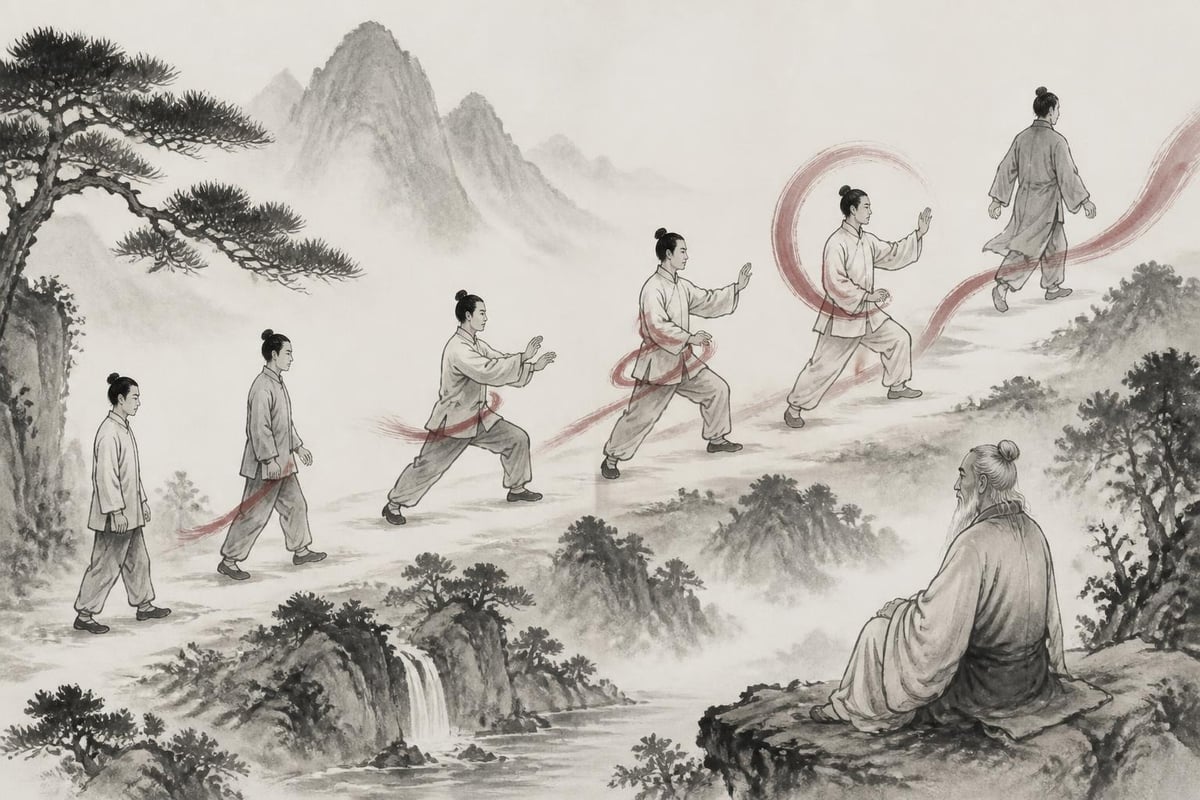
Stay with the discomfort. Each slow step trains your mind to be present. Over time, what felt tediously slow becomes rich with sensation and awareness.
Physical Tension
You might notice yourself holding tension in shoulders, jaw, or hands while concentrating on your feet. This defeats the purpose of tai chi's relaxed power.
Release points to check:
- Jaw unclenched, tongue resting gently on upper palate
- Shoulders dropped and wide
- Hands soft, fingers naturally curved
- Belly relaxed, not held tight
- Face peaceful, not frowning in concentration
Integrating Tai Chi Walking Into Daily Life
Once you've practised the fundamentals, tai chi walking doesn't need to stay confined to formal practice sessions. The principles can infuse your everyday walking with greater awareness and energy cultivation.
When walking to your car, try one block of tai chi walking. When walking your dog, practise a few steps here and there. When pacing while thinking, slow down and bring tai chi principles into your movement. Our Tai Chi Indoor Walking guide explores how to bring this practice into smaller spaces, such as your own home.
This integration helps you understand that tai chi isn't something separate from life, it's a way of moving through life with greater presence and vitality. The wisdom found in our broader Taoist philosophy course teaches that practice and daily living aren't separate realms but one continuous flow.
Deepening Your Understanding
As your basic tai chi walking improves, you can explore more subtle layers. Advanced practitioners work with specific visualisations, imagining roots growing from their feet, feeling energy rising up their spine, sensing the space around them as they move through it.
You might experiment with different speeds. Some days walk as slowly as possible, taking a full minute for each step. Other times, find a moderate pace that you can maintain for longer distances. Each speed reveals different insights about your body and energy. Our Tai Chi Walking Explained article covers a useful 10-minute routine if you'd like a structured way to explore this.
Progressive skill development:
| Beginning Level | Intermediate Level | Advanced Level |
|---|---|---|
| Basic weight shifting | Smooth, continuous flow | Energy cultivation throughout |
| Conscious foot placement | Natural breath integration | Walking meditation in any environment |
| 5-10 minute sessions | 15-30 minute sessions | Seamless daily integration |
| Need quiet space | Can practise with mild distractions | Maintain centre in any conditions |
Consider exploring how tai chi walking relates to other practices. Many students find that it naturally complements our Qi Gong course and deepens their overall understanding of energy work. The foundational principles you're developing through walking appear throughout all tai chi forms and Taoist movement practices.
Learning From Authentic Sources
While articles and videos provide helpful starting points, nothing replaces guidance from experienced teachers who've spent years refining these practices. The nuances of weight transfer, the subtleties of breath coordination, the internal aspects of qi cultivation, these elements emerge more fully when you have skilled instruction.
Programmes that offer structured progression, community support, and access to authentic lineage teachers provide the foundation for genuine skill development. When you're ready to move beyond basic tai chi walking for beginners step by step and explore the full depth of tai chi practice, working with masters who understand both the physical and energetic dimensions makes all the difference.
Our free 7-Day Tai Chi Walking course includes teachings directly from Master Gu, whose 25+ years of experience brings authentic Wudang tradition to students worldwide. This kind of direct transmission from teacher to student has preserved these practices for generations.
Your First Week of Practice
Here's a simple plan for your first seven days of tai chi walking practice. Consistency matters more than duration.
Day 1-2: Focus only on standing posture and weight shifting in place. Don't walk yet. Just shift your weight slowly from left to right, feeling the complete transfer.
Day 3-4: Add stepping. Take three steps forward, pause, turn around, take three steps back. Repeat for 5 minutes. Focus on heel placement.
Day 5-6: Introduce breathing coordination. Maintain the same short walking pattern but add conscious breath awareness with each step.
Day 7: Extend your practice to 10 minutes. Walk continuously, integrating everything you've learned. Notice what feels natural now compared to day one.
Remember that learning tai chi walking for beginners step by step is exactly that, a step-by-step process. Some elements will click immediately. Others might take weeks or months to feel natural. Both timelines are perfectly fine. Your body is learning a new way of being, and that takes the time it takes.
The transformation happens not in dramatic moments but in the quiet accumulation of mindful steps, one after another, day after day. Each step roots you more deeply in the present moment. Each breath connects you more fully with your body's innate wisdom. Each practice session builds the foundation for a lifetime of mindful movement.
Tai chi walking offers a practical entry point into ancient movement wisdom that transforms how you move through the world. By learning tai chi walking for beginners step by step, you're not just developing a new skill, you're cultivating a relationship with your body, breath, and energy that extends into every aspect of life. If you're ready to deepen your practice with authentic guidance from Master Gu and connect with a global community of dedicated practitioners, explore what Taoist Wellness Online offers through comprehensive courses in tai chi, qi gong, and Taoist philosophy. Your journey toward balanced, mindful movement begins with a single conscious step.