Is Daoism a Religion? Understanding the Sacred Path
Oct 07, 2026
The question "is Daoism a religion" has sparked thoughtful debate among scholars, practitioners, and seekers for generations. This isn't simply an academic curiosity. How we answer shapes our understanding of one of humanity's most enduring wisdom traditions. The confusion arises because Daoism encompasses both a profound philosophical framework for living in harmony with nature and an organised system of temples, rituals, and devotional practices. Rather than choosing one answer, we might discover that the question itself invites us into a deeper understanding of what makes a tradition sacred.
The Origins and Evolution of Daoism
Daoism emerged in ancient China more than 2,500 years ago, rooted in observations of nature's patterns and the fundamental forces governing existence. The earliest expressions appeared in classical texts like the Tao Te Ching and the Zhuangzi, written between the 6th and 4th centuries BCE. These foundational works emphasised living in accordance with the Dao (the Way), cultivating naturalness, and embracing simplicity.
The tradition developed along interconnected streams:
- Philosophical Daoism (Daojia): focused on contemplative wisdom, personal cultivation, and understanding the nature of reality
- Religious Daoism (Daojiao): organised around temples, priests, rituals, deities, and communal worship
- Folk practices: woven into daily life through festivals, healing arts, and ancestor veneration
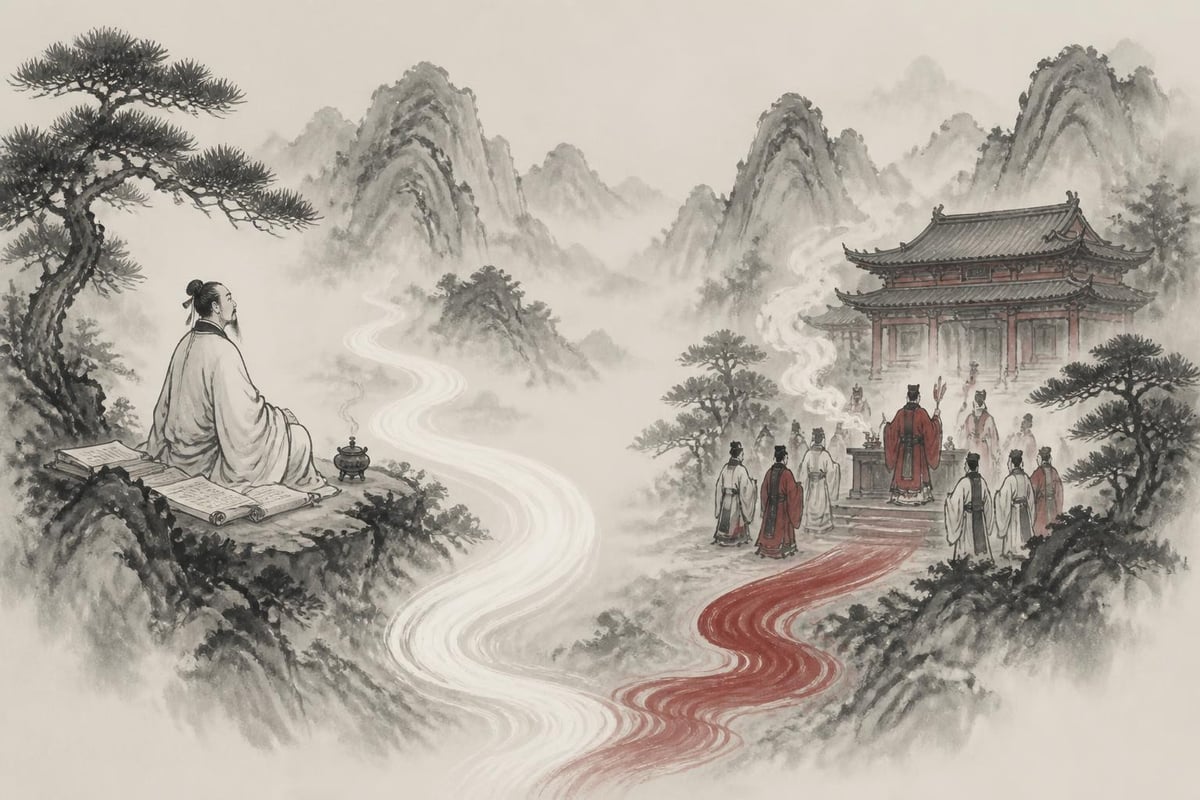
Over centuries, these streams wove together, influencing one another while maintaining distinct characteristics. The Han Dynasty (206 BCE - 220 CE) witnessed Daoism's transformation into an organised religious movement with established clergy, liturgy, and institutional structures. Masters developed complex cosmologies, meditation techniques, and alchemical practices aimed at spiritual transformation and longevity.
If you'd like to trace these roots in more depth, our article on Origin of Taoism: Ancient Roots of a Living Tradition follows the story from Laozi through to the first organised Taoist communities.
Master Gu explains why the word "Taoism" carries two different meanings in the short video below.
What Makes Something a Religion?
Before we can meaningfully ask "is Daoism a religion", we need clarity about what defines religious practice. Western academic frameworks typically identify several key elements:
| Religious Element | Traditional Definition | How It Appears in Daoism |
|---|---|---|
| Sacred texts | Authoritative scriptures | Daozang canon with 1,400+ texts |
| Organised clergy | Ordained religious leaders | Daoist priests and monastics |
| Ritual worship | Ceremonial practices | Elaborate temple ceremonies |
| Deities/supernatural | Gods or transcendent beings | Pantheon of immortals and spirits |
| Community gathering | Congregational practice | Temple festivals and gatherings |
| Moral framework | Ethical guidelines | Precepts and virtue cultivation |
The challenge lies in applying Western religious categories to traditions that developed within entirely different cultural contexts. Chinese civilisation didn't historically separate "religion" from philosophy, medicine, art, or statecraft in the way European thought categorised knowledge.
The Philosophical Dimension
When people question "is Daoism a religion", they often envision the contemplative, philosophical approach found in the classical texts. This stream emphasises direct personal experience over dogma or belief.
The Tao Te Ching presents a vision of existence flowing from an unnamed source, the Dao, which cannot be captured in concepts or words. Its 81 short chapters offer guidance for leaders, insights into human nature, and reflections on how to live with grace. Nothing demands belief in supernatural forces or participation in ritual.
Zhuangzi's writings take a more playful approach, using paradoxical stories and humour to dissolve rigid thinking. His famous butterfly dream questions the nature of reality itself. These philosophical texts invite readers into direct inquiry rather than religious conversion. Our article on Zhuangzi: Ancient Wisdom for Modern Balance explores how his stories still speak to everyday life.
Core philosophical principles include:
- Wu wei (effortless action aligned with natural flow)
- Ziran (spontaneous naturalness)
- Pu (returning to uncarved simplicity)
- Relativism and perspective-shifting
- Embracing change and transformation
Many contemporary practitioners engage Daoism primarily through these philosophical teachings, applying them to modern life without participating in religious ceremonies. They practise Tai Chi, study the classics, and cultivate inner stillness through meditation - all without identifying as religiously Daoist.
For students who would like to explore these ideas through authentic teaching, our Taoist Philosophy course offers practical wisdom for navigating contemporary challenges with greater ease and clarity.
The Religious Dimension
Religious Daoism presents organised structures, devotional practices, and communal worship that clearly align with conventional religious definitions. Temples dedicated to various deities dot the Chinese landscape, staffed by ordained priests who perform elaborate ceremonies.
Ritual and Ceremony
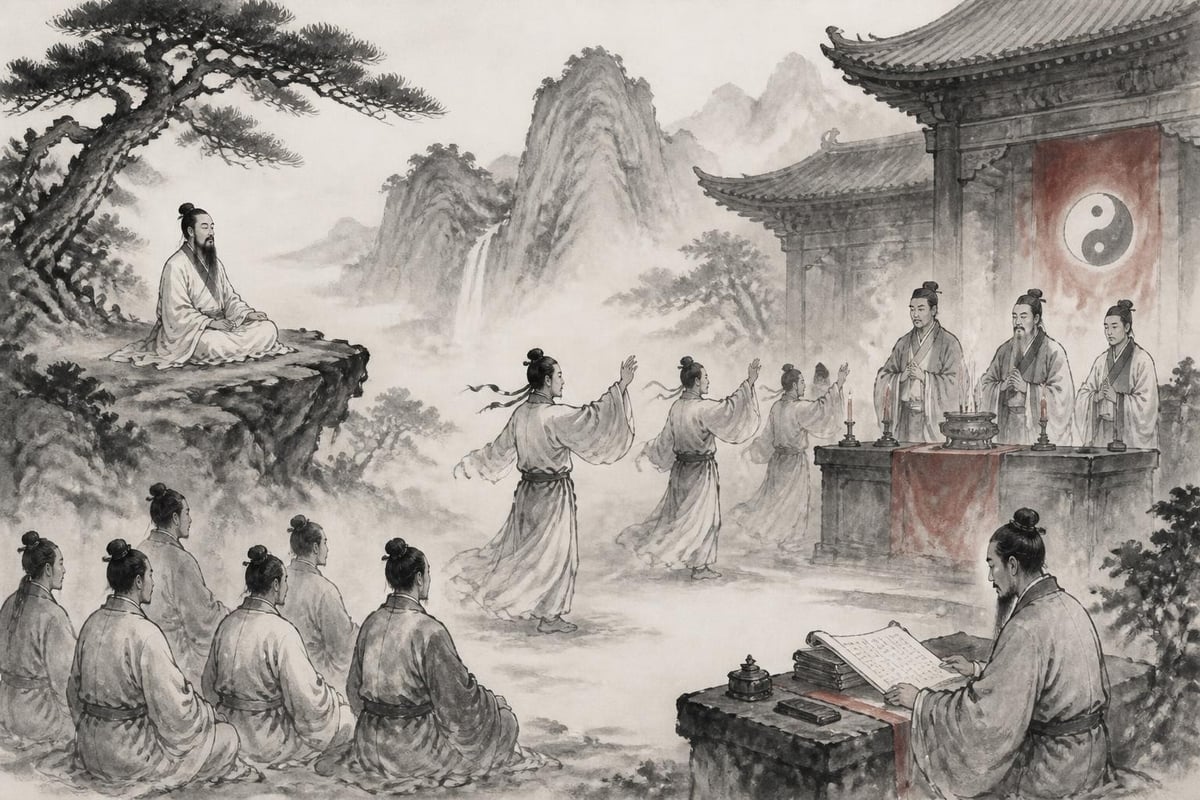
Daoist religious practice encompasses a rich ceremonial life. Priests conduct rituals for healing, blessing, protection, and harmonising cosmic forces. The Jiao (offering) ceremony can last multiple days, involving intricate movements, chanted scriptures, and offerings to celestial bureaucracies of deities.
These rituals serve practical purposes: ensuring good harvests, protecting communities from illness, guiding deceased ancestors, and maintaining cosmic balance. Participants seek divine assistance through prayer, offerings, and adherence to moral precepts.
The Daoist Pantheon
Religious Daoism recognises a vast array of spiritual beings organised into hierarchies mirroring imperial bureaucracy. The Three Pure Ones occupy the highest celestial realm, while immortals, local deities, and ancestral spirits fill intermediate positions.
Practitioners develop relationships with specific deities through devotion, offerings, and requests for guidance or assistance. This polytheistic framework clearly distinguishes religious Daoism from its philosophical counterpart.
Monastic Communities
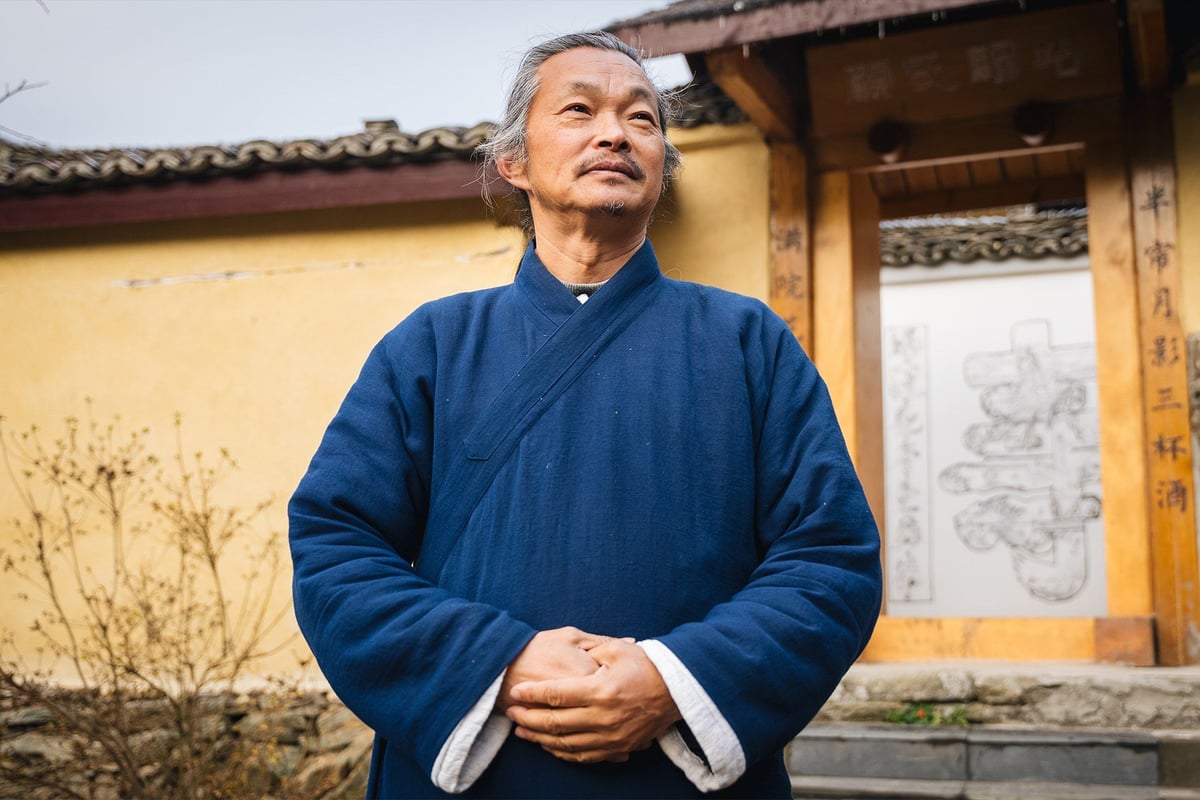
Daoist monasteries, particularly on sacred mountains like Wudang, maintain continuous traditions of training and practice. Monks and nuns dedicate their lives to cultivation, ritual mastery, and preserving lineage teachings. Master Gu, who teaches authentic Wudang traditions, represents this unbroken transmission of knowledge passed through generations.
Integration of Practice and Belief
The question "is Daoism a religion" becomes more nuanced when we recognise how philosophical and religious elements interweave in actual practice. Many Daoist practitioners don't experience these as separate categories requiring choice.
Someone might study the Tao Te Ching for philosophical insight while also participating in temple festivals. They practise Qi Gong for health while honouring the immortals who developed these techniques. The boundaries modern scholars draw may not reflect lived experience.
Common integrated practices include:
- Internal alchemy (Neidan): meditation techniques for spiritual transformation
- Tai Chi and Qi Gong: movement arts cultivating vital energy
- Dietary practices: eating in harmony with seasons and elemental theory
- Feng shui: arranging space according to energy flow
- Traditional medicine: herbal formulas and acupuncture rooted in Daoist cosmology
These practices resist simple categorisation as purely religious or philosophical. They emerge from a worldview where energy, spirit, and matter form a unified whole. The Qi Gong practices taught in traditional lineages blend physical exercise, meditation, and cultivation of subtle energies in ways that transcend Western distinctions.
Cultural Context and Western Categories
Much of the confusion about "is Daoism a religion" stems from imposing Western categorical thinking onto Chinese traditions. The Chinese language historically lacked a direct equivalent to the Western concept of "religion" as a distinct sphere of life.
When Jesuit missionaries arrived in China during the 16th century, they struggled to classify what they encountered. Was Confucianism a religion or ethical philosophy? Were ancestor practices religious worship or cultural respect? These questions reflected European assumptions rather than Chinese self-understanding.
| Western Framework | Chinese Approach |
|---|---|
| Religion vs. philosophy | Integrated cultivation of self and society |
| Sacred vs. secular | Continuity between realms |
| Belief-centred | Practice-centred |
| Institutional affiliation | Flexible participation |
| Exclusive identity | Multiple simultaneous identities |
Modern Chinese people frequently participate in Buddhist, Daoist, and Confucian practices without seeing contradiction. They might visit a Buddhist temple for one purpose, consult a Daoist priest for another, and uphold Confucian family values - all while identifying primarily as culturally Chinese rather than religiously anything.
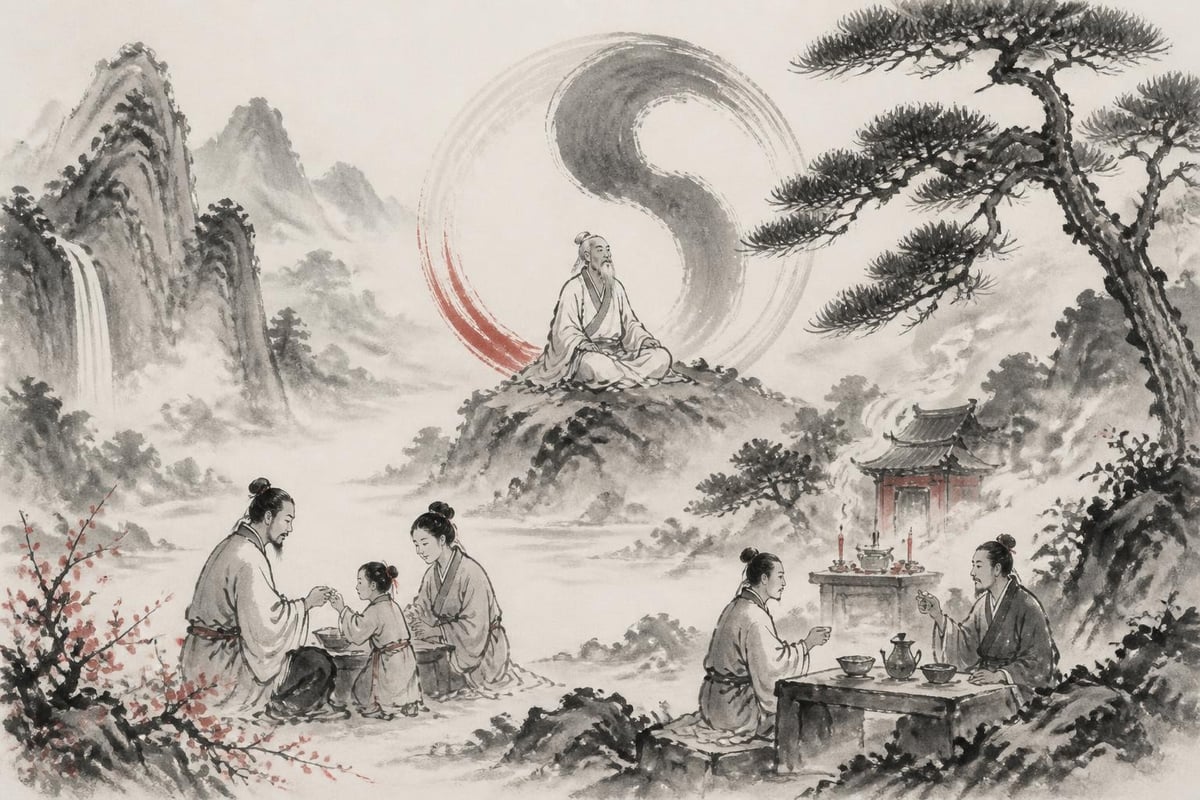
This flexible approach challenges Western assumptions about religious identity requiring exclusive commitment to one tradition. When we ask "is Daoism a religion", we might be asking the wrong question - or at least one shaped by cultural assumptions foreign to the tradition itself.
Contemporary Perspectives and Global Practice
As Daoism spreads globally, new contexts reshape how people engage the tradition. Western practitioners often gravitate toward philosophical teachings and cultivation practices while remaining less connected to religious institutions.
Modern Academic Perspectives
Scholars generally acknowledge that both dimensions exist and matter. The term "Daoism" encompasses philosophical inquiry, religious practice, and everything in between.
The question "is Daoism a religion" receives various scholarly answers depending on which aspect receives focus. Many contemporary academics conclude that Daoism functions as both philosophy and religion, with the balance shifting across time, region, and individual practice.
Global Adaptation
Outside China, Daoism manifests primarily through:
- Wellness practices: Tai Chi, Qi Gong, and meditation taught for their wellbeing benefits
- Philosophical study: Reading groups exploring classical texts
- Martial arts: Internal martial arts rooted in Daoist principles
- Alternative healing: Acupuncture, herbalism, and energy work
- Spiritual exploration: Seeking wisdom beyond conventional religion
Many Western students discover Daoism through Tai Chi training, initially approaching it as exercise before encountering deeper philosophical and spiritual dimensions. This gateway often leads to broader engagement with the Daoist worldview and practices.
The community of global practitioners brings diverse perspectives, creating new expressions while honouring traditional roots.
Living the Question
Rather than definitively answering "is Daoism a religion", perhaps the tradition invites us to hold the question with openness. Daoism itself teaches us to embrace paradox, recognise multiple perspectives, and avoid rigid categorisation.
For some practitioners, Daoism functions as their primary religious identity, complete with devotional practices, ritual observance, and community belonging. For others, it offers philosophical wisdom and practical techniques without religious commitment. Many experience something in between - a spiritual path that nourishes without requiring conventional religious belief.
The tradition accommodates all these approaches because:
- It emphasises direct experience over doctrinal belief
- It values naturalness and individual authenticity
- It recognises the limitations of language and concepts
- It welcomes multiple valid perspectives
- It focuses on transformation rather than conversion
Your own relationship with Daoism needn't conform to external definitions. What matters most is authentic engagement - studying the teachings, practising the arts, cultivating inner stillness, and living in greater harmony with the natural world.
Whether you approach Daoism as religion, philosophy, wellness practice, or something uniquely your own, the path offers genuine richness. The ancient wisdom remains remarkably relevant for modern challenges: finding balance in chaotic times, moving with rather than against life's currents, and discovering peace within change.
Those seeking to explore these teachings through authentic transmission can benefit from structured learning that honours traditional lineage while remaining accessible to contemporary students. If you'd like a gentle place to start, our free Taoist course introduces Tai Chi, Qi Gong, Meditation, and Taoist Wisdom, step by step.
The Personal Path Forward
Ultimately, asking "is Daoism a religion" matters less than discovering what the tradition offers your own life. The classical texts, cultivation practices, and wisdom teachings remain available regardless of how we categorise them.
If philosophical inquiry calls you, explore the Tao Te Ching and Zhuangzi. If you feel drawn to community and ritual, you might look for a temple or spiritual centre near you. If physical cultivation attracts you, begin practising Tai Chi or Qi Gong from authentic sources that maintain traditional integrity.
The beauty of Daoism lies in its flexibility and inclusiveness. You needn't reject other spiritual paths or adopt an exclusive religious identity. You needn't believe in deities to benefit from the philosophy. You needn't become a monk to practise cultivation.
Practical entry points include:
- Daily meditation or quiet contemplation
- Learning Tai Chi or Qi Gong movements
- Reading and reflecting on classical texts
- Observing nature's patterns and seasons
- Simplifying your life and reducing excess
- Practising wu wei in daily activities
If you're new to Tai Chi or Qi Gong, or you have an existing health condition or injury, please check with your healthcare professional before starting a new movement practice.
Each person's journey unfolds differently. Some dive deep into one aspect while others sample broadly. The tradition supports both approaches, recognising that the Dao manifests through infinite expressions.
The question "is Daoism a religion" ultimately invites self-reflection: What are you seeking? What does spiritual practice mean to you? How do ancient wisdom traditions speak to contemporary life? Your answers shape your path more than academic definitions.
Whether Daoism qualifies as a religion depends partly on definition and partly on perspective, but its value transcends categorisation. The tradition offers profound wisdom, time-tested practices, and a path toward balance and inner peace. If you're ready to explore authentic Daoist teachings through Wudang Tai Chi, Qi Gong, and meditation practices, Taoist Wellness Online provides comprehensive training with Master Gu, a 15th-generation San Feng Pai Wudang Taoist Master with 25+ years of teaching experience, helping students worldwide. Begin your journey today and discover how these ancient practices can enrich your modern life.