Dantian: Your Body's Energy Center Explained
Oct 06, 2026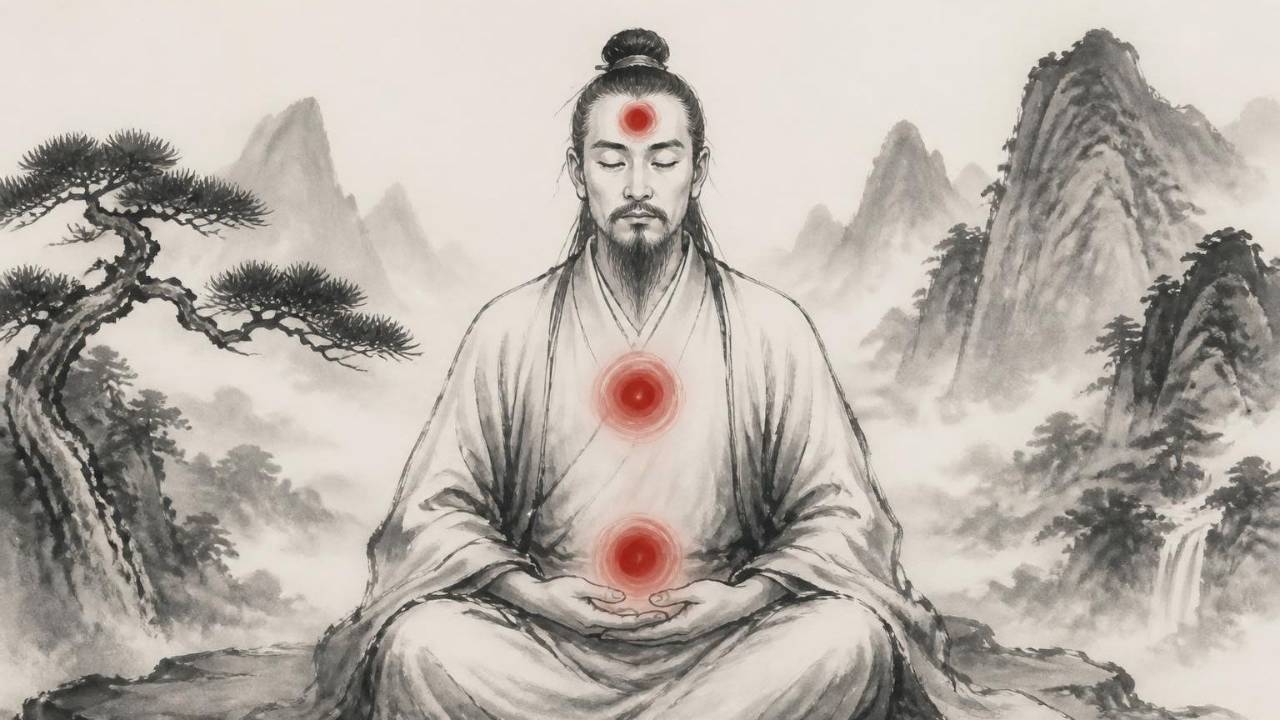
When you first begin exploring Tai Chi or Qi Gong, you'll quickly come across a term that sounds both mysterious and essential: dantian. This ancient concept isn't just theoretical philosophy. It's a practical gateway to understanding how energy moves through your body, how to ground yourself when life feels chaotic, and how to reconnect with a deeper sense of vitality that many of us have forgotten is there. The dantian sits at the heart of nearly every authentic Taoist practice, from the flowing movements of Wudang Tai Chi to the still, focused breathing of meditation.
What Is the Dantian?
The word dantian literally translates as "elixir field" or "cinnabar field", a poetic nod to the alchemical tradition within Taoism. The characters 丹田 appear throughout classical Taoist texts, pointing to specific areas of the body where vital energy, or qi, gathers and transforms.
Think of the dantian as your body's power station. It's where you store energy, where movement is generated, and where you return to find balance when everything else feels scattered.
The Three Dantian Centres
Traditional Taoist teaching describes three main dantian centres, each with its own qualities and purpose:
- Lower Dantian (Xia Dantian): Located roughly three finger-widths below your navel and deep inside your abdomen, this is your main energy reservoir and the foundation of physical vitality
- Middle Dantian (Zhong Dantian): Situated at the heart centre in the middle of your chest, this is associated with emotional balance and connection
- Upper Dantian (Shang Dantian): Found between and slightly above your eyebrows (often called the "third eye"), this relates to awareness, intuition and spiritual cultivation
For most practical purposes in Tai Chi and Qi Gong, when we say "dantian" on its own, we mean the lower dantian. This is your centre of gravity, your root, your source.
In this conversation, George sits down with Qi Gong teacher and author Ken Cohen to explore the three dantian and how they relate to Jing, Qi and Shen.
Why the Lower Dantian Matters
In Wudang Tai Chi and Qi Gong, the lower dantian acts as the organising principle for all movement. When you learn to move from this centre rather than from your shoulders, arms or head, everything begins to shift.
Your movements become more efficient. Your balance can improve. You feel more grounded, even when life tries to knock you off course.
Physical Benefits of Dantian Awareness
Working with your lower dantian is associated with a range of physical benefits. Many students notice:
- Better posture and spinal alignment, as the body naturally organises itself around its centre of gravity
- Greater balance and stability, which can be especially valuable as we age
- Less tension in the shoulders and neck, because movement is no longer being driven from these areas
- Deeper, more efficient breathing that engages the whole abdominal region
- Improved coordination, as the limbs move in relationship to a stable core
Because the lower dantian sits so close to the deep muscles of the core, this work pairs naturally with gentle strengthening. Our article on Tai Chi Stomach Exercises: Strengthen Your Core Naturally explores how Tai Chi supports the core without strain.
Studies exploring meditation and brain connectivity suggest that practices which focus attention on specific areas of the body may be associated with measurable changes in how the brain functions. While this research doesn't look at the dantian specifically, it echoes what practitioners have long observed: where you place your attention matters.
How to Locate Your Lower Dantian
Finding your lower dantian isn't about precise anatomical measurement. It's about developing a felt awareness of an area inside your body.
If you have an existing health condition, are pregnant, or are recovering from an injury or abdominal surgery, please check with your healthcare professional before starting any new breathing or standing practice.
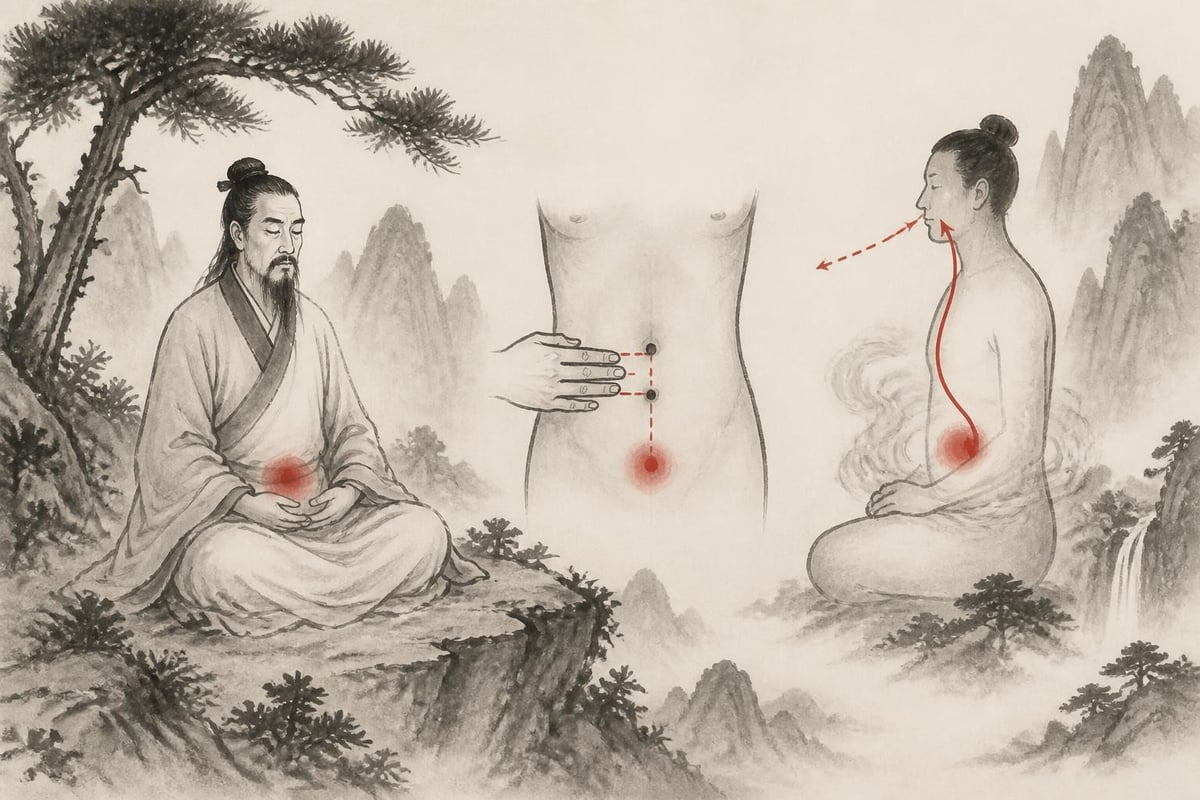
Here's a simple way to begin:
Step 1: Stand comfortably with your feet shoulder-width apart and your knees slightly soft.
Step 2: Place one hand palm-down on your lower abdomen, about three finger-widths below your navel.
Step 3: As you breathe naturally, imagine the breath travelling down to this area. Don't force anything - just notice.
Step 4: With each exhale, let your attention settle a little deeper, not just at the surface of the skin but into the space inside your belly.
Step 5: After a few minutes, remove your hand and see whether you can still sense warmth, weight, or simply awareness in that area.
This simple practice, sometimes described as "holding the dantian with the mind", appears in both traditional training and modern Qi Gong programmes. It's how the dantian begins to shift from an idea into something you actually experience. If you'd like gentle, guided support as you explore this, our free Taoist course introduces Tai Chi, Qi Gong, Meditation and Taoist Wisdom step by step.
Cultivating Dantian Energy Through Practice
Awareness is the first step. Cultivation is what follows. Inside Taoist Wellness Online, Master Gu guides students through these foundational skills using authentic Wudang practices.
Dantian Breathing
This foundational technique appears across Taoist practice and has attracted interest from researchers too. Clinical research into tanden breathing (the Japanese term for the dantian) has reported encouraging results, suggesting these traditional methods may be worth closer attention.
The basic method:
- Sit or stand comfortably with your spine naturally upright
- Rest your attention at your lower dantian
- As you inhale, imagine the breath filling this area, allowing your lower abdomen to gently expand
- As you exhale, feel your lower abdomen naturally draw inward
- Keep your chest relatively quiet - the movement happens below
The key isn't forced belly breathing. It's allowing the breath to settle naturally into your centre while keeping a gentle awareness there.
Moving from the Dantian in Tai Chi
Every authentic Wudang Tai Chi form teaches you to begin movement from your centre. Your arms don't move your body - your dantian moves your body, and your arms follow. You'll find this principle at the heart of every form in our Tai Chi course.
When you practise Cloud Hands, for example:
- Your dantian turns gently from side to side
- Your spine follows this rotation
- Your arms float through space as a result of your centre turning
- Your weight shifts naturally from leg to leg
| Movement Initiated From | Results | Energy Cost |
|---|---|---|
| Shoulders/Arms | Tension, limited range, disconnection | High |
| Dantian/Centre | Flow, whole-body integration, stability | Low |
This isn't just about how the movement looks. It's about efficiency. It's part of how people can practise for years while being kind to their joints, and why experienced masters can move with a power that seems to defy their age.
Dantian in Qi Gong Practice
Qi Gong makes the cultivation of dantian energy even more explicit. Many Wudang Qi Gong exercises specifically guide qi to gather, circulate and transform within the lower dantian. If you're curious about building this kind of practice at home, our article on Qi Gong Online: Practice Ancient Energy Cultivation at Home is a helpful next read.
Standing Meditation (Zhan Zhuang)
This deceptively simple practice involves standing still in specific postures while resting your awareness at your dantian. Over time, you may notice:
- Warmth developing in your lower abdomen
- A sense of fullness or density
- Subtle pulsing or vibration
- Deep relaxation combined with alertness
Some small studies have observed patterns of brain activity associated with stimulation of the dantian area, suggesting there may be physical changes linked to what practitioners feel. Either way, these sensations aren't the goal - they're simply signs of settling. Standing practices like this are woven throughout our Qi Gong course, so you can build them gradually.
Small Circulation (Xiao Zhou Tian)
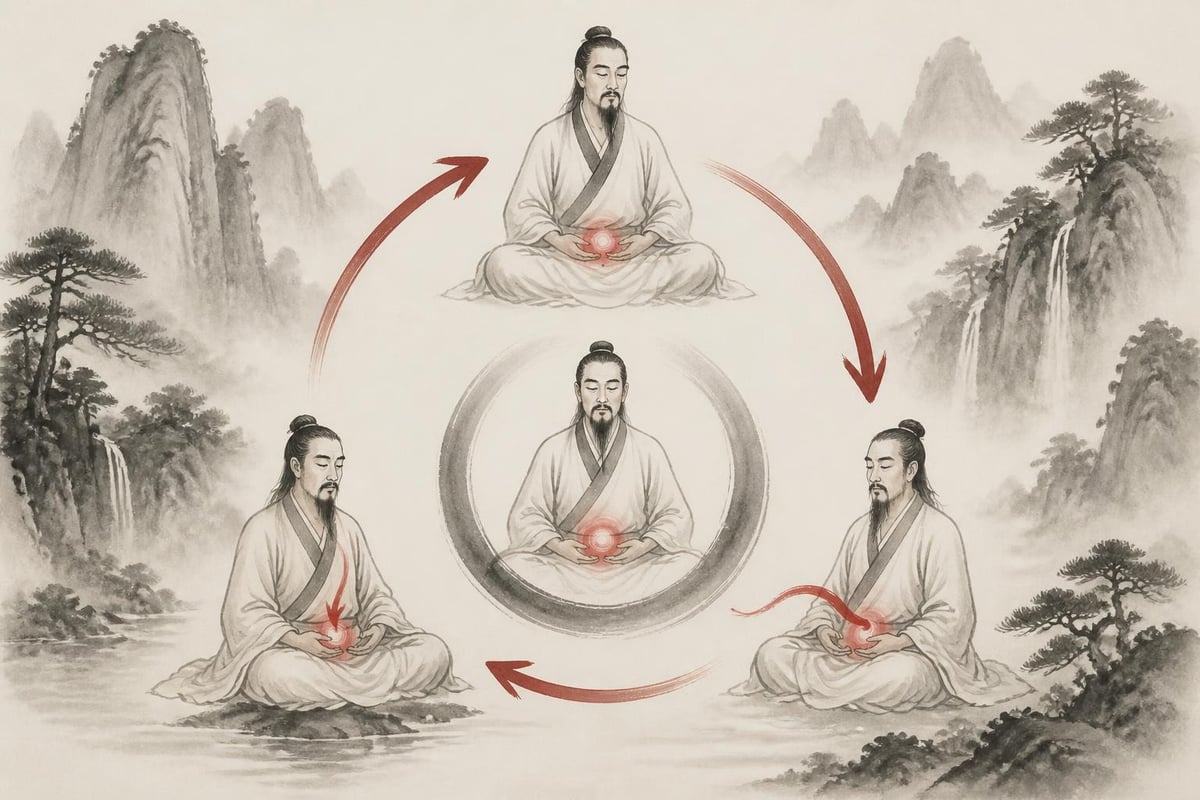
More advanced practitioners work with circulating qi along specific pathways in the body. The lower dantian is both the starting point and the return point for this circulation. This practice needs proper guidance - ideally from an experienced teacher such as Master Gu, a 15th-generation San Feng Pai Wudang Taoist Master with over 25 years of teaching experience. Even so, understanding the dantian as a reservoir helps make sense of this deeper work.
Common Challenges and How to Work with Them
Most people meet similar obstacles when they begin dantian work:
"I don't feel anything": This is completely normal at first. Feeling follows attention. Keep practising with patience, without demanding quick results.
"My mind wanders constantly": Of course it does - that's what minds do. Each time you notice it wandering, gently return to your dantian. This return is the practice.
"I feel tension when I focus there": You might be trying too hard. Softness is key. Think of your attention as resting at the dantian, not gripping it.
"Sometimes I feel something, sometimes nothing": Perfect. This variation is natural and tends to smooth out with steady practice.
Building Consistent Practice
| Frequency | Duration | Focus | What You May Begin to Notice |
|---|---|---|---|
| Daily | 10-15 min | Basic awareness | Subtle sensations, often within 2-4 weeks |
| Daily | 20-30 min | Breathing practice | Warmth or fullness, often within 1-3 months |
| Daily | 30-45 min | Integration with movement | Moving more naturally from your centre, often within 3-6 months |
These timelines vary enormously from person to person. Some people feel sensations straight away; others need months of patient practice. Both paths are completely valid.
Dantian in Daily Life
The real test of dantian work isn't how you feel during practice. It's how you move through your day.
As your dantian awareness grows, you may notice:
- Steadier balance on uneven ground, because your centre of gravity feels clearer
- More stamina during physical activity, because you're moving more efficiently
- Calmer responses to stress, because you have a physical anchor point to return to
- A clearer sense of perspective, as you learn to notice the difference between racing, anxious thoughts and a calmer, more grounded awareness
Dantian practice can be a lovely support for everyday wellbeing, but it isn't a replacement for professional care. If you're living with anxiety or ongoing stress, please reach out to your GP or a qualified mental health professional alongside your practice.
Practical Applications
You can bring dantian awareness into moments like:
- Standing in the queue at the supermarket
- Sitting in traffic
- Walking the dog
- Carrying the shopping
- Playing with children or grandchildren
- Doing household chores
Simply return your awareness to your centre. Breathe into that space. Let your body organise itself around it. This isn't separate from your life - it becomes woven into how you live.
The Philosophical Context
Within Taoist philosophy, the dantian represents more than physical anatomy. It's where the fundamental forces of yin and yang meet, where pre-natal and post-natal qi come together, and where essence (jing) stored in the kidneys is transformed into vitality (qi) and eventually into spirit (shen).
This alchemical language might sound esoteric, but it points to something practical. The lower abdomen is where digestion happens, where reproduction originates, and where the deep core muscles help stabilise the spine. Ancient Taoists recognised the importance of this region long before modern anatomy textbooks did.
When you work with your dantian, you're joining a tradition that has refined these practices over centuries. You're also simply learning to pay attention to a part of your body that modern culture tends to overlook in favour of the head.
Integration with Other Practices
The dantian isn't isolated from the rest of Taoist practice. It works hand in hand with:
- Breath regulation: The dantian naturally becomes the focus of deeper, more abdominal breathing
- Mindfulness: Returning attention to the dantian trains concentration and present-moment awareness
- Movement arts: Tai Chi and Qi Gong both use the dantian as the starting point for coordinated, whole-body movement
- Meditation: Many Taoist meditation techniques begin by settling awareness at the lower dantian before moving on to other practices
If stillness is where you'd like to take this next, our Taoist Meditation course returns to the dantian again and again as a central reference point.
Learning with Guidance
While you can begin exploring dantian awareness on your own, learning from an experienced teacher helps you progress with confidence and avoid common pitfalls. Authentic Wudang training places great emphasis on good alignment, the right level of effort, and the patient building of skill over time.
Good guidance can help you:
- Understand the postural habits that can get in the way of dantian development
- Learn clear cues for relaxation and alignment
- Follow exercises suited to your current stage
- Explore questions that arise from your own experience
- Tell the difference between genuine progress and imagination
At Taoist Wellness Online, students learn through step-by-step lessons with Master Gu and George, alongside a monthly live session and Q&A. The community matters too. Practising alongside others, sharing experiences and receiving encouragement all help your practice keep growing.
Continuing Your Exploration
Understanding the dantian intellectually is only the beginning. It becomes meaningful through direct, repeated practice. Start with a few minutes each day of simply resting your attention at your lower dantian while breathing naturally.
Notice what happens without judgement. Some days you'll feel warmth, fullness or subtle movement. Other days you won't feel anything in particular. Both are fine. You're gently training your nervous system to recognise and work with this centre, and that happens whether or not you feel dramatic sensations.
As your practice deepens, the dantian stops being a concept you think about and becomes a place you naturally return to. This is often when the real benefits begin to emerge: grounded stability, quiet confidence, and a reservoir of energy to draw on when you need it.
The dantian offers a practical way into the wisdom traditions of Taoism, connecting ancient understanding with your own lived experience in your body. Whether you're just beginning or looking to deepen an established practice, Taoist Wellness Online offers authentic Wudang training with Master Gu, helping students around the world develop genuine understanding through courses in Tai Chi, Qi Gong and Taoist meditation. Your journey towards balance, vitality and a more centred presence can begin today.