Taoist Wisdom for Burnout: Ancient Keys to Balance
Sep 15, 2026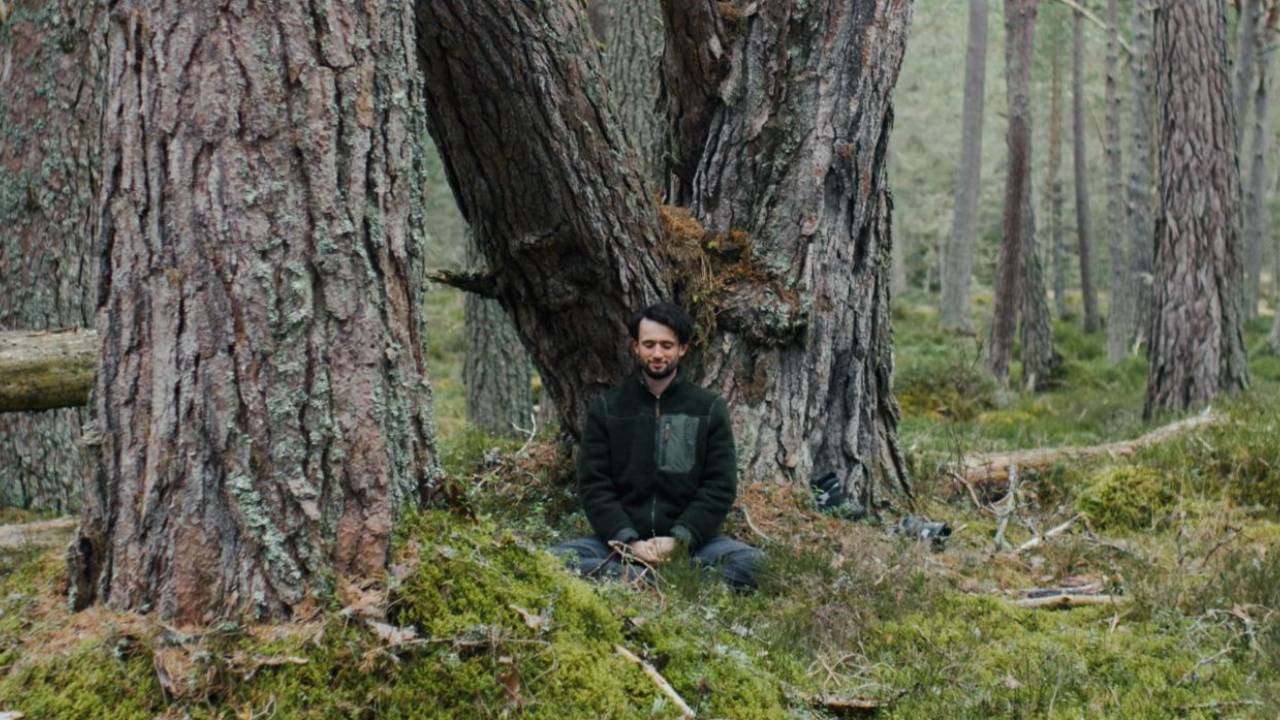
Burnout has become one of the defining struggles of modern life. We push harder, work longer, and expect ourselves to maintain impossible standards until our bodies and minds finally refuse to cooperate. The exhaustion runs deeper than tiredness. It settles into our bones, clouds our thinking, and disconnects us from the simple joy of being alive. While contemporary solutions often add more tasks to our already overwhelmed schedules, taoist wisdom for burnout offers a different path entirely. These ancient teachings don't ask you to do more. They invite you to flow differently, to align with natural rhythms rather than fight against them, and to find restoration through presence instead of productivity.
Understanding Burnout Through a Taoist Lens
Western culture often frames burnout as a failure of time management or personal resilience. We're told to optimise, delegate, set better boundaries, or practise "self-care" by squeezing in one more activity. But taoist wisdom for burnout sees the problem differently.
The Taoists observed that nature never forces. Rivers don't push water uphill. Trees don't strain to grow. Yet everything accomplishes what it needs to without struggle. When we experience burnout, we've typically been working against our natural energy rather than with it.
The Concept of Qi Depletion
In Taoist understanding, burnout represents a severe depletion of Qi (life force energy). This isn't just metaphorical. When you ignore rest, override your body's signals, and maintain chronic stress, you literally drain your vital reserves.
Your body has different types of Qi:
- Defensive Qi protects you from illness and stress
- Nutritive Qi nourishes your organs and tissues
- Original Qi represents your inherited constitutional energy
- Gathering Qi supports respiration and circulation
Burnout happens when we continuously withdraw from these accounts without making deposits. Our Qi Gong course teaches the gentle, intentional movement that Wudang traditions use to help restore these energy reserves.
Wu Wei: The Art of Effortless Action
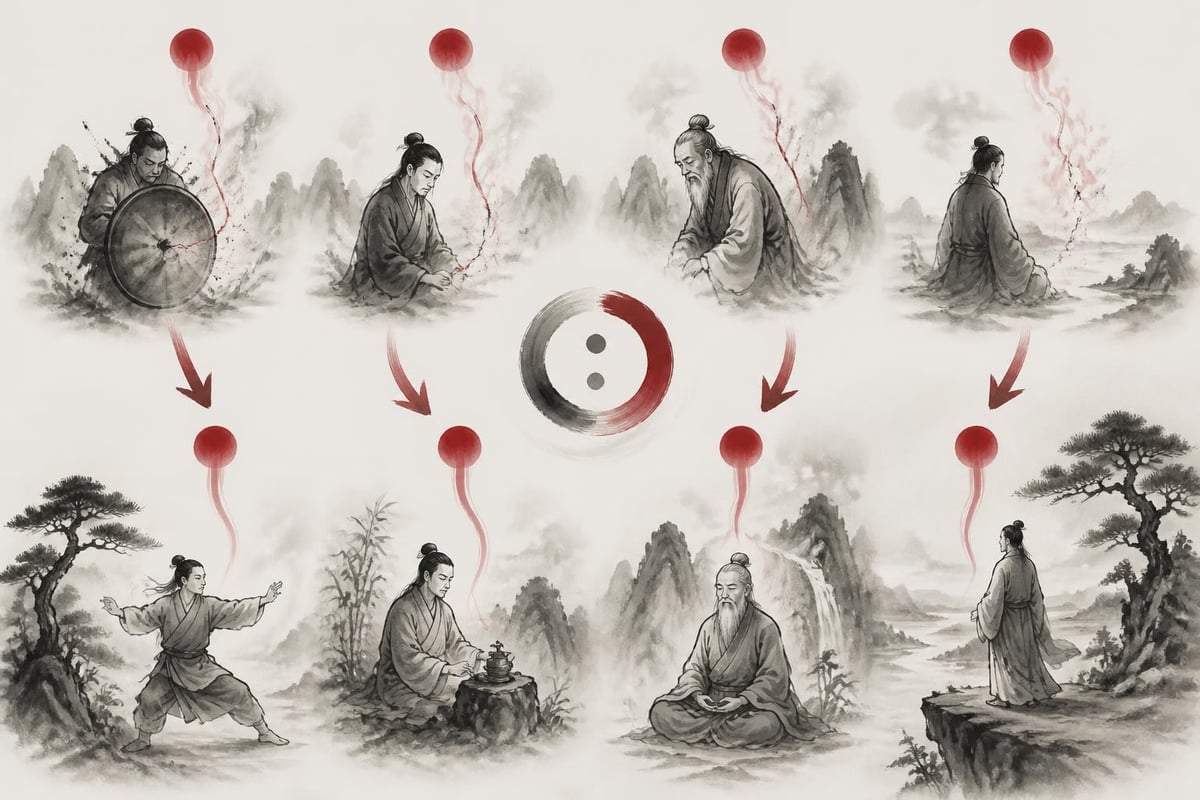
One of the most powerful applications of taoist wisdom for burnout lies in the principle of Wu Wei, often translated as "non-doing" or "effortless action." This doesn't mean laziness or giving up. It means working with the grain of reality instead of against it.
Think about swimming in the ocean. You can exhaust yourself fighting the current, or you can angle your body to work with the water's movement. Both require effort, but one depletes you while the other carries you forward.
Recognising Force Versus Flow
| Forcing (Leading to Burnout) | Flowing (Sustainable Energy) |
|---|---|
| Ignoring fatigue signals | Resting when tired |
| Maintaining rigid schedules regardless of energy | Adapting tasks to current capacity |
| Pushing through resistance | Finding natural openings |
| Judging yourself for limitations | Accepting present conditions |
When you practise Wu Wei in your daily life, you start noticing where you're creating unnecessary friction. Maybe you answer emails immediately instead of when you're mentally fresh. Perhaps you force creativity on deadline instead of capturing ideas when they naturally arise.
George explores this kind of everyday mindfulness in the video below, a gentle guide to noticing these small moments of forcing versus flowing as they happen.
Yin and Yang: Balancing Rest and Activity
The famous Yin-Yang symbol holds essential taoist wisdom for burnout. Most people think it simply means "balance," but the teaching goes deeper.
Notice that the symbol shows constant movement. The white contains a dot of black. The black contains a dot of white. Nothing is pure. Nothing is static. Health comes not from perfect 50-50 balance but from dynamic equilibrium where rest and activity flow into each other naturally.
Signs of Yin-Yang Imbalance
Excessive Yang (doing, action, productivity):
- Constant mental chatter
- Difficulty sitting still
- Insomnia or restless sleep
- Feeling wired but tired
- Irritability and impatience
Excessive Yin (withdrawal, passivity, collapse):
- Lack of motivation
- Heavy fatigue upon waking
- Social isolation
- Foggy thinking
- Low mood and disconnection
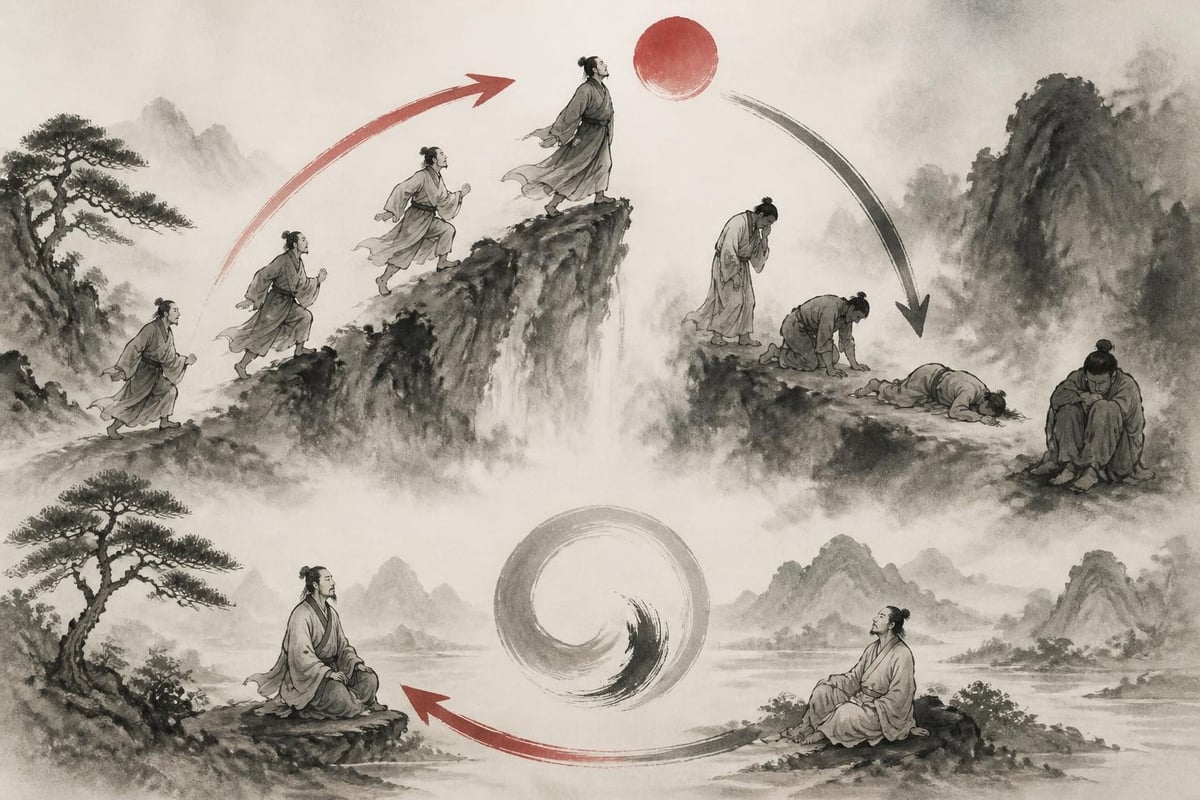
Burnout typically starts with excessive Yang. You override rest, push past limits, and ignore your body's wisdom. Eventually, the system crashes into excessive Yin, where even getting out of bed feels impossible.
Practical Taoist Approaches to Burnout Recovery
Ancient wisdom becomes powerful when we apply it to daily life. These practices draw from centuries of Wudang tradition and can begin restoring your energy immediately.
Morning Grounding Rituals
Instead of reaching for your phone, try these first:
- Sit quietly for three minutes - Just breathe and notice you're alive
- Simple Qi Gong movements - Gentle stretches to wake your energy
- Set one intention - Not a to-do list, but how you want to feel
- Drink warm water - Hydrate your system gently
These simple acts tell your nervous system that you're not in emergency mode. You're choosing presence over panic.
Taoist Breathing for Immediate Relief
When burnout symptoms spike during your day, abdominal breathing offers instant support. This isn't complicated breathing exercises. It's remembering how you breathed as a child.
Place one hand on your belly. Breathe in slowly through your nose, letting your belly expand. Pause briefly. Breathe out slowly, letting your belly soften. Do this for five breaths.
This simple practice activates your parasympathetic nervous system, shifting you from "fight or flight" into "rest and digest." Our Taoist meditation course expands on these foundations, but you can start right now, right where you are.
Movement as Medicine
Taoist wisdom for burnout emphasises gentle, flowing movement over intense exercise. While vigorous workouts have their place, they can further deplete someone already running on empty. As with any new movement practice, it's worth checking with your healthcare provider first, particularly if you have existing health concerns.
Tai Chi and Qi Gong work differently. These practices:
- Restore rather than deplete energy
- Calm the nervous system while building strength
- Require no special equipment or fitness level
- Can be done in small spaces
- Adapt to your current capacity
The slow, mindful movements help your body remember what ease feels like. They teach you to sense subtle energy shifts before exhaustion becomes crisis.
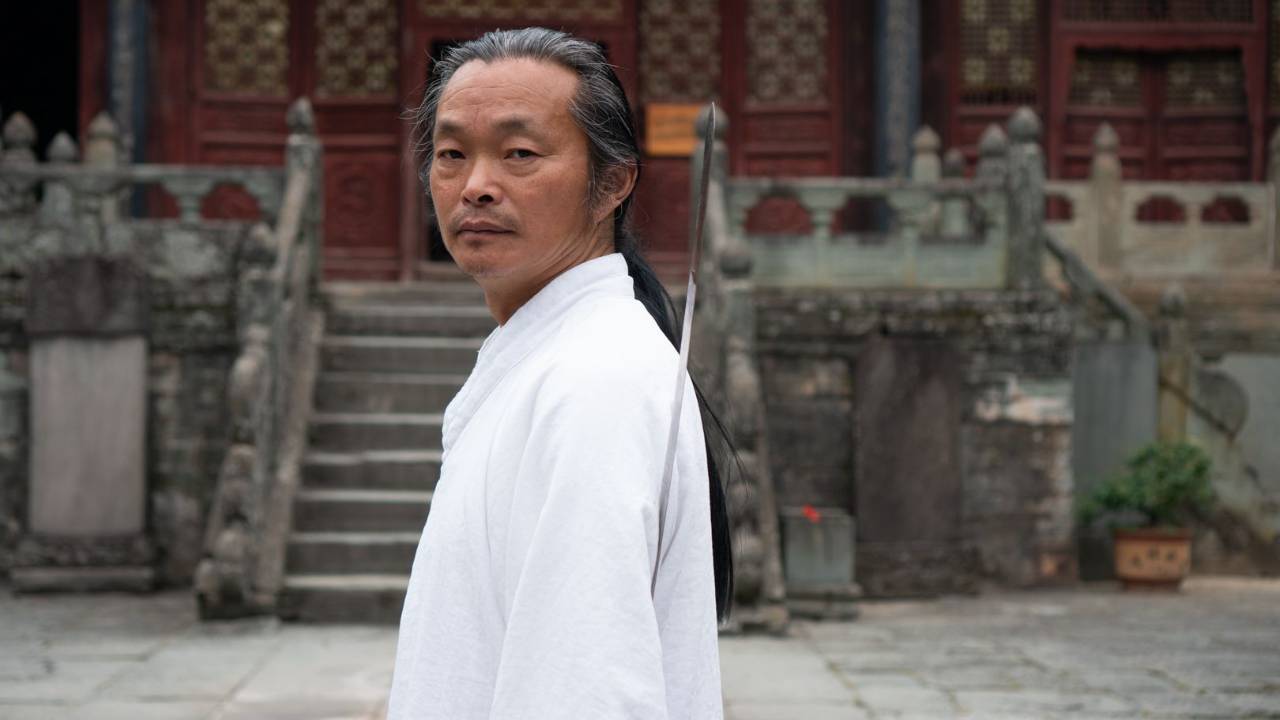
When you learn authentic Tai Chi from Master Gu, a 15th-generation San Feng Pai Wudang Taoist Master with over 25 years of teaching experience, you're not just learning forms. You're receiving practices refined over generations specifically to maintain health and prevent depletion.
Seasonal Living and Natural Rhythms
Modern life pretends seasons don't exist. We expect the same productivity in dark winter as bright summer. We maintain identical schedules year-round. But taoist wisdom for burnout teaches us to honour natural cycles. Our piece on The Role of Nature in Taoism explores this idea of harmony with the seasons in more depth.
The Five Seasons in Taoist Thought
| Season | Energy Quality | Supportive Activities | Rest Needs |
|---|---|---|---|
| Spring | Rising, expanding | Start new projects, plan | Moderate |
| Summer | Full, outward | Social connection, action | Light, cooling rest |
| Late Summer | Transitional, grounding | Integration, nourishment | Balanced |
| Autumn | Descending, releasing | Completion, letting go | Increasing |
| Winter | Storage, deep rest | Reflection, restoration | Maximum |
When you try to operate at summer intensity during winter, you create the conditions for burnout. Your body needs more rest when days are short and cold. Fighting this natural pull depletes your reserves.
Working With Resistance Instead of Against It
One of the subtlest aspects of taoist wisdom for burnout involves changing your relationship with difficulty. We typically see obstacles as problems requiring more effort. Taoist teaching suggests they might be information.
When you feel resistance, pause. Ask what it's telling you. Sometimes resistance means you're on the wrong path. Sometimes it means you need a different approach. Sometimes it simply means "not now."
This doesn't mean avoiding hard things. It means distinguishing between growth challenges and system warnings. Growth challenges energise you even when difficult. System warnings drain you and feel wrong in your body. Our article Understanding the Principles of Taoism unpacks more of this thinking if you'd like to explore it further.
The Water Principle
Water demonstrates perfect Taoist wisdom. It's soft and yielding, yet it shapes stone. It doesn't fight obstacles - it flows around them or waits patiently until conditions change. It naturally seeks the lowest place, which eventually gives it the most power.
When facing burnout, adopt water's approach:
- Yield to what cannot be changed - Accept current limitations
- Find natural openings - Work when energy is available
- Accumulate gradually - Small consistent actions compound
- Nourish depths first - Restore core energy before surface productivity
Integration Through Community and Teaching
Recovering from burnout often requires more than solo practice. Our community provides support from others walking similar paths. Shared practice amplifies individual effort and reminds you that you're not alone in this struggle.
Traditional Taoist teaching emphasises direct transmission - learning from those who embody the wisdom. Reading about Wu Wei differs from practising with a teacher who demonstrates it in their presence and guidance. The living tradition carries something books cannot. If this kind of grounded, day-to-day guidance is what you're after, our free Taoist course is a gentle place to start.
Daily Micro-Practices
You don't need hours for taoist wisdom for burnout to work. Start with these brief practices:
- Three conscious breaths before starting any task
- One minute of stillness at midday
- Evening gratitude for three simple things
- Weekly tech sabbath - several hours without devices
- Monthly nature time - sit outside without agenda
These create small islands of calm in an overwhelming world. Over time, the islands connect and expand.
Redefining Success and Productivity
Perhaps the deepest application of taoist wisdom for burnout involves questioning the assumptions that created exhaustion in the first place. What if productivity isn't the highest good? What if your worth doesn't depend on output? What if rest is sacred work?
The Tao Te Ching teaches that the softest things in the world overcome the hardest. Your burnout happened because you believed you had to be hard, to force, to push. Recovery comes through remembering your inherent softness, your natural rhythms, your animal wisdom that knows when to rest.
Measuring What Matters
Instead of counting tasks completed or hours worked, consider tracking:
- Energy quality throughout the day
- Moments of genuine presence
- Physical ease and comfort
- Mental clarity and calm
- Emotional resilience
These metrics reveal actual wellbeing rather than performative productivity. They help you recognise true recovery versus surface-level functioning.
The Long View: Prevention and Sustainability
Taoist wisdom for burnout isn't a quick fix. It's a fundamental reorientation toward sustainable living. Once you recover, the real work begins: building a life that doesn't require recovery.
This means:
- Regular practice becomes non-negotiable self-maintenance
- Boundary setting protects your energy reserves
- Seasonal adjustment honours natural rhythms
- Early warning recognition catches depletion before crisis
- Community connection provides ongoing support
The ancient practices we teach were developed by people who understood that true mastery requires preserving your life force, not spending it recklessly. They created systems for longevity, vitality, and sustainable energy across an entire lifetime.
Prevention looks like noticing the first whispers of fatigue and responding with kindness. It means saying no to opportunities that cost more than they're worth. It requires trusting that rest is productive, that pause creates clarity, and that your value exists independent of achievement.
Living Questions for Ongoing Discovery
Rather than rigid rules, taoist wisdom for burnout offers living questions to guide your choices:
- What wants to happen naturally here?
- Where am I forcing instead of flowing?
- What does my body need right now?
- Is this effort moving with life or against it?
- What would change if I trusted the process?
These questions don't have final answers. They invite ongoing dialogue with your experience, helping you navigate complexity with increasing wisdom.
The path from burnout to balance isn't linear. You'll have days of clarity and days of confusion. You'll take steps forward and occasionally slip backward. This is natural. The Tao itself moves in spirals, not straight lines. Trust the process, honour your pace, and remember that every moment offers a fresh opportunity to choose presence over pressure.
Burnout taught you that the old way doesn't work, and that awareness itself is progress. These ancient Taoist principles offer more than recovery - they provide a sustainable foundation for living with energy, purpose, and peace. At Taoist Wellness Online, Master Gu shares authentic Wudang teachings that have helped students worldwide transform their relationship with energy, work, and rest. Whether you're healing from burnout or building prevention practices, the wisdom tradition stands ready to support your journey back to balance.