Master Tai: Your Guide to Finding an Authentic Teacher
Oct 19, 2026
Finding a Tai Chi master who can genuinely guide your practice is one of the most important decisions you'll make on your Tai Chi journey. In 2026, with countless online courses and local classes available, it's easy to feel overwhelmed by choice. Yet not all teachers carry the depth of knowledge, lineage, and embodied wisdom that can turn Tai Chi from exercise into a lasting, meaningful practice. Understanding what makes a Tai Chi teacher authentic helps you find guidance that honours both tradition and your personal growth.
What Defines a Tai Chi Master
The word "master" in Tai Chi carries weight beyond simple expertise. A true Tai Chi master represents the continuation of a lineage, typically spanning generations of dedicated practitioners. This transmission goes deeper than learning forms. It includes the subtle principles, philosophical foundations, and refined understanding that develop through decades of committed practice.
Lineage and Authentic Transmission
Lineage matters in Tai Chi practice. When you study with a teacher who has received direct transmission from their own master, you connect to centuries of accumulated wisdom. This isn't about status or hierarchy. It's about preserving knowledge that might otherwise be lost or diluted. For a closer look at what this means in practice, see our article on Tai Chi masters, lineage and modern practice.
Consider these markers of authentic lineage:
- A direct student-teacher relationship with a recognised master
- Training within an established traditional school (such as Wudang, Chen, Yang, Wu, or Sun)
- Many years of dedicated practice before teaching
- Recognition within the traditional Chinese martial arts community
- The ability to demonstrate and explain the internal principles, not just the external forms
A teacher from the Wudang tradition, for example, brings knowledge of Taoist energy practices and meditation that sit naturally alongside movement. Our own teacher, Master Gu, is a 15th-generation San Feng Pai Wudang Taoist Master with 25+ years of teaching experience. Master Gu explains how Wudang Tai Chi differs from other styles in the short video below.
This holistic approach is one of the things that distinguishes traditional teaching from simplified fitness variations.
The Journey to Becoming a Tai Chi Teacher
Becoming a Tai Chi master takes more than a teacher training weekend or a certificate. The path often spans 20 to 30 years of steady study, personal cultivation, and deep immersion in the art.
Years of Personal Practice
Many recognised masters began training in childhood or early adulthood, practising for hours daily. This long timeline isn't about collecting techniques. It's about letting the principles sink in deeply, shaping the practitioner's body, awareness and understanding.
| Stage of Development | A Rough Guide to Duration | Focus Areas |
|---|---|---|
| Foundation Building | 3-5 years | Basic forms, stances, breathing |
| Intermediate Refinement | 5-10 years | Internal principles, applications, deeper forms |
| Advanced Integration | 10+ years | Teaching principles, subtle refinement, embodied wisdom |
| Mastery | 20+ years | Full transmission, lineage preservation, innovation within tradition |
The body becomes the laboratory. Through consistent practice, an experienced teacher develops refined sensitivity, understands how subtle adjustments affect the whole body, and can often sense what students need before they put it into words.
Traditional Training Methods
Authentic Tai Chi teachers have usually followed a rigorous traditional training path. This might include:
- Standing meditation (zhan zhuang) for long periods each day
- Repeating single movements thousands of times
- Partner work to develop sensitivity and understand martial applications
- Study of classical texts and Taoist philosophy
- Close guidance from their own teacher over many years
This depth of training helps a teacher guide students towards real understanding, not just choreographed movement sequences.
Recognising Quality in a Tai Chi Master
When you're seeking guidance, certain qualities can help you tell a genuine, experienced teacher from someone with more limited understanding. These markers can help you decide where to invest your time and energy.
Embodied Understanding
A true Tai Chi master doesn't just know the forms intellectually. They embody the principles. You can often see this in several ways:
Their movement quality shows relaxation, fluidity, and rootedness at the same time. There's no visible tension or forcing, and the forms flow with a natural grace that comes from good internal organisation rather than outward choreography.
Their teaching approach emphasises inner experience over outward perfection. Rather than drilling repetitions purely for appearance, they encourage you to feel your breathing, your balance and your state of mind.
Their presence reflects the calm, centred awareness that Tai Chi cultivates. Teaching feels spacious rather than rushed, supportive rather than critical.
Comprehensive Knowledge
Tai Chi exists within a broader world of Chinese wellbeing practices and Taoist philosophy. An experienced teacher understands these connections and can draw on them to support your learning.
- Qi Gong foundations that build body and breath awareness
- Taoist meditation practices that nurture mental clarity and calm
- Traditional Chinese thinking about energy and wellbeing
- Martial applications that reveal the practical purpose behind each movement
- Philosophical context from texts like the Tao Te Ching
This breadth lets a teacher adapt to your interests, whether you're drawn to wellbeing, martial aspects, meditation, or philosophy.
Different Approaches Among Tai Chi Teachers
Not all Tai Chi masters teach in the same way, even within the same lineage. Understanding these differences helps you find a teacher whose approach suits your learning style and goals.
Traditional vs. Modern Presentation
Some masters keep to strictly traditional methods, speaking sparingly, demonstrating repeatedly, and expecting students to absorb through observation and practice. Others adapt their style to contemporary students, with detailed explanations, anatomical insights, and structured progressions.
Neither approach is better. What matters is finding the style that supports your learning. If you thrive on detailed explanation, look for a teacher who bridges traditional knowledge with modern language. If you learn best through quiet observation and practice, a more traditional approach may suit you.
Emphasis and Specialisation
Teachers often emphasise different aspects based on their own training and inclinations:
- Health and wellbeing focus, with gentle, restorative practice
- Martial applications, exploring self-defence and partner practice
- Meditative and philosophical dimensions, emphasising inner stillness
- Form precision, maintaining traditional movement standards
- Internal principles, developing more advanced awareness
Most authentic masters understand all of these but may emphasise some more than others. If you're mainly interested in Tai Chi for relaxation and wellbeing, a teacher with a health focus makes sense. If martial understanding intrigues you, look for someone who actively teaches applications.
Learning from a Tai Chi Master Online
The digital age has transformed access to authentic teaching. In 2026, you can study with experienced teachers wherever you live. This brings both opportunities and things to consider; our article on learning Tai Chi online explores them in more detail.
Benefits of Online Study
Authentic lineage becomes accessible. Rather than settling for the only local teacher available, you can learn from someone who holds genuine transmission from a traditional school. This was impossible just a generation ago.
Flexible practice schedules let you fit training into daily life without travelling to classes. You can practise in your own space, at times that support consistency.
Structured curricula often offer clearer progression than drop-in classes. You can move through foundations, forms and deeper principles at your own pace.
Online learning does have one limit: a teacher can't physically adjust your posture through a screen. That's why clear, well-structured lessons, repeated practice and a supportive community matter so much.
If you'd like to try this style of learning, our free Taoist course offers an accessible introduction to Wudang teachings with Master Gu, helping you build a foundation in Tai Chi, Qi Gong, meditation and Taoist wisdom.
Making Online Learning Effective
Getting the most from online instruction takes some intention:
- Create a dedicated practice space that supports your training
- Keep a regular schedule rather than sporadic viewing
- Review lessons several times to absorb subtle details
- Join live sessions and Q&As when available, to ask your questions
- Connect with like-minded students around the world to share experiences and stay motivated
- Practise what you learn rather than endlessly consuming content
The key is to treat online access as genuine training, not entertainment. Approached with dedication, studying online can be deeply rewarding. If you'd like a structured path, our Tai Chi course is a good place to begin.
Questions to Ask When Choosing a Tai Chi Teacher
Whether you're looking for in-person or online guidance, thoughtful questions help you decide whether a teacher offers authentic instruction that suits your needs. If you're searching for classes in your area, our guide to Tai Chi training near you may help.
About Their Background and Training
Where did you train, and with whom? Authentic teachers can trace their lineage clearly, naming their own teachers and explaining their training journey.
How long have you practised and taught? Look for decades of personal practice and substantial teaching experience.
What style or school do you represent? Knowing the tradition helps you understand what you're learning. Wudang Tai Chi, for instance, has its own distinct characteristics.
About Their Teaching Approach
What does your beginner curriculum include? A thorough answer covering foundations, breathing, and philosophical context points to careful teaching.
How do you support students as they progress? Good instruction adapts to different needs rather than following a rigid formula.
What resources do you provide beyond lessons? Study materials, practice videos and community support all enhance learning.
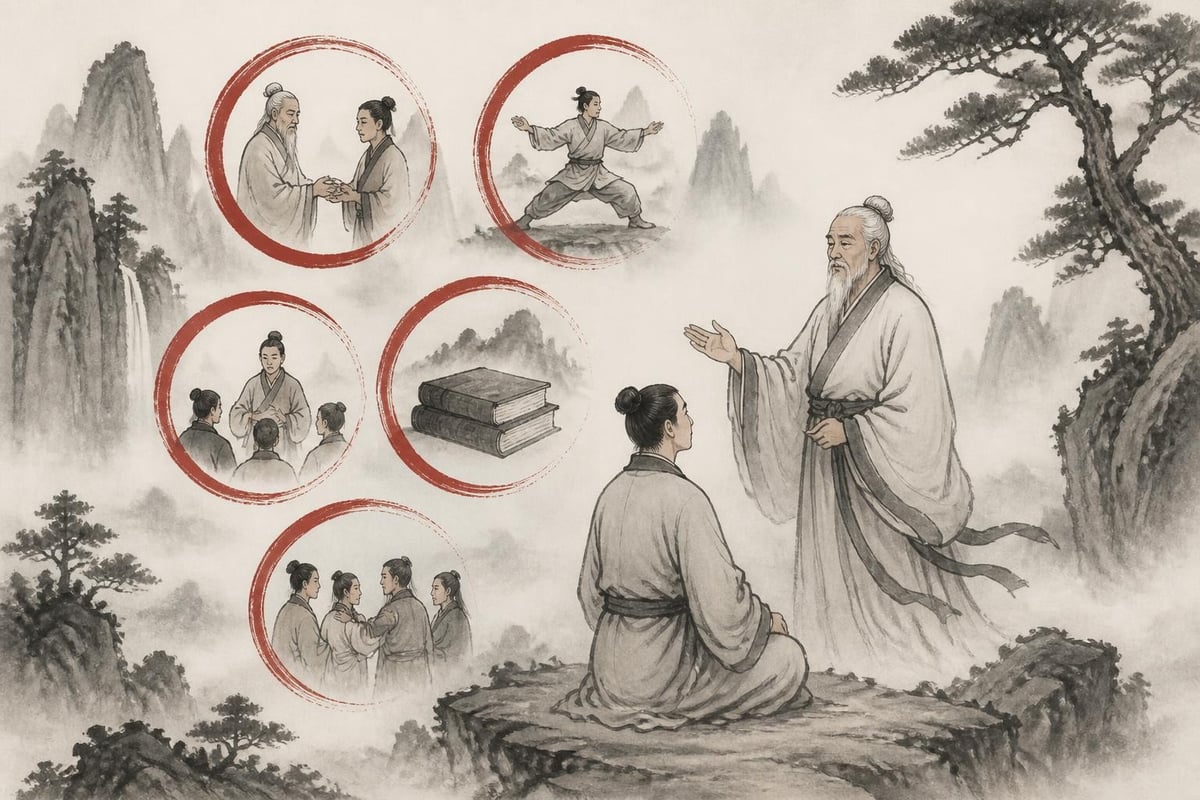
The Student-Teacher Relationship
The connection between student and teacher is the foundation for meaningful progress. It differs from typical fitness instruction in important ways.
Mutual Commitment and Respect
Traditional Chinese arts see the teacher-student relationship as one of mutual dedication. You're not expected to adopt ancient customs, but understanding this context helps you approach learning with the right spirit.
Students commit to consistent practice, respectful attention, and sincere effort. It's more than a transaction; it's a relationship of learning.
Teachers commit to sharing authentic knowledge, offering guidance suited to your level, and supporting your development over time.
Beyond Technique Transmission
A good Tai Chi master offers more than movement instruction. Through their example, you can learn:
- How to practise with patience and self-compassion
- How to observe your body and mind with clarity
- How to bring ancient principles into modern life
- How to keep developing independently over the years
The relationship itself becomes part of the practice, teaching respect, dedication, humility, and growth.
Integrating a Teacher's Guidance into Daily Life
The real measure of good instruction is how it shows up in your daily experience. A genuine Tai Chi teacher offers tools that reach well beyond practice sessions.
Practical Applications
The principles you learn through Tai Chi can be applied throughout your day:
- Moving with efficiency and ease in everyday activities
- Breathing naturally and calmly during challenging moments
- Cultivating presence that can enrich relationships and work
- Balancing effort and relaxation to keep your energy steady
- Flowing with change rather than resisting life's natural ups and downs
These applications make Tai Chi relevant to contemporary life while honouring its traditional depth.
Long-Term Practice
| Time Frame | What You May Begin to Notice | Practice Focus |
|---|---|---|
| First month | A growing sense of relaxation, early familiarity with the basic forms | Foundations, breathing awareness |
| 3-6 months | Better balance awareness, less tension, greater body awareness | Form refinement, Qi Gong integration |
| 1-2 years | Feeling calmer under stress, improved posture, clearer focus | Deepening practice, meditation connection |
| 3+ years | A deeper sense of body awareness and emotional steadiness | Advanced principles, personal cultivation |
Results vary from person to person, and these benefits tend to build gradually when you practise consistently. There's no forcing or striving. As with any new exercise, please check with your healthcare professional first if you have existing health concerns. Tai Chi can sit alongside, but should not replace, professional support - if you're struggling with stress, anxiety or low mood, please also speak to your GP or a qualified professional.
Finding Your Path with a Tai Chi Teacher
Your journey with Tai Chi is uniquely yours, even while learning from an established tradition. A skilled teacher recognises this, offering both structure and flexibility.
Starting Where You Are
Authentic teaching meets you at your current level. You don't need fitness, flexibility, or prior experience, just a willingness to practise and an open mind.
Physical limitations can be worked with. Good instruction offers gentler options while keeping the essential principles, and it's always wise to check with your healthcare professional first.
Time constraints are real. Even 10-15 minutes of daily practice can be meaningful, and consistency matters more than duration.
Scepticism is natural. You don't need to believe in energy or adopt a spiritual framework at the start. The practice itself provides direct experience that informs understanding over time.
Growing Through Practice
As you develop, your relationship with the practice deepens. What begins as gentle physical exercise can gradually reveal layers of breath awareness, mental training, and philosophical insight.
Some students are drawn to meditation within months; others focus mainly on movement for years before exploring deeper dimensions. Both paths are valid.
Your journey with a teacher isn't about reaching a destination. It's about cultivating a practice that enriches your life for years to come, connecting you to ancient wisdom while supporting your modern needs.
Finding an authentic Tai Chi master can transform Tai Chi from movement exercise into a rich, lifelong practice. Whether you're seeking relaxation, physical ease, mental clarity, or philosophical depth, learning from someone with genuine lineage and decades of dedication gives you teachings that can guide you for years. Taoist Wellness Online offers courses in Tai Chi, Qi Gong and Taoist meditation with Master Gu, a 15th-generation San Feng Pai Wudang Taoist Master with 25+ years of teaching experience, along with a monthly live session and Q&A and a supportive global community.