Basic Tai Chi: A Beginner's Guide to Practice
Aug 21, 2026
Starting a basic tai chi practice can feel like opening a door to something both ancient and refreshingly new. You're stepping into a tradition that has nurtured health and clarity for centuries, yet the movements themselves are gentle enough for anyone to begin today. Whether you're seeking better balance, stress relief, or simply a way to move that feels good in your body, basic tai chi offers a pathway that's both accessible and profound. The beauty of this practice lies in its simplicity, the way it meets you exactly where you are and grows with you over time.
Understanding the Foundation of Basic Tai Chi
Basic tai chi begins with principles that sound simple but contain layers of wisdom. The practice emerged from Taoist philosophy, where movement mirrors the natural flow of energy in the universe. When you learn basic tai chi, you're not just memorising choreography but cultivating an awareness that transforms how you inhabit your body.
The Wudang tradition, which forms the authentic lineage of our teachings, emphasises internal development alongside external movement. This means your practice focuses on cultivating qi (life energy) while building physical strength and flexibility. You don't need to be athletic or flexible to start, just willing to explore movement with patience and curiosity.
George shares Chungliang Al Huang's approach to Tai Chi in the video below, a beautiful companion piece as you begin.
Core Principles That Guide Your Practice
Every basic tai chi movement follows certain foundational principles. Your posture should feel rooted yet light, like a tree with deep roots and branches that sway in the breeze. Your weight shifts smoothly from one leg to the other, never rushed or forced.
Key principles include:
- Sung (relaxation): Releasing unnecessary tension while maintaining structural integrity
- Upright alignment: Keeping your spine naturally extended without stiffness
- Smooth transitions: Moving continuously without stops or jerky changes
- Mindful breathing: Coordinating breath with movement in a natural rhythm
- Present awareness: Staying mentally engaged with each moment of practice
These principles work together to create the distinctive quality of tai chi movement. When you watch someone practising our Tai Chi course forms, you notice a calm fluidity that seems effortless, though it develops through consistent attention to these fundamentals.
Getting Started with Your First Movements
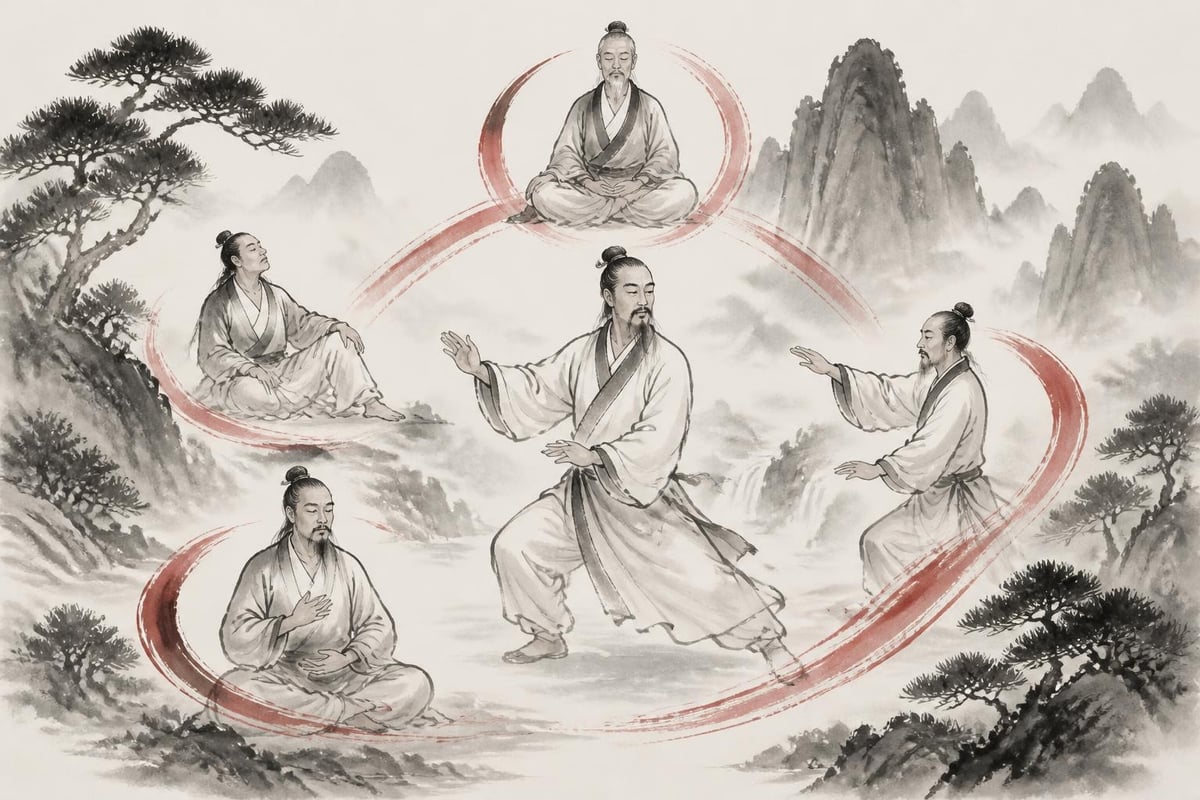
Beginning your basic tai chi journey doesn't require special equipment or a large space. You need comfortable clothing that allows free movement, flat shoes or bare feet, and enough room to extend your arms in all directions. Many people start practising in their living room or backyard.
The opening stance sets the tone for everything that follows. Stand with feet shoulder-width apart, knees slightly bent, arms relaxed at your sides. Feel your weight distributed evenly across both feet. This simple position is where you begin to notice how your body holds tension and where you can invite more ease.
Learning the Basic Stance and First Form
Your first form in basic tai chi typically involves simple movements that introduce the fundamental patterns. The Wudang approach teaches these movements with attention to both the external shape and the internal energy flow. Our article on Simple Tai Chi Moves to Start Your Practice Today walks through several of these foundational movements in more detail.
Starting position elements:
- Feet parallel, about shoulder-width apart
- Knees softly bent, not locked
- Tailbone tucked slightly, pelvis neutral
- Shoulders relaxed downward
- Crown of head lifting gently upward
- Chin tucked slightly, gaze forward
From this foundation, you learn to shift weight, raise and lower your arms, and turn your waist. Each movement connects to the next like beads on a string. The beauty of basic tai chi lies in how these simple actions become a moving meditation when you practise with full attention.
Health Benefits That Unfold Over Time
Research continues to validate what practitioners have known for generations. Basic tai chi offers measurable benefits for both physical and mental wellbeing, though you don't need to wait for scientific studies to feel the effects in your own body.
The gentle, flowing movements strengthen muscles without strain, improve balance and coordination, and increase flexibility gradually. Because basic tai chi never forces your body into extreme positions, it's suitable for people of all ages and fitness levels. You work within your comfortable range of motion and expand that range naturally over time.
| Benefit Category | Specific Effects | Timeline to Notice |
|---|---|---|
| Physical Strength | Leg strength, core stability, joint mobility | 4-8 weeks |
| Balance & Coordination | Improved proprioception, reduced fall risk | 6-12 weeks |
| Stress Reduction | Lower cortisol, better mood regulation | 2-4 weeks |
| Sleep Quality | Deeper sleep, easier falling asleep | 3-6 weeks |
| Mental Clarity | Enhanced focus, reduced anxiety | 2-4 weeks |
How Basic Tai Chi Supports Your Whole System
The practice works on multiple levels simultaneously. While you're strengthening your legs through gentle weight-shifting, you're also calming your nervous system through coordinated breathing. While you're improving balance, you're cultivating mental focus.
This integrated approach reflects the Taoist understanding that body, mind, and spirit aren't separate systems but aspects of one whole. When you practise basic tai chi regularly, you're supporting your entire being, not just working on isolated parts.
The comprehensive health benefits of Tai Chi have made it increasingly popular in medical and wellness communities. Doctors now recommend it for conditions ranging from arthritis to anxiety, recognising its gentle effectiveness. As with starting any new movement practice, it's worth checking with a healthcare professional first if you have an existing health condition.
Building Your Daily Practice Routine
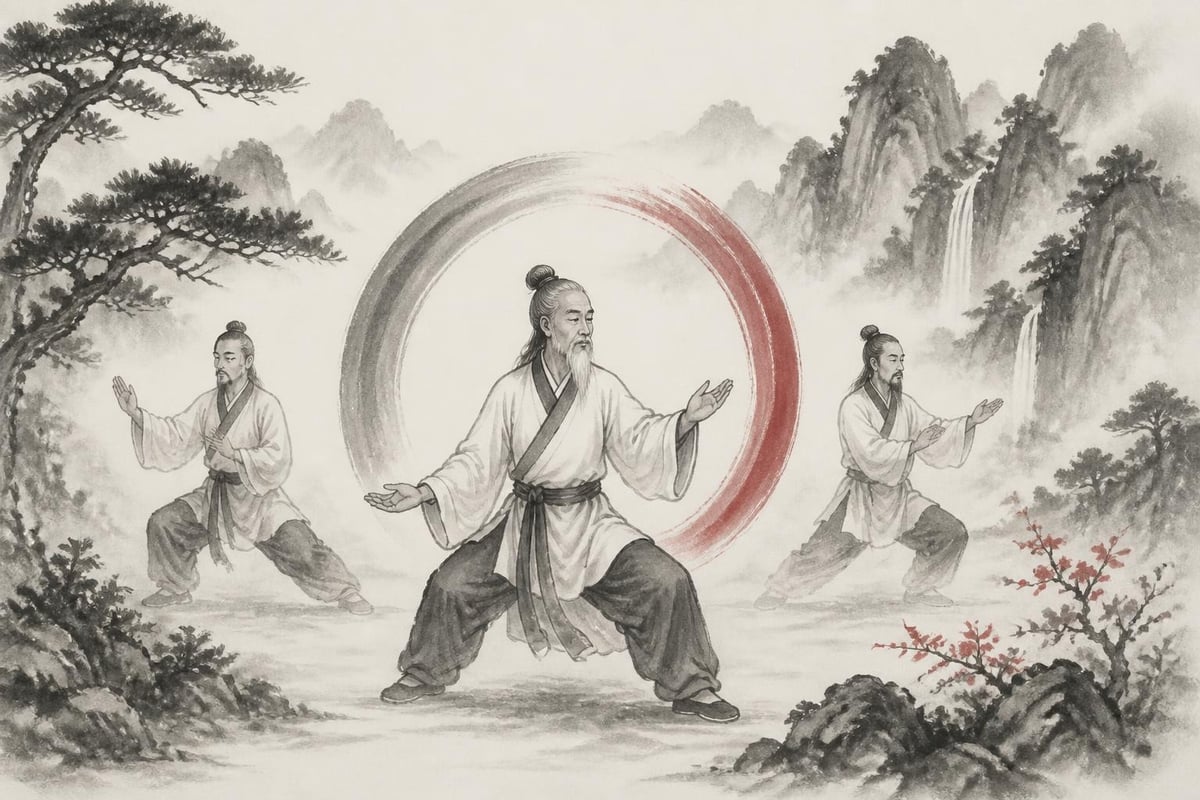
Consistency matters more than duration when you're establishing a basic tai chi practice. Fifteen minutes daily creates more benefit than an occasional hour-long session. Your body and mind learn through regular repetition, building neural pathways that make the movements feel increasingly natural.
Morning practice offers unique advantages. Your mind is fresh, distractions are minimal, and the gentle movement helps you transition from sleep to activity. That said, any time you can practise consistently works. Some people prefer evening practice to release the day's accumulated tension.
Creating a Practice Space and Schedule
You don't need a dedicated studio, but having a consistent practice spot helps build the habit. Choose a place where you can move freely without bumping into furniture, preferably with natural light and fresh air if possible.
Elements of an effective practice space:
- Clear floor area at least 6 feet by 6 feet
- Good ventilation and comfortable temperature
- Minimal visual distractions
- Quiet or with gentle background sounds
- Stable flooring (not slippery)
Start with just five minutes if that's what feels manageable. Practise your basic tai chi stance and a few simple movements. As this becomes routine, gradually extend your practice time. Our free Taoist course offers a structured introduction that helps you establish this foundation with guidance and support, covering Tai Chi, Qi Gong, Meditation, and Taoist Wisdom.
Quality of attention matters more than quantity of time. Five minutes of focused, present practice creates more benefit than thirty minutes of distracted movement.
Common Challenges and How to Navigate Them
Every beginner faces similar obstacles when learning basic tai chi. Your mind wanders, your legs get tired, you can't remember the sequence, or you feel self-conscious about moving slowly. These experiences are completely normal and actually part of the learning process.
The wandering mind is perhaps the most universal challenge. You start a movement, and suddenly you're thinking about your grocery list or replaying a conversation. When you notice this happening, simply return your attention to your body without judgement. This returning is the practice.
Working with Physical Limitations
Basic tai chi adapts beautifully to different bodies and abilities. If standing for long periods is difficult, you can practise many movements while seated. If balance is a concern, practise near a wall or sturdy chair until your stability improves.
Adaptations for common challenges:
| Challenge | Adaptation Approach |
|---|---|
| Limited balance | Practise near support, reduce stance width |
| Knee discomfort | Decrease depth of bends, focus on alignment |
| Low stamina | Shorten practice sessions, rest between forms |
| Memory difficulties | Practise fewer movements more thoroughly |
| Tight joints | Work within comfortable range, warm up longer |
The Wudang tradition emphasises working intelligently with your body's current capacity. You're not trying to force yourself into an ideal form but rather exploring movement that serves your wellbeing. This approach allows basic tai chi to remain accessible throughout your lifetime, adapting as your needs change.
Deepening Your Understanding Through Study
While movement forms the heart of basic tai chi, understanding the principles behind the practice enriches your experience. The ancient texts and teachings offer insights that transform simple movements into profound practices.
You don't need to become a scholar, but learning about the philosophy that shaped tai chi helps you practise with greater depth. The concept of yin and yang, for example, shows up in every movement: empty and full, opening and closing, rising and sinking. When you understand these patterns, you recognise them everywhere. Our article on Boost Your Well-being with 5 Tai Chi Forms gives a clear sense of where your journey can take you as you move beyond these basics.
Resources That Support Your Learning Journey
Books, videos, and online courses each offer different learning advantages. Videos let you see movements from multiple angles. Books provide detailed explanations you can review at your own pace. Live instruction, whether in person or online, gives you feedback and community.
Our reading list offers curated resources that support your basic tai chi practice with authentic Wudang teachings. Having access to our community of practitioners creates accountability and shared learning that deepens your practice.
Many students find that combining different learning resources works best. You might follow video lessons for learning forms, read books to understand principles, and join live sessions for personalised guidance. This multi-layered approach supports both the physical and conceptual aspects of your practice.
Integrating Basic Tai Chi into Your Life
The real test of any practice is whether it becomes part of your daily life or remains something you do occasionally. Basic tai chi has remarkable staying power because the benefits you experience motivate continued practice. You sleep better, handle stress more calmly, and move through your day with greater ease.
Integration happens gradually. At first, your practice is a separate activity, something you set aside time for. Over months, the principles begin showing up in daily life. You notice yourself breathing more deeply during a tense meeting. You catch yourself shifting your weight mindfully while standing in line. The practice seeps into your ordinary moments.
Recognising Progress Beyond Perfect Forms
Progress in basic tai chi doesn't always look like executing perfect movements. Sometimes progress is noticing your breath, catching a moment of genuine relaxation, or maintaining your practice during a difficult week. These internal shifts matter as much as external form.
Signs of developing practice:
- You look forward to practice time
- Movements feel more natural, less thought-required
- You notice tension in daily life and can release it
- Balance improves in everyday situations
- Sleep quality and energy levels stabilise
- You can practise basic forms from memory
The journey with basic tai chi unfolds over years, not weeks. This long view helps you stay patient with yourself during plateaus and frustrations. Every practitioner, regardless of experience level, continues discovering new layers in movements they've practised thousands of times.
Moving Forward with Your Practice
As your basic tai chi foundation strengthens, you'll naturally become curious about more advanced forms, deeper study of our Taoist Philosophy course, or complementary practices like our Qi Gong course and Taoist meditation. These explorations build on your foundation rather than replacing it.
The forms you learn as a beginner remain relevant throughout your practice life. You simply practise them with increasing refinement, discovering subtleties you couldn't perceive at first. This is why basic tai chi never becomes boring; there's always another layer of depth to explore.
Working with an experienced teacher becomes increasingly valuable as your practice develops. Our Master Gu brings authentic Wudang lineage and decades of teaching experience to guide students through both beginning stages and advanced development. Having access to traditional teachings helps you avoid common pitfalls and progress with proper foundation.
Your basic tai chi practice is both complete in itself and a doorway to lifelong learning. The simple movements you're practising today contain everything you need for health, balance, and peace. At the same time, they open into an ocean of deeper practice that can sustain your interest and growth for decades. This paradox makes tai chi uniquely satisfying; you're never lacking what you need, yet there's always more to discover.
Starting with basic tai chi gives you tools for physical health, mental clarity, and energetic balance that serve you throughout life. The practice meets you where you are and grows with you, offering both immediate benefits and long-term depth. If you're ready to begin your journey with authentic Wudang teachings, Taoist Wellness Online provides comprehensive guidance through courses designed by Master Gu, a 15th-generation San Feng Pai Wudang Taoist Master with over 25 years of teaching experience. Join a global community of practitioners and discover how ancient wisdom can support your modern life.